The Indian solar industry is witnessing an unprecedented boom. Driven by rising electricity tariffs, growing environmental awareness, and massive government pushes like the PM-Surya Ghar: Muft Bijli Yojana, residential and commercial rooftop solar adoption is at an all-time high.Many solar business owners complain that while running Facebook campaigns is easy, their dashboards are often flooded with “junk leads”—wrong phone numbers, renters who don’t own a roof, or casual browsers looking for freebies.If you are tired of wasting your marketing budget on low-quality data, this guide is for you. This is the definitive 2026 blueprint on how to leverage Facebook ads for solar companies to consistently generate premium, high-converting solar leads in the Indian market.
Why Facebook Ads Remain Unrivaled for Indian Solar Marketing
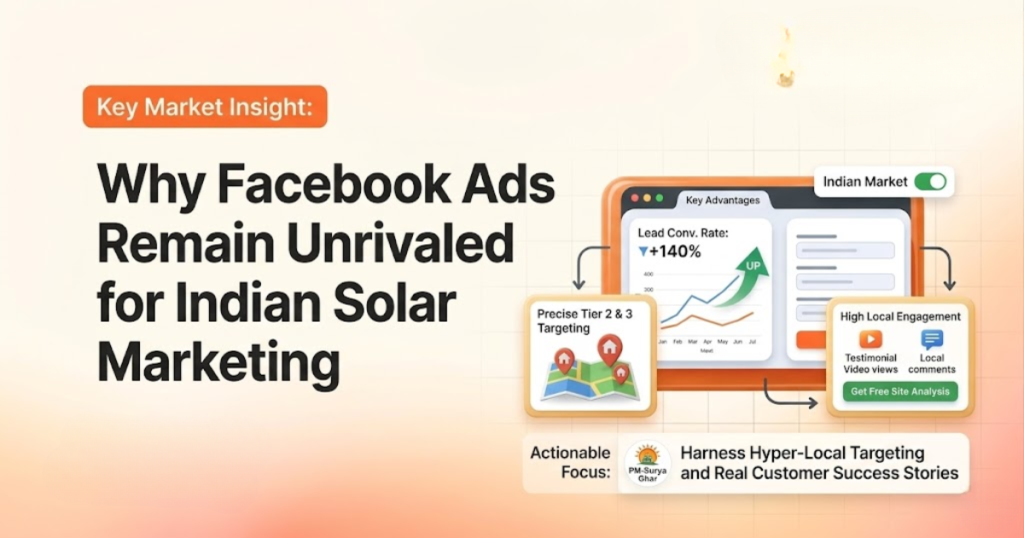
Some marketers argue that because solar is a high-ticket investment, platforms like Google Search or LinkedIn are superior. While they have their place, Facebook (along with Instagram) remains the undisputed king for B2C and small-scale commercial solar lead generation in India for three reasons:
- Visual Storytelling: Solar is a highly visual product. Seeing high-definition drone footage of a freshly installed rooftop or a screenshot of a “Zero Rupees” electricity bill triggers immediate desire. Facebook is a visual-first ecosystem built for this type of content.
- Penetration in Tier-2 & Tier-3 Hubs: The real growth explosion in Indian solar isn’t happening in Tier-1 metros anymore; it’s happening in expanding hubs like Jaipur, Indore, Guwahati, and Nashik. Homeowners in these regions spend significant time on Meta platforms.
- The Power of Latent Demand: Most Indian homeowners want solar but aren’t actively searching for it on Google because they assume it’s too complicated or expensive. A well-crafted Facebook ad disrupts their feed, educates them on affordability, and captures demand that your competitors don’t even know exists.
The 4-Step 2026 Facebook Ads Blueprint for Solar Companies
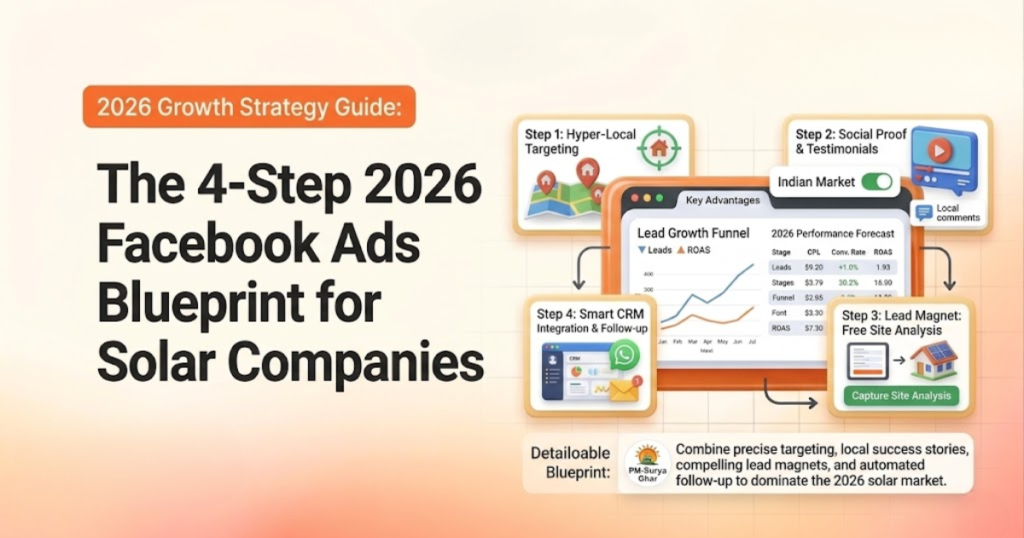
To stop attracting casual clickers and start capturing qualified property owners, you need to transition from a basic “Click to Apply” ad to a strategic lead-filtering ecosystem.
Step 1: Speak the Financial Language of the Indian Homeowner (Ad Creatives)
In India, solar is not just a green initiative—it is a financial asset. Your ad creatives must directly reflect the economic benefits of going solar.
- Lead with the Subsidy Hook: Explicitly feature the government subsidy details. Use clear copy like, “Save up to ₹78,000 with Central Government Subsidies!” Highlighting hard numbers instantly builds credibility and grabs attention.
- Leverage Regional & Vernacular Content: If you are targeting regional belts like Gujarat or Assam, do not rely solely on generic English ad copies. Use localized text or regional variations (e.g., Gujarati or Assamese-English blends). Clean, local-language ad copies see up to a 3x higher trust factor and conversion rate.
- Ditch Stock Images for Real Social Proof: A polished stock photo of a western suburban house will immediately get scrolled past. Instead, use raw, authentic smartphone videos or photos of local installations. Have a real customer say: “I installed my system through Mocaup, and my monthly power bill dropped from ₹8,000 to zero.”
Step 2: Laser-Focused Audience Targeting (Eliminating the Noise)
Because solar requires homeownership and financial stability, broad targeting is a recipe for wasted ad spend. Optimize your targeting parameters using these guardrails:
- Age Segmentation: Focus on the 32–65 age bracket. Individuals in this demographic are highly likely to be primary homeowners and the core financial decision-makers of the household.
- Interest Clusters: Target user personas displaying deep interest in Property Development, Custom Home Construction, Smart Homes, Sustainable Living, and Renewable Energy Finance.
- The Crucial Exclusion Rule: Always use Meta’s detailed targeting to exclude “Renters” or “Tenants.” If an individual does not own the rooftop rights to the property, they cannot install solar panels, making them an expensive dead-end lead.
Step 3: Implement “High-Intent” Lead Filtering Forms
The primary reason solar companies receive junk leads is Meta’s auto-fill feature on Instant Forms. Users tap an ad, their pre-saved profile data is instantly filled out, and they hit submit without reading.
In 2026, you must switch your form setting to “Higher Intent” and introduce custom qualifying questions that act as an organic filter:
- What is your average monthly electricity bill? (e.g., Below ₹5,000 / ₹5,000 – ₹10,000 / Above ₹10,000)
- Do you own the roof space of your property? (Yes / No)
- When are you planning to transition to solar? (Within 1 Month / Within 3 Months / Just Researching)
Pro-Tip: Route your sales resources efficiently. Leads indicating a bill below ₹5,000 or answering “No” to roof ownership should be funneled into an automated email/WhatsApp nurturing sequence rather than taking up your sales team’s valuable calling hours.
Step 4: Execute the 15-Minute Follow-Up Protocol
The shelf-life of a digital solar lead is incredibly short. If a homeowner submits their details at 10:00 AM and your team calls them the next afternoon, their intent has cooled down, or worse, they’ve clicked on a competitor’s ad.
Integrate your Facebook Lead Forms with a CRM or automation tool (like Zapier or Interakt) to trigger an instant WhatsApp confirmation containing your corporate portfolio, customer reviews, and a brief explanation of what happens next. Your inside sales team should follow up with a phone call within 15 to 30 minutes to schedule an on-site structural and shadow analysis.
Performance Framework: Quantity vs. Quality
When you transition from generic marketing to this quality-first blueprint, your lead metrics will shift significantly for the better:
| Performance Metric | Generic Lead Campaigns | 2026 Quality-First Blueprint |
| Cost Per Lead (CPL) | Low (₹50 – ₹100) | Moderate to High (₹250 – ₹500) |
| Data Quality | Poor (Invalid numbers, high bounce) | Verified (Accurate numbers, high intent) |
| Site Visit Conversion Rate | 1% – 2% | 8% – 14% |
| Overall Campaign ROI | Low / Hard to measure | 4x to 7x Return on Ad Spend (ROAS) |
Conclusion: Scale Your Solar Brand with Precision
The Indian solar market is going through a massive transformation. The companies that establish a reliable, high-intent digital acquisition funnel today are the ones that will dominate the market for the next decade.
Mastering facebook ads for solar companies isn’t about chasing the cheapest click; it’s about aligning your ad creatives with real consumer pain points, deploying strict audience filters, and following up with lightning speed.
What challenges are you currently facing with your online solar campaigns? Let’s discuss in the comments below!
Looking to scale your solar installation business with high-performance digital marketing campaigns? Contact our expert strategy team today for a custom blueprint tailored to your target region!