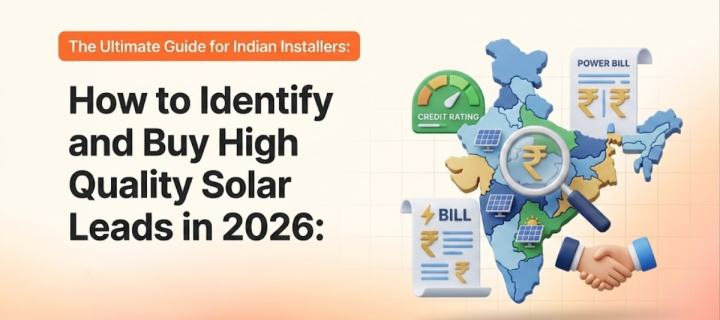
The Indian solar industry is experiencing an unprecedented boom. Driven by ambitious government initiatives like the PM-Surya Ghar: Muft Bijli Yojana, soaring commercial electricity tariffs, and a massive cultural shift toward sustainability, the market is flooded with demand.However, for a solar Engineering, Procurement, and Construction (EPC) company or installer, more demand does not automatically translate to more revenue. The biggest bottleneck holding solar businesses back in 2026 is not a lack of inquiries—it is the overwhelming influx of low-quality, unverified, or junk leads.This comprehensive guide will break down exactly how to identify, filter, and buy high quality solar leads that actually convert into high-margin installations.
1. Deconstructing the Anatomy of a “High Quality Solar Lead” in India
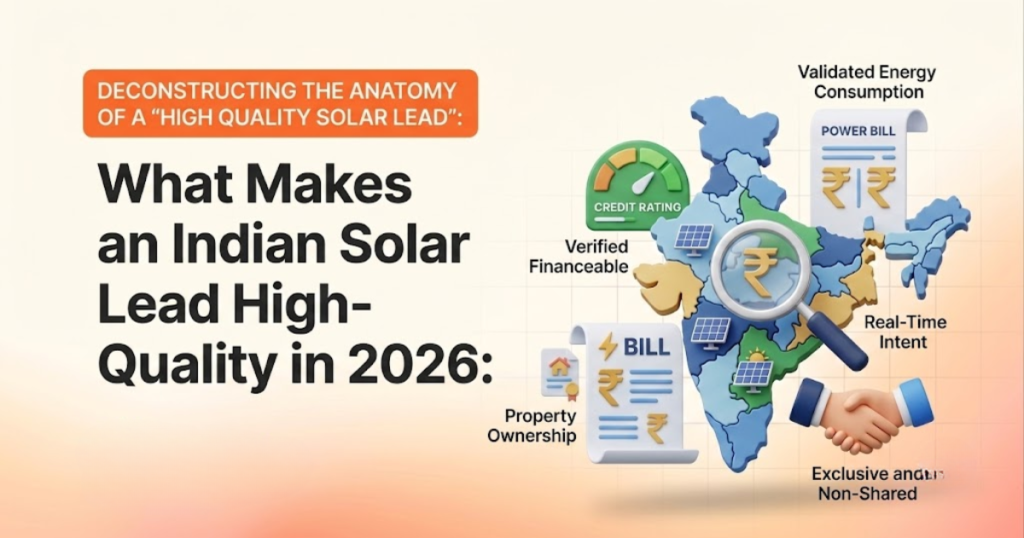
Before spending a single rupee on buying leads or running ad campaigns, you must define what a qualified opportunity looks like. In the Indian market, a lead is only considered high quality if it fulfills specific, non-negotiable operational and financial criteria.
The 4 Pillars of Solar Lead Qualification
To stop wasting time, every lead must be passed through a strict filtering framework:
- Verified Roof Ownership (The Structural Filter): The prospect must own the independent house, residential villa, or commercial building. In India, multi-story apartment tenants or individuals with shared roof access cannot install residential rooftop solar without complex, often impossible, housing society NOCs.
- High Monthly Electricity Tariffs (The Financial Catalyst): A high-quality lead must have a current electricity bill that makes solar a financially viable investment. For residential properties in India, this typically means a monthly bill of ₹2,500 to ₹3,000+ (or consumption above 300 units). For Commercial & Industrial (C&I) clients, the tariff should ideally be ₹7 to ₹11+ per unit to guarantee a swift 3-4 year payback period.
- Capital and Financing Readiness (The Budget Filter): While subsidies reduce the upfront cost, the customer must have the financial capacity to clear the initial investment—either through outright capital or via institutional solar financing/EMIs. High-quality leads are those aware that solar is a capital asset, not a free government handout.
- An Active, Immediate Buying Timeline (The Intent Filter): Customers who want solar installed within the next 30 to 90 days represent high-quality leads. Prospects who are “just researching for a house I will build in 2028” should be funneled into long-term email nurturing, not handed to your core sales closers.
2. Comparing Lead Sources: Shared vs. Exclusive vs. In-House
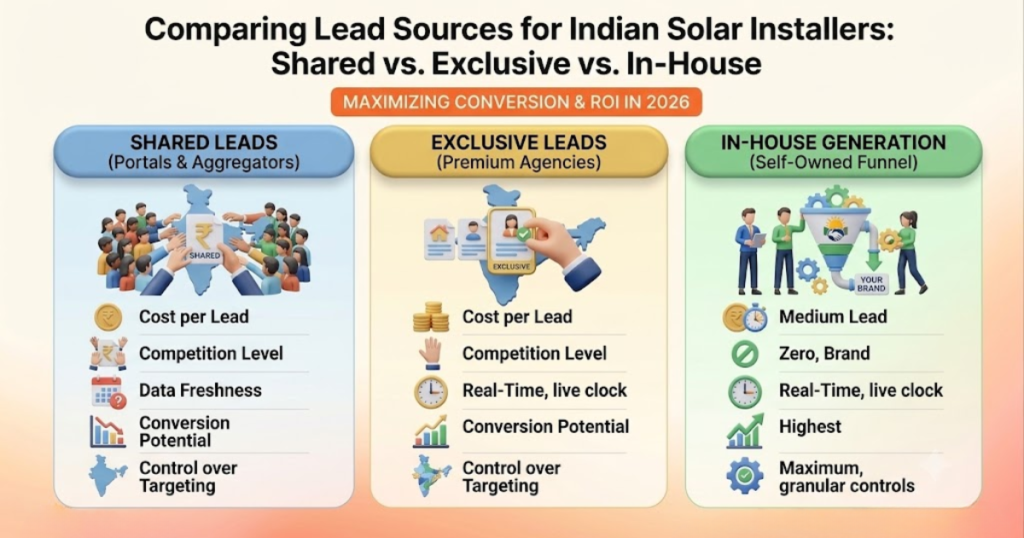
When looking to scale your pipeline, you have three primary paths. Understanding the financial and conversion differences between these models is crucial for managing your customer acquisition cost (CAC).
| Feature / Metric | Shared Leads (Third-Party Portals) | Exclusive Bought Leads (Premium Agencies) | In-House Lead Generation (Self-Owned Funnel) |
| Distribution | Sold to 3 to 5 installers simultaneously. | Sold 100% exclusively to your company. | 100% proprietary to your brand. |
| Average Cost (INR) | Low (₹150 – ₹400 per lead) | Medium-High (₹1,200 – ₹3,500 per lead) | Variable (Depends on ad spend & SEO) |
| Conversion Rate | Very Low (1% – 3%) | Moderate to High (8% – 15%) | Highest (15% – 25%) |
| Sales Speed Required | Ultra-Fast (Must call within 2 minutes) | Moderate (Can call within a few hours) | Flexible (Strong brand affinity built-in) |
| Competition Level | Extremely High (Price-war situation) | Zero competing calls on that specific lead | Zero competition; customer trusts you. |
| Long-Term Asset? | No. You are renting a list. | No. It is a transactional purchase. | Yes. Builds your permanent brand equity. |
3. The Dangerous Pitfalls of Cheap Solar Leads (Red Flags to Watch Out For)
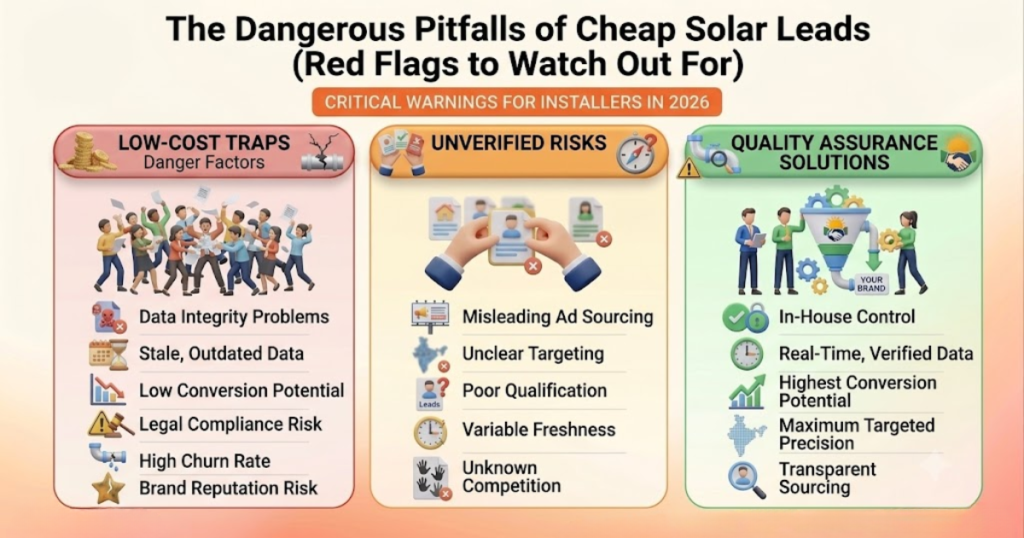
Many lead generation agencies attract installers with promises of “Bulk Solar Leads at just ₹50 per lead.” In B2B marketing, you get exactly what you pay for. Buying unverified, cheap leads is often more expensive in the long run due to the hidden costs of wasted sales labor.
Critical Red Flags When Evaluating Lead Vendors:
- The “Free Subsidy” Trap: Many low-tier agencies run deceptive social media ads with headlines like “Get Free Solar Panels from the Government – Fill Form Now.” This generates thousands of clicks from low-income demographics who expect free electricity without paying a single rupee. These leads are practically impossible to convert for premium EPC installers.
- Outdated Co-Registration Data: Some data brokers scrape older property registries or industrial directories from 2022-2024 and resell them as “Fresh 2026 Solar Leads.” If a prospect says, “I never filled out a form for solar,” you are dealing with stale, non-compliant data.
- Lack of Intent Customization: If an agency cannot tell you the exact ad creative, landing page, or keyword that generated the lead, they are likely sourcing it through generic pop-up surveys or incentivized reward games online.
4. Crucial Questions to Ask a Lead Generation Vendor Before Buying
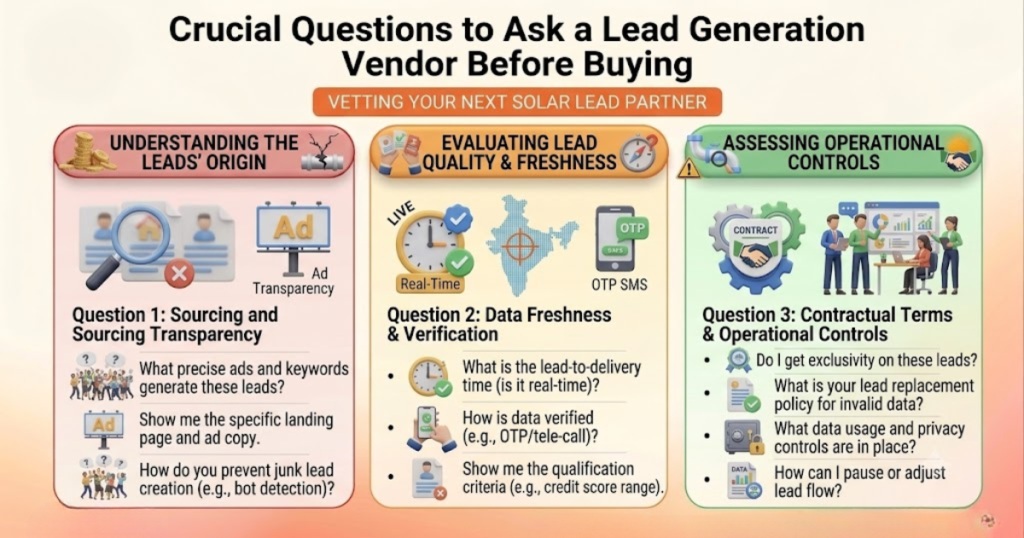
If you choose to work with an external digital marketing agency or lead aggregator to buy high quality solar leads, do not sign a contract without putting them through a rigorous vetting process.
Pro-Tip: Treat your lead vendor like a core strategic partner. If they are evasive about their sourcing methodologies, terminate the conversation immediately.
Ask These Exact Questions:
- “What is your exact lead generation framework and source?”
- Good Answer: “We run highly targeted Google Search campaigns targeting high-intent keywords like ‘Best solar company in Delhi NCR’ paired with custom, multi-step landing pages.”
- Bad Answer: “We have a private network and proprietary social media loops.” (This usually means generic, low-intent Facebook forms).
- “What precise qualification questions do you ask prospects before passing them to us?”
- Good Answer: “Every prospect must manually input their monthly electricity bill amount, specify whether they own the rooftop, select their city, and confirm their mobile number via an active OTP/tele-verification system.”
- “What is your replacement policy for invalid data?”
- Good Answer: “We replace any lead that contains a non-working phone number, a wrong number, or an individual residing in an apartment with zero roof access within 48 hours of delivery.”
- “Are these leads delivered in real-time?”
- Good Answer: “Yes, the exact moment a prospect submits their details, the data is pushed directly into your CRM via Webhooks/API within 5 seconds.”
5. Building Your In-House Engine: How to Generate Premium Leads Independently
While buying premium exclusive leads is a fantastic way to inject immediate volume into your sales pipeline, the long-term goal of any scaling Indian solar brand should be building an independent, in-house lead generation engine. This eliminates third-party reliance and drives down your customer acquisition cost over time.
Step A: Hyper-Targeted Local SEO & Google Business Profile (GBP)
Most high-ticket commercial, industrial, and premium residential buyers do not click on random social media ads; they use search engines when their intent is at its peak.
- Optimise your website pages for city-specific keywords: Solar panel installation companies in Ahmedabad, Commercial solar EPC setup in Pune, or On-grid solar system price in Jaipur.
- Keep your Google Business Profile updated with high-resolution photos of completed local installations, active customer video testimonials, and explicit mentions of your operating locations. Google rewards localized proximity searches with highly profitable, zero-cost inbound phone calls.
Step B: Build Multi-Step, Friction-Based Landing Pages
The biggest mistake in digital ad campaigns is making it too easy for a user to submit their info. A single-click Facebook Lead Form requires zero effort, leading to accidental submissions and low-quality data.
Instead, drive traffic to a dedicated, high-converting landing page that uses a multi-step solar calculator format. Force the prospect to answer specific qualification questions:
- What type of property do you own? (Residential / Commercial / Industrial / Agricultural)
- What is your average monthly electricity bill? (Under ₹2,000 / ₹2,000 to ₹5,000 / Above ₹5,000)
- What is your pin code/location? (To filter out regions outside your operational reach)
- Enter your Phone Number to receive your estimated system sizing & payback analysis.
By introducing constructive friction, you automatically weed out casual browsers. The individuals who complete all four steps are, by definition, high quality solar leads.
Step C: Leverage Generative Engine Optimization (GEO) & Educational Content
In 2026, customers regularly use AI search engines (like Gemini and Perplexity) to research heavy investments. They ask complex prompts such as: “What is the step-by-step process to claim the national solar subsidy in Rajasthan for a 5kW system?”
To capture these elite buyers, publish deep, authoritative, and structured content on your blog addressing technical integration, financial break-even analyses, net-metering policies across different state DISCOMs (like Tata Power, MSEDCL, BESCOM), and comparisons of mono-perc vs. bifacial solar modules. When AI engines search the web for sources to answer user queries, your platform will be cited as the trusted local authority.
Frequently Asked Questions (FAQ)
Q1: Why are the solar leads I buy from popular Indian business directories converting so poorly?
Ans: Most mass B2B directories operate on a heavily shared model. When a homeowner searches for solar on their platform, their contact details are instantaneously sold to 5 to 10 different vendors simultaneously. Within thirty minutes, the customer is bombarded with a dozen aggressive sales calls. This creates immediate fatigue, causes the prospect to block numbers, and forces them into a destructive price-war where only the cheapest, lowest-quality installer wins.
Q2: What is a realistic conversion rate for exclusive, high-quality solar leads in India?
Ans: If the leads are exclusive, generated via high-intent channels (like Google Search or multi-step landing pages), and followed up on promptly, you should realistically expect a 10% to 20% site-survey milestone conversion, and an overall 5% to 12% final sales closure rate. If your closure rate is below 3% on exclusive leads, you need to audit your internal sales follow-up velocity and pitch script.
Q3: How quickly should my team call a newly generated solar lead?
Ans: Within 5 to 15 minutes max. Solar intent decays incredibly fast online. If a user fills out a form while sipping coffee, browsing options, and you wait 24 hours to call them back, they will likely have forgotten your brand name or filled out a competitor’s form. Fast response times dramatically improve connection and conversion rates.
Q4: Does running ads targeting the “PM-Surya Ghar Yojana” generate good leads?
Ans: It can, but only if you use strict negative targeting filters. Because the scheme is heavily promoted by the government, it attracts massive search volume from all economic segments. To ensure high quality, your ad copy must clearly state that the subsidy is for on-grid rooftop systems and requires a certain minimum roof space and upfront investment capacity, filtering out those looking for completely free off-grid setups.
Q5: Should I buy residential or commercial solar leads to maximize profit?
Ans: Residential leads offer faster sales cycles, higher volume, and simpler execution, but lower individual contract values. Commercial and Industrial (C&I) leads have extended sales cycles (often 3 to 6 months) involving complex board approvals, but a single conversion can net you a 100kW to 1MW+ project, yielding massive financial returns. A healthy solar agency should ideally maintain a 70:30 pipeline split between residential volume and C&I high-ticket projects.
Conclusion: The Strategic Shift from Quantity to Quality
In the competitive landscape of 2026, scaling a solar installation business requires moving away from vanity metrics. Having a database of 1,000 unverified names will only exhaust your callers and lower team morale.
Instead, pivot your budget toward securing high quality solar leads. Whether you choose to source them from premium, exclusive digital marketing agencies or build your own high-intent Google Search and local SEO asset pipeline, prioritizing validated interest, financial capacity, and real-time delivery will protect your margins and sustainably scale your operations.