Every morning, thousands of business owners across India—from fast-scaling tech startups in Bengaluru to traditional industrial manufacturers in Gujarat and solar EPC providers in Rajasthan—log into their digital marketing dashboards. They see beautiful upward graphs. Clicks are up by 45%. Impressions have crossed the one-million mark. Click-Through Rates (CTR) look incredibly healthy.The Indian digital ecosystem is crowded with thousands of boutique agencies making grand promises. Yet, a massive disconnect remains between marketing metrics and business revenue. If you are tired of paying hefty monthly retainers only to receive “vanity metrics” that don’t cover your payroll, it is time to pivot. You need to transition to a dedicated performance based digital marketing agency—a partner that ties its financial success directly to your Return on Ad Spend (ROAS) and bottom-line revenue.
However, because “performance marketing” has become the latest industry buzzword, almost every traditional agency has rebranded overnight. How do you cut through the noise and select a partner that genuinely puts their skin in your game?
This exhaustive guide breaks down the framework for identifying, vetting, and onboarding a real performance marketing partner in the Indian business landscape. performance based digital marketing agency
1. The Core Paradigm Shift: Clicks VS ROAS
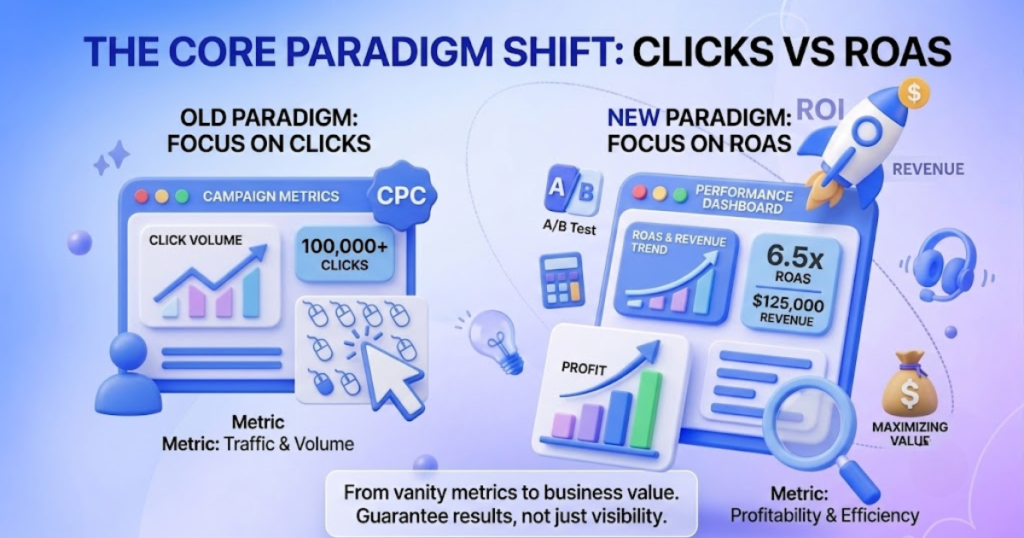
To make an informed hiring decision, you must first understand the fundamental structural difference between traditional digital marketing and true performance-driven marketing.
Traditional marketing focuses on top-of-the-funnel (TOFU) awareness. Performance marketing focuses aggressively on bottom-of-the-funnel (BOFU) actions, conversions, and capital efficiency. performance based digital marketing agency
[Traditional Marketing] ──> Focus: Impressions & Clicks ──> Result: Brand Awareness
[Performance Marketing] ──> Focus: Cost Per Lead & ROAS ──> Result: Business Revenue
Understanding Vanity Metrics (The Illusion of Growth)
Vanity metrics are data points that look spectacular on a PowerPoint presentation but don’t contribute to business profitability.
- Impressions: How many times your ad was displayed on a screen. (Zero correlation to sales).
- Clicks: How many times users tapped your ad. (Many are accidental or casual browsers with no intent to buy).
- Page Likes & Follows: Social proof that can easily be bought or superficial engagement that rarely converts to sustained customer lifetime value.
Understanding ROAS and Revenue Metrics (The Reality of Growth)
Performance-based metrics evaluate the direct financial outcome of every single rupee spent on ad networks like Meta, Google, or LinkedIn.
- Return on Ad Spend (ROAS): Calculated as \text{ROAS} = \frac{\text{Total Revenue Generated from Ads}}{\text{Total Ad Spend}}. If you spend ₹1,00,000 on Google Ads and generate ₹4,00,000 in tracked sales, your ROAS is a healthy 4\text{x} (or 400%).
- Cost Per Acquisition (CPA) / Cost Per Lead (CPL): The exact cost incurred to acquire one paying customer or one deeply qualified business enquiry.
- Customer Lifetime Value (LTV) to CAC Ratio: Ensuring that the cost to acquire a customer doesn’t exceed the profit they bring in over their entire relationship with your brand.
2. Definitive Comparison: Genuine Performance Agency VS Traditional Agency
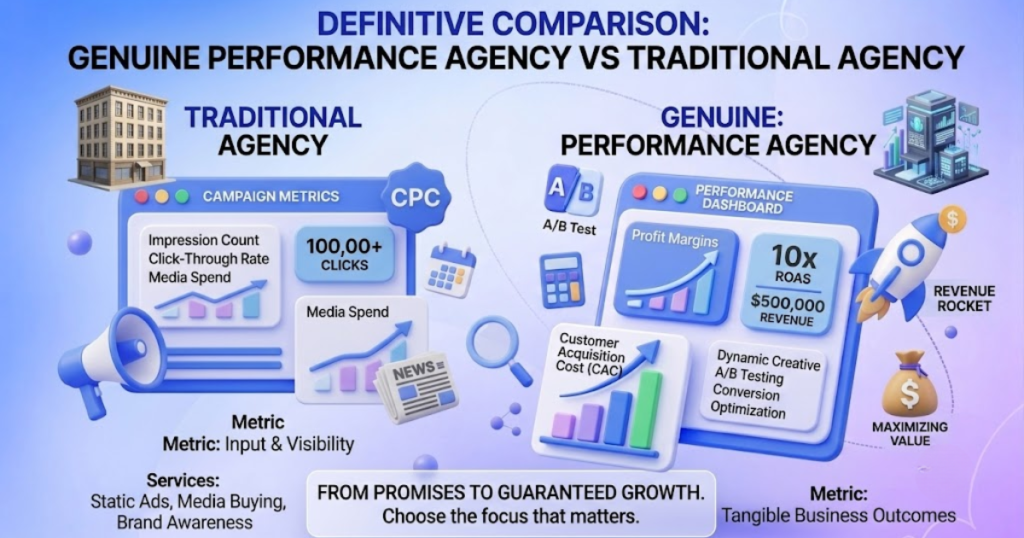
Before signing an agency contract, map their operational style against this comprehensive architectural breakdown. This will help you immediately filter out legacy agencies masquerading as performance specialists.
| Operational Attribute | Legacy / Traditional Agency | Genuine Performance Based Agency |
| Primary North Star Metric | Brand awareness, traffic volume, ad impressions, social media engagement. | Tracked ROAS, qualified leads, customer acquisition cost (CAC), revenue. |
| Pricing Architecture | Fixed monthly retainers or a flat percentage of ad spend regardless of performance. | Risk-sharing models: Low base retainer + performance bonuses based on hit targets. |
| Creative Philosophy | Aesthetic, high-budget, award-winning designs that focus on abstract brand storytelling. | Direct-response creatives: Hooks, copy angles, psychological triggers, and functional videos. |
| Data & Tracking Depth | Standard Google Analytics setup with basic traffic tracking; frequent gaps in data. | Deep server-side tracking, CRM integration, advanced attribution modeling, custom dashboards. |
| Testing Velocity | Launches 2 to 3 creative variations a month and leaves them running statically. | Continuous A/B testing: Testing dozens of hooks, copy lines, and landing page variations weekly. |
| Accountability & Response | “Sir, our ads are performing perfectly. The issue lies with your sales team or your pricing.” | “We noticed a drop in conversion at Step 3 of the funnel; we are re-writing the copy today.” |
3. Step-by-Step Blueprint to Evaluate an Indian Performance Agency
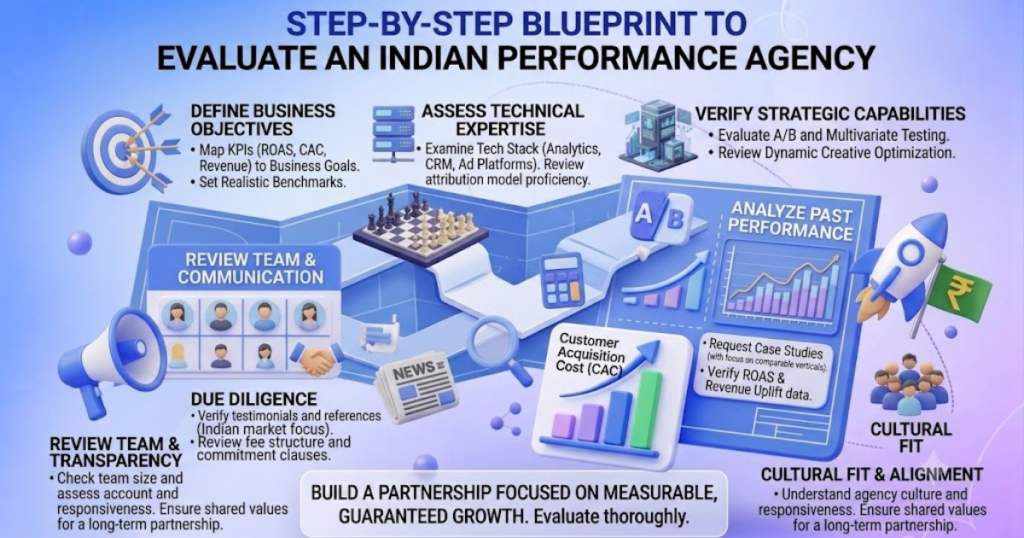
Selecting the right partner requires a systematic vetting process. Do not let slick sales pitches sway you. Instead, use this operational checklist during your discovery calls.
Step 1: Audit Their Pricing Philosophy (Skin in the Game) – performance based digital marketing agency
A true performance agency doesn’t want a massive, unconditional monthly fee. They prefer to tie their upside to your business growth. Look for agencies offering variations of these models:
- The Base + Performance Bonus Model: A nominal base fee to cover minimum human resource costs, combined with a tiered payout for every milestone reached (e.g., achieving a baseline 3.5\text{x} ROAS).
- The Pure Pay-Per-Qualified-Lead Model: Ideal for B2B industrial, real estate, and solar sectors. You agree upon a strict definition of a “Qualified Lead” and pay a fixed price only for leads that pass that validation filter.
- The Revenue/Profit Share Model: Highly popular in D2C e-commerce. The agency charges a small operating fee and takes a defined percentage (e.g., 3% to 7%) of the net tracked revenue generated specifically by their ad accounts.
Step 2: Dissect Their Lead Qualification & Funnel Strategy– performance based digital marketing agency
Ask the agency point-blank: “How do you define and filter a qualified lead?”
If their answer is simply running native lead-generation forms on Instagram or Facebook where users’ data pre-fills automatically, tread carefully. This method notoriously produces high volumes of low-intent leads who say “Maine toh click nahi kiya” when your sales team calls.
A high-quality performance agency will discuss complex multi-step funnels:
- Custom Landing Pages: Driving traffic to fast-loading, highly persuasive custom landers.
- Friction-Based Quizzes: Forcing prospects to answer 3 to 5 deep qualification questions (e.g., “What is your monthly electricity bill?” for solar clients, or “What specifications do your junction boxes require?” for industrial manufacturing leads).
- CRM Automation: Instantly pushing leads into your system (like HubSpot, Zoho, or Salesforce) with custom tracking tags so your sales team can act within 5 minutes.
Step 3: Inspect Their Tracking Infrastructure & Technical Competence – performance based digital marketing agency
Performance marketing is entirely a game of data processing. With the death of third-party cookies and data privacy updates, standard pixel tracking is no longer sufficient. Ensure your prospective agency natively supports:
- Server-Side Tracking & Conversions API (CAPI): Sending conversion data directly from your website’s server to Meta or Google, bypassing ad blockers and browser restrictions.
- First-Party Data Integration: Leveraging your existing customer lists legally to train ad network algorithms to find lookalike audiences with high purchasing intent.
- Multi-Touch Attribution (MTA): Identifying exactly which touchpoints contributed to a conversion, especially for high-ticket long-cycle sales where a client interacts with your brand 7 times before buying.
4. Industry-Specific Frameworks for Performance Marketing
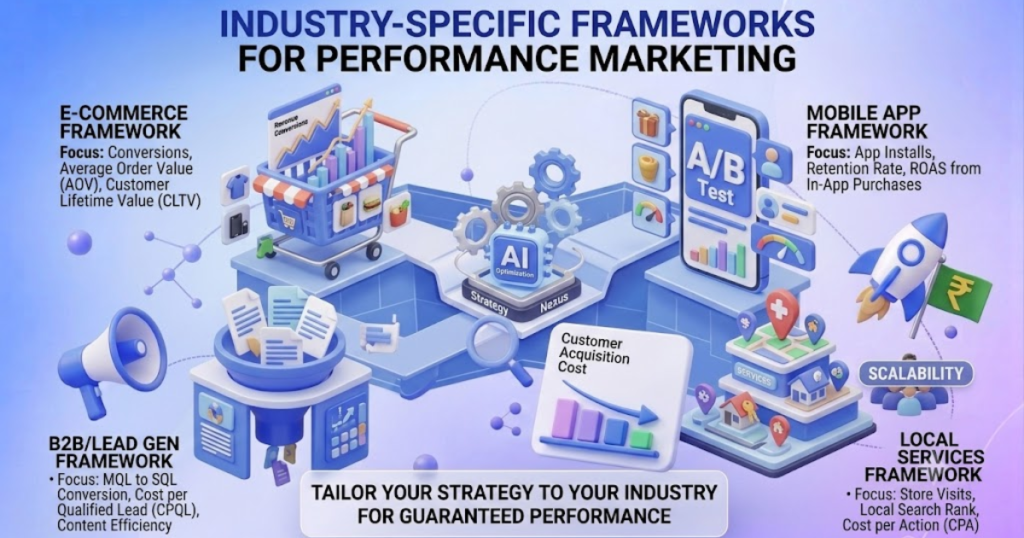
Performance marketing isn’t a one-size-fits-all solution. Different business verticals require completely distinct key performance indicators (KPIs) and strategies.
A. High-Ticket B2B & Industrial Manufacturing
For businesses selling items like industrial PVC enclosures, specialized switchgears, or machinery parts, volume is secondary to absolute technical accuracy.
- The Strategy: Educational whitepapers, downloadable CAD diagrams, and detailed case studies distributed via hyper-targeted LinkedIn Ads and Google Search Ads.
- Primary Focus: High-intent search terms like “IP67 electrical enclosure manufacturers“ rather than generic words like “plastic boxes.”
- Success Metric: Cost Per Sales Qualified Lead (SQL) and Pipeline Velocity (how fast a lead converts into a signed contract).
B. Solar Energy, Commercial & Industrial (C&I) Rooftop Solar
The solar sector is highly localized and driven heavily by specific consumer pain points: high electric bills, regional subsidy transparency, and long-term ROI.
- The Strategy: Direct-response localized video creatives showcasing real installations in regional hubs (e.g., Jaipur, Surat, Guwahati). Utilizing scripts highlighting precise numbers like “Save up to ₹1,30,800 with solar subsidies.”
- Primary Focus: Geographic micro-targeting combined with interactive landing pages featuring built-in solar calculators.
- Success Metric: Verified site-visit appointments scheduled, not just raw phone numbers collected.
C. D2C E-Commerce & Retail Brands
Fast-moving consumer goods require instantaneous transactional flow.
- The Strategy: High-velocity creative testing utilizing Meta Advantage+ Shopping Campaigns, Google Performance Max (PMax), and influencer-style user-generated content (UGC).
- Primary Focus: Conversion Rate Optimization (CRO) on the product pages, optimization of average order value (AOV), and robust cart abandonment retargeting sequences.
- Success Metric: Direct blended ROAS and New Customer Acquisition Cost.
5. Critical Red Flags to Watch Out For 🚩
When interviewing agencies, protect your advertising capital by staying alert to these three critical operational red flags:
Red Flag #1: “Guaranteed 10x ROAS from Day One”
Any agency promising immediate, monumental returns without auditing your historical account data, your landing page speed, your pricing structure, or your past customer feedback is simply trying to win your contract with false hope. True performance marketing requires a structured testing phase. Expect a realistic agency to say: “We will spend the first 14 days running structural split tests to establish a profitable baseline, then we will aggressively scale.”
Red Flag #2: Gatekeeping Ad Accounts and Assets
Your Facebook Business Manager, Google Ads Account, and Google Analytics profile are your company’s core intellectual property. Never allow an agency to run ads out of an ad account owned exclusively by them. If the relationship sours, they can revoke your access, taking years of valuable pixel optimization data, custom audience assets, and creative history with them. A trusted agency will always operate inside your business manager account with partner-level access.
Red Flag #3: Flat, Static Reporting Methods
If an agency only provides a monthly PDF report full of aggregate metrics at the end of the month, they are likely concealing inefficiencies. Performance marketing happens in real-time. A legitimate agency will provide a transparent, live dashboard (built on Looker Studio or similar software) where you can track ad spend, leads generated, and real-time ROAS every single day.
Frequently Asked Questions (FAQs)
Q1: Can a performance marketing agency guarantee an exact ROAS in a legal contract?
No ethical agency can guarantee an absolute revenue figure in writing because digital marketing does not operate in a vacuum. The agency controls ad creatives, targeting, hooks, and traffic quality. However, they cannot control external variables such as changes in your competitor’s pricing, sudden ad network algorithm shifts, manufacturing delays, inventory stockouts, or your internal sales team’s closing performance. Instead of absolute revenue guarantees, a true performance agency guarantees operational accountability, transparent resource allocation, and a risk-sharing fee structure.
Q2: What is a realistic budget required to start working with a performance agency in India?
While there is no fixed minimum, performance marketing relies on data volume to train AI ad bidding algorithms. For a campaign to optimize effectively, your ad budget should be sufficient to generate at least 50 conversion events per week. For most Indian B2B, solar, or D2C startups, a foundational ad spend budget of ₹50,000 to ₹1,50,000 per month (excluding the agency fee) is recommended to run statistically viable split tests and gather clean performance data.
Q3: How long does it typically take to see a positive ROAS?
Generally, a performance marketing lifecycle follows three distinct phases:
- Days 1–14 (Testing & Infrastructure Phase): Setting up deep tracking API systems, auditing audiences, launching direct-response ad copy hooks, and gathering baseline conversion data. ROAS may break even or be slightly negative here.
- Days 15–45 (Optimization Phase): Killing unprofitable ad angles, doubling down on winning demographics, improving landing page load times, and fine-tuning lead quality. ROAS typically stabilizes and moves into profitability.
- Days 45+ (Scaling Phase): Budget is systematically increased on proven assets to maximize overall revenue yield.
Q4: We are a traditional B2B brand. Does performance marketing work for us, or is it only for e-commerce?
Performance marketing is exceptionally powerful for high-ticket B2B industries. While e-commerce brands measure success by instant checkouts, a B2B brand measures performance by the generation of highly qualified, intent-verified sales enquiries. By utilizing friction-based forms, technical landing pages, and search keyword isolation, a performance agency can consistently lower your B2B Customer Acquisition Cost (CAC) and eliminate wasted spend on non-decision makers.
Q5: What happens if the agency fails to meet the agreed-upon performance milestones?
This depends entirely on your initial service-level agreement (SLA). In a structured performance-linked contract, if the agency fails to meet the minimum agreed baseline performance metrics over a specific period (e.g., 30 days) due to execution errors, their performance bonuses are forfeited. Most performance contracts also include a flexible, performance-indexed termination clause allowing you to exit the partnership with a short 7-to-15-day notice if key metrics consistently drop below safe thresholds.
The Bottom Line: Transitioning to Accountable Growth
Marketing should never be viewed as an unquantifiable business expense that you simply cross your fingers and hope works out. In today’s hyper-competitive economic environment, every rupee of your marketing budget must behave like an efficient, accountable employee.
Partnering with a dedicated performance based digital marketing agency transitions your brand away from vague vanity metrics and aligns your marketing spend directly with your company’s commercial trajectory. It forces your marketing initiatives to be transparent, data-driven, and intrinsically profitable.
Before signing your next marketing retainer, stop asking agencies how many posts they will upload to Instagram next month. Ask them how they plan to transform your ad spend into predictable, compounding business revenue.