The Indian solar sector is undergoing a massive paradigm shift. Fueled by government initiatives like the PM-Surya Ghar: Muft Bijli Yojana for residential rooftops and aggressive net-metering policies for Commercial & Industrial (C&I) clients, the demand for solar deployment is at an all-time high.However, with this massive market boom comes a fierce business challenge: sustained, high-quality solar lead generation.
For solar EPC (Engineering, Procurement, and Construction) companies, system integrators, and local installers, the core marketing dilemma always boils down to a strategic crossroad:
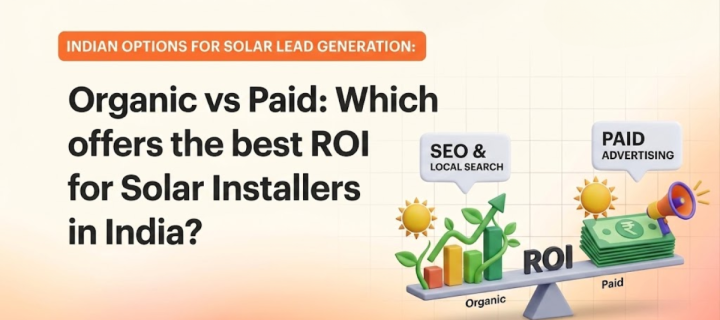
Should you pump your hard-earned capital into immediate Paid Advertising (Meta Ads, Google Search Network), or should you build a long-term equity asset via Organic Lead Generation (SEO, Content Marketing, Local Map Packs)?
This comprehensive guide breaks down both methodologies, analyzes real-world Indian performance metrics, evaluates true return on investment (ROI), and outlines a hybrid strategy designed to maximize your customer acquisition pipelines.
1. Deconstructing Paid Solar Lead Generation
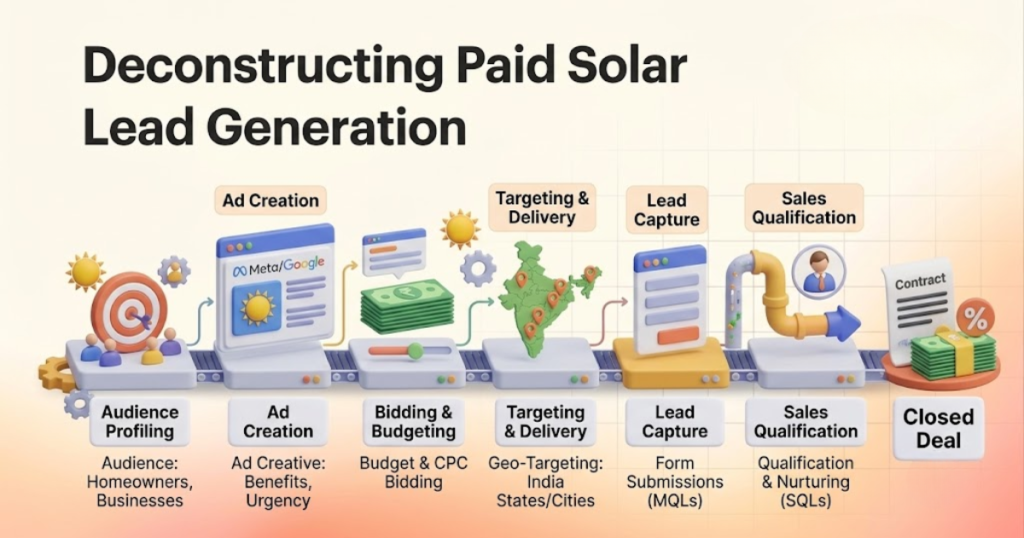
Paid lead generation refers to any marketing strategy where you directly pay an advertising platform (like Meta, Google, or LinkedIn) to display your promotional copy to a targeted audience. In exchange, you get instant visibility and immediate clicks to your landing pages.
[Ad Campaign Launched] ➔ [User Clicks on Ad] ➔ [Lead Form Captured] ➔ [Sales Call in <5 Mins]
Direct Framework of Paid Solar Marketing
To succeed with paid channels in the Indian ecosystem, installers typically deploy two primary engines:
- Meta Ads (Facebook & Instagram): Highly visual. These platforms excel at disrupting a user’s daily feed with highly engaging reels, video testimonials, and breakdown graphics of regional subsidy benefits.
- Google Search Ads (PPC): Highly Intent-Driven. When an estate manager or homeowner searches for “best solar panel system installers near me”, your sponsored link appears at the very top of Google.
The Clear Advantages (Pros)
- Immediate Velocity: Unlike search engine optimization which takes time, paid campaigns can generate validated leads within 24 to 48 hours of setup.
- Granular Geographical Targeting: Indian tier-1 and tier-2 distribution structures vary. Paid ads allow you to hyper-target specific states (such as Rajasthan, Gujarat, or Assam), precise major cities (like Jaipur or Ahmedabad), or even specific industrial clusters and affluent pin codes.
- Agile Trend Capitalism: When state regulatory bodies announce a revision in solar rooftop subsidies, you can launch a dedicated ad creative focusing on that exact financial update within hours.
The Structural Drawbacks (Cons)
- Inflated Cost-Per-Click (CPC): As hundreds of new solar vendors enter the digital marketplace daily, the bidding auctions on Google Search keywords have skyrocketed. High-intent keywords now experience heavy inflation.
- The Problem of “Junk” Leads: Low-friction lead forms (like Facebook Instant Forms) frequently capture accidental clicks, wrong contact numbers, or individuals who don’t possess roof ownership. This clogs your internal sales pipeline with low-intent inquiries.
- Zero Residual Lifetime Value: Paid advertising operates strictly on a pay-to-play model. The moment your daily ad spend wallet runs dry, your traffic drops to zero instantly.
2. Unpacking Organic Solar Lead Generation
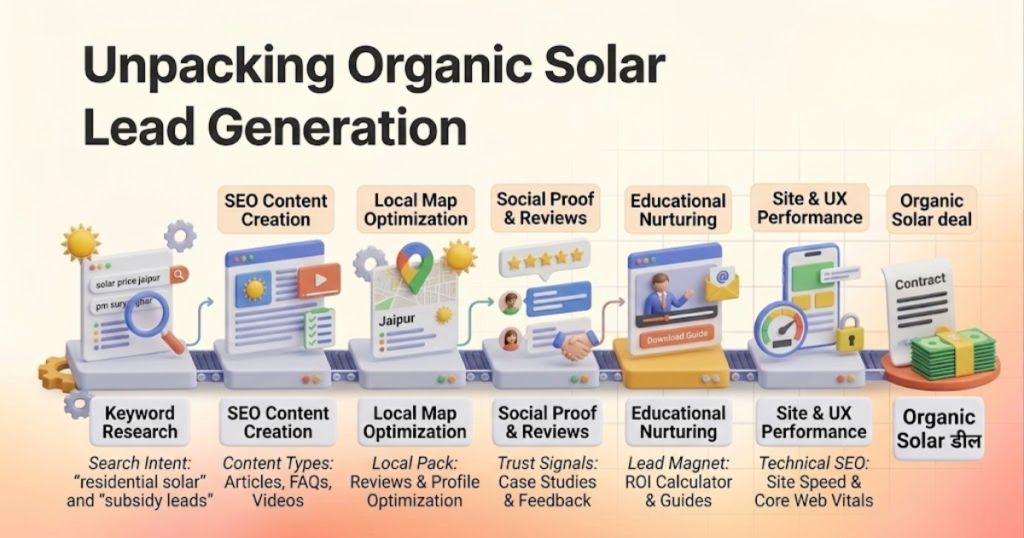
Organic lead generation is the strategic practice of optimizing your brand’s digital footprint so that high-intent consumers discover your website naturally. This is achieved via Technical SEO, localized business indexing, and informative, problem-solving content assets.
The Architecture of High-Yield Solar SEO
To capture organic demand, your website must answer the precise search queries your target audience asks during their research phase. This includes technical topics, regulatory navigation, and cost evaluations. For example:
- “Is a 5kW solar system enough for a 3-story house?”
- “How to claim the PM-Surya Ghar subsidy online?”
- “Monocrystalline vs. Polycrystalline solar panels efficiency comparison.”
The Clear Advantages (Pros)
- Unrivaled Lead Quality and Intent: When a procurement manager manually types “Top industrial solar EPC company in Maharashtra” into a search engine, their intent to purchase is incredibly close to maturity. These leads convert at a significantly higher rate than a passive social media browser.
- Zero Recurring Per-Lead Cost: While setting up the content requires an upfront investment, you do not pay Google or any other search engine a single rupee for the thousands of clicks or form submissions you secure over time.
- Domain Authority and Trust: Indian consumers, especially high-net-worth individuals (HNIs) and commercial enterprise heads, view organically ranking websites as industry leaders rather than transient entities running short-term ads.
The Structural Drawbacks (Cons)
- Extensive Latency Period: SEO is a long-term compound asset. A new website or a newly published blog post can take anywhere from 3 to 6 months to index, build backlink authority, and rank on the first page of Google.
- Algorithm Volatility: Search engine core updates can dynamically alter search engine results pages (SERPs). This necessitates continuous auditing, regular content updating, and technical upkeep.
3. Metric Breakdown: Paid vs. Organic
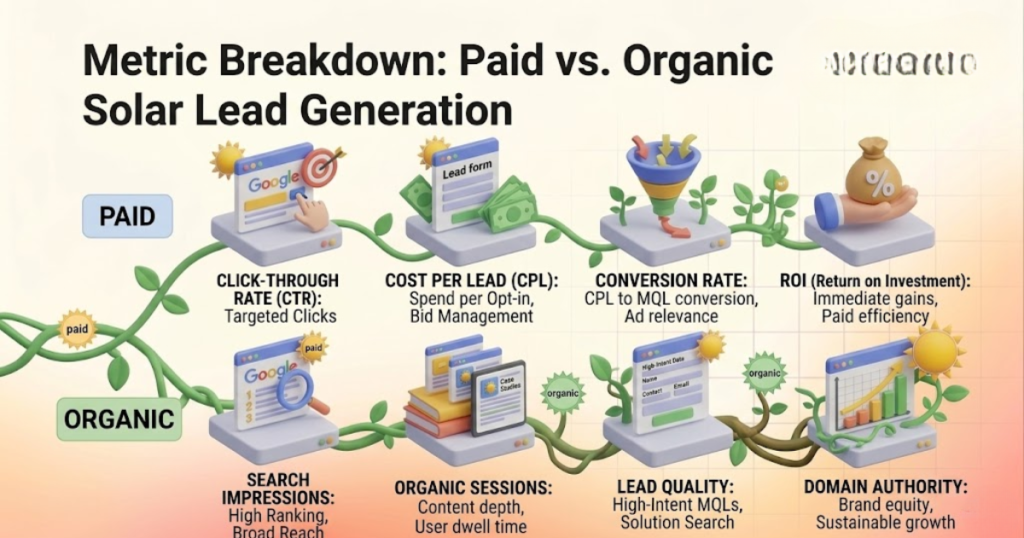
To determine where your marketing capital will yield the highest return, it is vital to analyze the core behavioral differences, financial metrics, and velocity rates of both ecosystems within the Indian marketplace.
Comparative Evaluation Matrix
| Core Performance Metrics | Paid Advertising (Meta / Google Ads) | Organic Channels (SEO / Local Map Packs) |
| Time to First Lead | Extremely Fast: 24 to 48 Hours | Slow to Moderate: 3 to 6 Months |
| Average Conversion Rate | Lower: Typically 2% to 5% | Higher: Typically 10% to 22% |
| Audience Mindset | Passive/Interrupted: Browsing social feeds | Active/Intentional: Actively seeking solutions |
| Cost Dynamics | Linear escalation (More leads require more ad spend) | Exponential compounding (Value increases over time) |
| Primary Target Market | Residential consumers, quick-volume turnarounds | Commercial & Industrial (C&I), high-value HNIs |
| Dependence on Third-Party Scale | High (Vulnerable to ad platform policy shifts) | Low (You fully own your organic web assets) |
4. Deep-Dive Financial Analysis of ROI
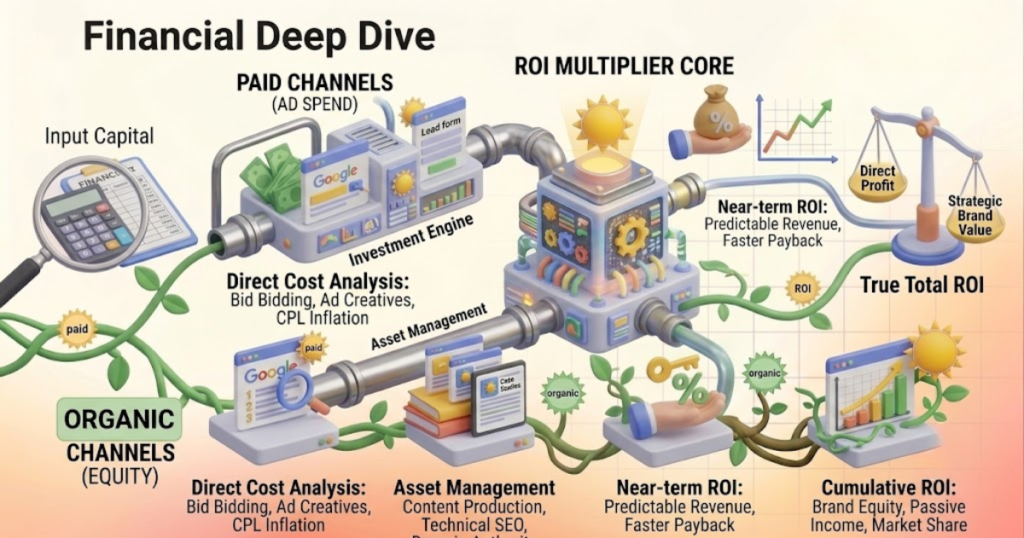
To evaluate real ROI, we must calculate the lifetime value of a client relative to the total cost required to acquire them. Let’s look at two distinct scenarios modeled around a standard Indian mid-sized Solar EPC company.
Scenario A: The Paid Ads Track – solar lead generation
Suppose you allocate ₹1,00,000 per month to Meta and Google Ads.
- At an average Cost Per Lead (CPL) of ₹250, you acquire 400 raw leads.
- Due to the passive nature of social feeds, your sales team qualifies 25% of them, filtering out tenants, incorrect numbers, and low-budget inquiries, leaving 100 Marketing Qualified Leads (MQLs).
- With a final site-survey-to-close conversion rate of 3%, you lock in 3 closed residential installation contracts.
- If your net profit per residential installation is ₹40,000, your immediate return is ₹1,20,000.
- The Paid ROI Equation: You spent ₹1,00,000 to clear a net profit of ₹1,20,000. This delivers an immediate 1.2x short-term financial return. However, the next month, you must spend another ₹1,00,000 to maintain this pipeline.
Scenario B: The Organic SEO Track – solar lead generation
Suppose you invest an identical ₹1,00,000 per month for 4 months (Total ₹4,00,000) into technical SEO, local search optimization, and creating detailed, long-form educational guides on regional industrial solar applications.
- During Months 1 and 2, your incoming leads are minimal while your content builds indexing authority.
- By Month 6, your articles ranking for terms like “Commercial solar panel installation ROI in India” attract 5,000 targeted visitors per month to your site.
- At a 2% organic form submission rate, this organic traffic generates 100 highly intentional leads monthly.
- Because these users actively sought out your expertise, your qualification rate jumps to 60%, and your final sales conversion rate doubles to 6%. This results in 6 closed contracts per month.
- At an average net profit of ₹40,000 per project, you generate ₹2,40,000 in profit every single month.
- The Organic ROI Equation: By Month 12, your initial ₹4,00,000 investment has generated millions in contract volume. Even if you completely pause your SEO spending for the next 3 months, your content remains on the first page of Google, continuing to funnel inbound leads into your business at zero incremental cost.
5. The Optimal Hybrid Framework for 2026 – solar lead generation
Relying exclusively on one channel leaves your solar business vulnerable. If you run paid ads exclusively, your profit margins can shrink as ad costs rise. If you focus only on SEO, you miss out on immediate revenue from seasonal subsidy peaks.
The most successful solar brands use a balanced Hybrid Growth Funnel.
[ HYBRID MARKETING ENGINE ]
│
┌──────────────┴──────────────┐
▼ ▼
[ PAID ADS ] [ ORGANIC SEO ]
│ │
├─► Residential (Volume) ├─► Industrial C&I (Margins)
├─► Subsidy Flash Campaigns ├─► Educational Trust Assets
└─► Immediate Cash Flow └─► Long-Term Brand Equity
Execution Strategy for the Hybrid Framework – solar lead generation
- Fund Quick Cash-Flow via Targeted Paid Ads: Use Meta Ads focused on visual transformations—such as 15-second Instagram reels showcasing a completed residential installation with a customer talking about their zeroed electricity bill. Direct this traffic to high-converting landing pages.
- Capture High-Value Enterprise Accounts via SEO: Produce deep-dive technical assets analyzing the financial benefits of solar deployment for factories, schools, and cold storage units. Address technical nuances like Open Access solar power, accelerated depreciation benefits under Section 32 of the Income Tax Act, and net-metering approval steps.
- Implement Smart Remarketing: Use tracking pixels on your high-ranking organic pages. When a user reads an organic guide on your site about “How to select the right solar inverter for your factory”, add them to a remarketing audience. Then, display targeted Meta and Google ads to them featuring your custom enterprise case studies. This blend keeps your client acquisition costs remarkably low.
Frequently Asked Questions (FAQs)
Q1: Which platform delivers a lower Cost-Per-Lead (CPL) for residential solar in India?
Meta Ads (Facebook & Instagram) generally delivers the lowest initial CPL for residential rooftop solar systems, often ranging from ₹150 to ₹350 depending on the state and target demographics. However, these leads require a diligent internal sales team to call them back within minutes to filter out casual or accidental form submissions.
Q2: How long does it take for a solar website to generate organic leads via SEO?
For a completely new domain, expect a timeline of 4 to 6 months of consistent content production, local listing optimization, and technical setup before seeing a steady stream of inbound leads. However, if you focus heavily on hyper-local keywords, such as “Solar rooftop installers in Jodhpur” or “Industrial solar EPC vendor in Vapi”, you can begin ranking and capturing inbound inquiries within 6 to 12 weeks.
Q3: How do we target high-value Commercial and Industrial (C&I) solar clients online?
C&I clients are rarely acquired via casual Facebook lead forms. To capture these high-margin, large-scale projects, focus on Google Search Ads for commercial keywords and LinkedIn Account-Based Marketing (ABM) targeting factory owners, operational heads, and procurement directors. Pair this with in-depth website case studies demonstrating megawatt-scale performance, real payback periods, and long-term carbon offset metrics.
Q4: Does the PM-Surya Ghar Yojana impact how we should structure our paid ads?
Absolutely. Since the Indian government offers up to ₹78,00,000 (or applicable slab rates) in direct central subsidies for residential setups up to 3kW, your paid ad creatives should prominently feature these exact financial numbers. Ad copies that clearly state “Get up to ₹78,000 Government Subsidy – Check Your Eligibility” see significantly higher click-through rates and better conversion efficiency across the Indian residential market.
Q5: What is “Speed-to-Lead” and why is it critical for paid solar leads?
Speed-to-lead is the total duration between when a user submits an online inquiry form and when your sales representative contacts them. In paid solar marketing, contacting a lead within 5 minutes increases your chance of qualification by over 300%. Because social media browsers have short attention spans, delaying your outreach by even an hour increases the likelihood that they will forget submitting the form or connect with a competitor instead.
Summary Actions for Solar Enterprises
- Audit Your Local Presence: Claim and thoroughly optimize your Google Business Profile. Ensure your exact physical address, local phone numbers, and images of successful regional installations are updated weekly to capture local map pack traffic.
- Embed an Interactive Savings Calculator: Integrate a dynamic web module where users can select their current monthly electricity bill slab and instantly view their estimated required system size (kW), total cost, available government subsidy, and projected payback period.
- Consistently Develop Strategic Video Content: Record high-definition site walk-throughs and customer video testimonials in regional languages. Use this video library both as high-yield creatives for your paid ad campaigns and as trust-building embedded elements on your organic blog posts.