In the rapidly shifting digital landscape of 2026, the term “Marketing” has evolved from a creative pursuit into a high-precision data science. For Indian businesses aiming to scale in a trillion-dollar digital economy, the stakes have never been higher.If you are looking for performance marketing services 2026, you aren’t just looking for someone to “run ads.” You are looking for a strategic partner who understands the intersection of Artificial Intelligence (AI), Privacy Laws, and Consumer Psychology.
1. The Core Pillar: What is Performance Marketing Services 2026?
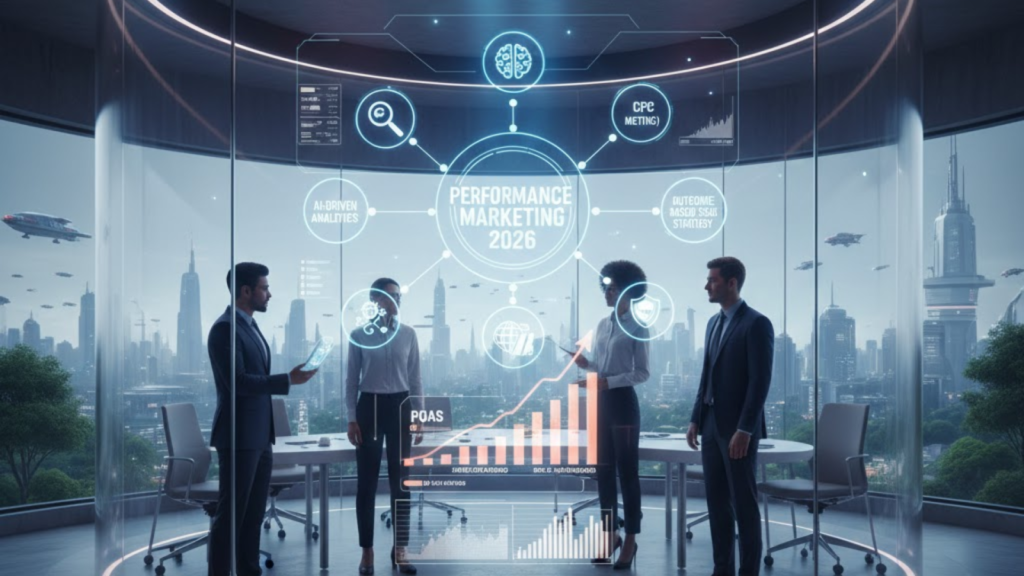
Performance marketing is no longer about “buying clicks.” In 2026, it is defined by Outcome-Based Marketing. Whether it’s a lead, a sale, or a download, you only pay for the result.
Key Shifts in 2026:
- From Attribution to Contribution: Models now track how every touchpoint (YouTube, WhatsApp, Search) contributed to the final sale.
- Predictive over Reactive: Agencies now tell you what will happen next month, not just what happened last week.
- The Rise of SGE (Search Generative Experience): Google’s AI now answers queries directly, changing how we track organic performance.
2. Essential Services You Shouldn’t Ignore in Performance Marketing Services 2026
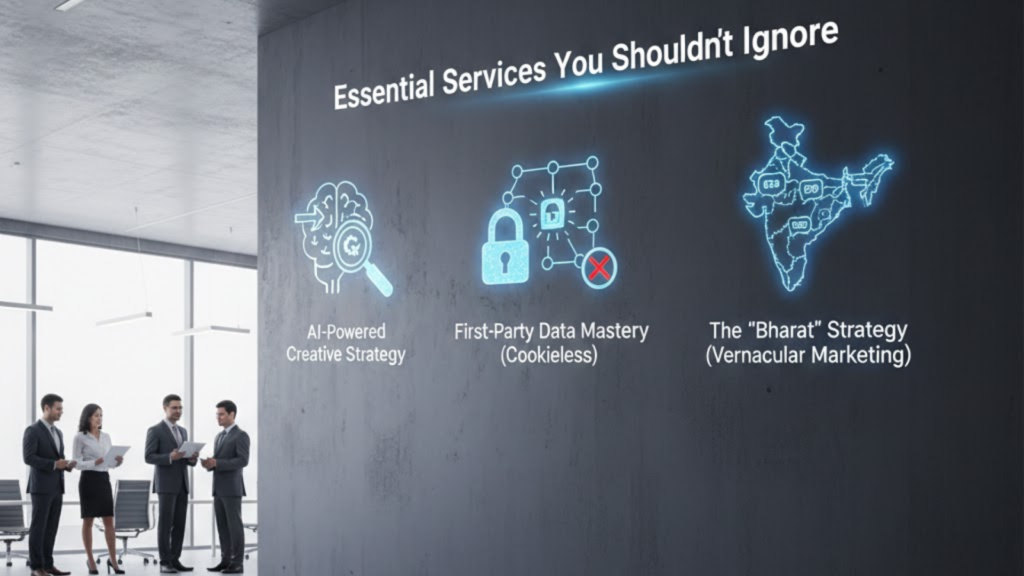
When auditing a performance marketing agency, ensure their “Services Menu” includes these futuristic essentials:
A. AI-Powered Creative Strategy
Gone are the days of one-size-fits-all banners.
- Dynamic Creative Optimization (DCO): Ads that change their background, language, and CTA in real-time based on who is watching.
- Synthetic Media: Using AI to generate hundreds of video variations for A/B testing in hours, not weeks.
B. First-Party Data Mastery (Cookieless Tracking)
With the total phase-out of third-party cookies, an agency must excel in:
- Server-Side Tracking: Bypassing browser limitations to ensure 100% data accuracy.
- CRM Integration: Connecting your sales data (like Salesforce or Zoho) directly to ad platforms to optimize for “Actual Profit,” not just “Revenue.”
C. The “Bharat” Strategy (Vernacular Marketing)
For the Indian market, 90% of new internet users are non-English speakers.
- Hyper-Local Targeting: Ads in Hindi, Marathi, Tamil, and Bengali are no longer optional—they are the primary driver of ROI in Tier 2 and Tier 3 cities.
3. Comparison: Traditional vs. 2026 Performance Marketing
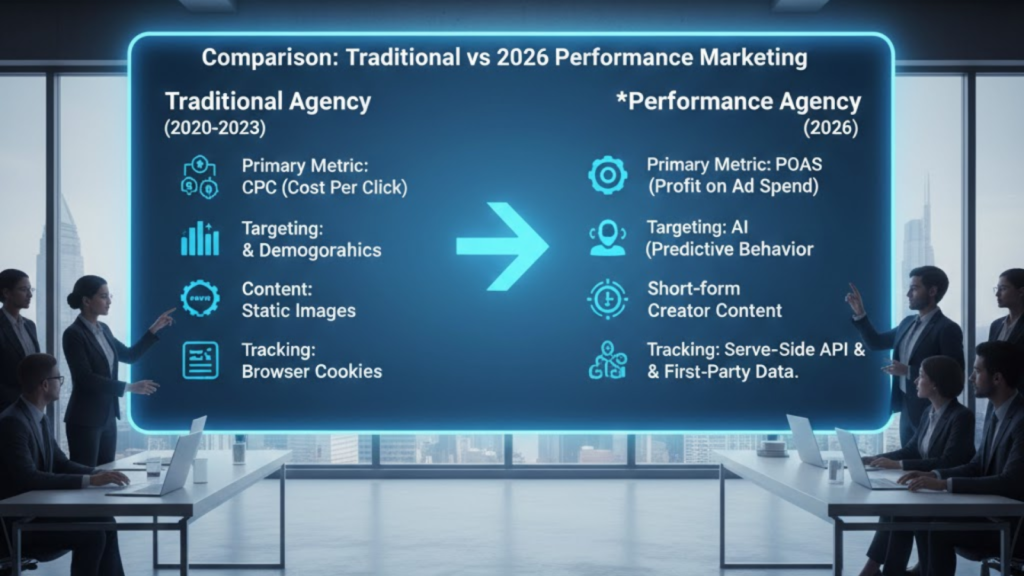
| Feature | Traditional Agency (2020-2023) | Performance Agency (2026) |
| Primary Metric | CPC (Cost Per Click) | POAS (Profit on Ad Spend) |
| Targeting | Interests & Demographics | AI-Predictive Behavior |
| Content | Static Images/Generic Videos | Short-form Creator Content |
| Tracking | Browser Cookies | Server-Side API & First-Party Data |
| Reporting | Monthly PDF Reports | Real-time 24/7 AI Dashboards |
4. How to Choose the Right Agency: A Step-by-Step Checklist
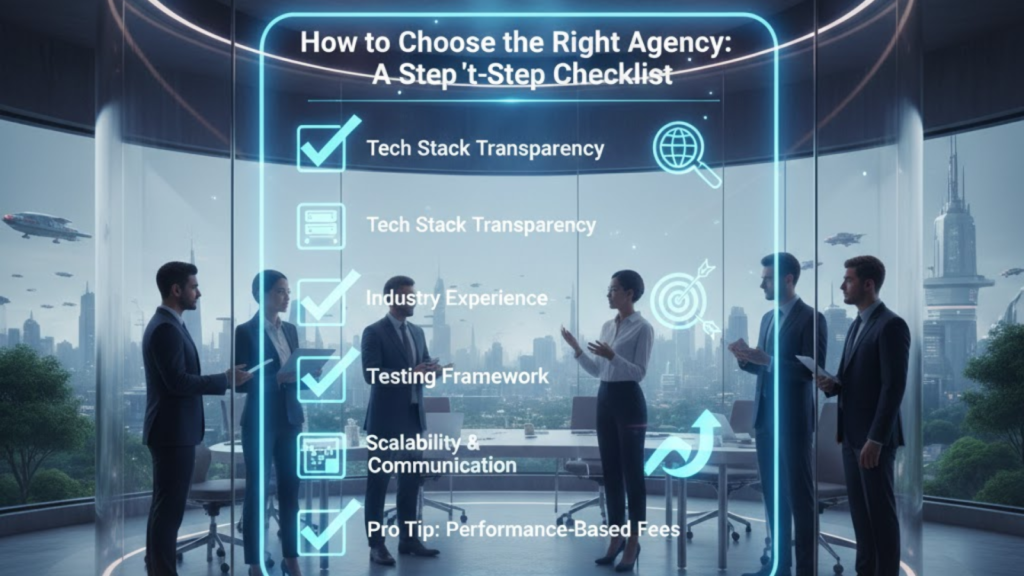
1. Tech Stack Transparency: The “Build vs. Buy” Debate
In 2026, an agency’s efficiency is directly limited by its technology. You must look under the hood to see if they are actually innovating or just using basic platform defaults.
- Proprietary AI vs. Generic Tools: Many agencies claim to be “AI-powered” but simply use Meta’s Advantage+ or Google’s PMax defaults. You need an agency with Proprietary Prediction Engines or Advanced Middleware (e.g., custom Python scripts or platforms like Improvado) that layer over standard tools to find hidden efficiencies.
- Data Warehouse Integration: Can they handle massive datasets? Inquire if they have the capacity for BigQuery or Snowflake integrations to process years of your historical data.
- Real-time Decisioning: 2026 demands instant agility. “Weekly Reports” are obsolete. Your agency must provide a Live Dashboard that refreshes hourly, using AI to highlight exactly where budget “leakage” is occurring.
2. Industry Experience: The Power of Niche Expertise
Performance marketing in 2026 is “Hyper-Specialized.” A generalist agency that succeeds in Real Estate might fail miserably in E-commerce.
- Benchmark Knowledge: A niche-specific agency already knows the 2026 Cost-per-Qualified-Lead (CPQL) benchmarks for a Luxury Apartment or a B2B SaaS subscription. They won’t waste three months of your budget just “learning” your industry.
- Policy Nuances: Different industries face different legal “Red Zones” (e.g., SEBI guidelines for Finance or strict Meta Healthcare policies). Niche experts know how to navigate these without getting your ad accounts banned.
- The “Bharat” Context: Growth in 2026 is driven by Tier-2 and Tier-3 cities. Verify if the agency has successfully scaled a brand in these regions using vernacular strategies and hyper-local targeting.
3. Testing Framework: Learning from Failure
True performance marketing is a cycle of Continuous Experimentation.
- Pivot Speed: Ask a hard question: “When the Meta algorithm crashed last month, what action did you take within 24 hours?” In 2026’s volatile market, a delay of 48 hours can result in millions of wasted ad spend.
- The 70/20/10 Rule: Ensure they have a structured framework: 70% of budget on proven “hero” campaigns, 20% on optimized experiments, and 10% on high-risk, high-reward platforms (like early-stage AI search engines or new social niches).
- Post-Mortem Culture: A reliable agency provides monthly “Failure Reports.” They should transparently analyze what didn’t work and, more importantly, what they learned from it to optimize the next phase.
4. Scalability & Communication: Managing Growth
Agencies often manage a ₹5 Lakh budget well, but their ROAS (Return on Ad Spend) often crashes when scaled to ₹50 Lakh.
- Linear vs. Exponential Scaling: Do they have proven scaling patterns? 2026 scaling isn’t just about increasing the daily budget; it involves jumping to new audiences (AI Lookalikes) and emerging platforms like Connected TV (CTV) or OTT Advertising.
- Communication Ecosystem: Email updates are too slow for 2026. Prioritize agencies that integrate with your team via Slack, Discord, or WhatsApp for Business for instant, real-time collaboration.
- Senior Growth Partners: Is your account being handled by a junior executive or a Senior Strategist? In the complex landscape of 2026, seniority and deep strategic experience are non-negotiable for high-budget accounts.
Pro Tip: In 2026, look for an agency that offers a Hybrid Pricing Model (a base retainer plus a Performance Fee based on profit or qualified leads).
5. Frequently Asked Questions (FAQ)
Q1: What is a good ROAS for performance marketing in 2026?
While it varies by industry, a 4x to 6x ROAS is generally considered healthy. However, in 2026, smart brands focus more on LTV (Lifetime Value) than immediate ROAS.
Q2: How much should I spend on Performance Marketing Services 2026?
For Indian startups, a minimum testing budget of ₹2,00,000 – ₹5,00,000 per month is recommended to gather enough data for AI models to optimize effectively.
Q3: Can Performance Marketing work for B2B?
Absolutely. In fact, Account-Based Marketing (ABM) using performance tools is the most efficient way to reach C-suite executives on LinkedIn and niche industry portals in 2026.
Q4: Is SEO part of performance marketing?
Yes. We now call it “Performance SEO” or “Search Experience Optimization.” It focuses on capturing high-intent traffic from AI-driven search results.
The Red Flags (Warning Signs)
- Guaranteed Results: If an agency guarantees a specific ROI in 30 days, run away. Markets are volatile; real agencies promise processes and optimization, not magic.
- Lack of Dashboard Access: You should own your data. If they don’t give you admin access to your Meta/Google accounts, they are hiding something.
- Vague Reporting: “We got you 1 million impressions” is a vanity metric. If they can’t show you the Cost Per Qualified Lead (CPQL), they aren’t performing.
Conclusion: Investing in Your Future
The search for the best performance marketing services 2026 ends with finding a team that values transparency, technology, and tenacity. As the Indian market becomes more crowded, only those who leverage deep-tech marketing will survive.
Don’t just hire an agency to spend your money; hire an agency to grow your wealth.