In today’s hyper-connected, digital-first India, having a physical presence is no longer enough. Your business’s survival and subsequent growth hinge on a robust and strategic online presence. The sheer volume of data, the rapid evolution of platforms (from Google Search to Instagram Reels and regional language content), and the competitive landscape demand professional expertise.This is where top online marketing companies come in. They are the architects of your digital success, turning potential customers into paying clients. However, the Indian market is saturated with digital agencies, making the selection process daunting.
This comprehensive guide, tailored for the discerning Indian business owner, will provide a detailed, step-by-step methodology to select a trustworthy, result-oriented, and human-driven marketing partner.
Part 1: Establishing the Foundation – Defining Your Digital Mandate

Before you even begin the search for the top online marketing companies, you must gain absolute clarity on your own business needs, challenges, and aspirations. An agency can only be “top-tier” if they are the top fit for you.
1.1 Pinpoint Your Business Stage and Marketing Maturity
Your required partner heavily depends on where your business currently stands. Matching the agency profile to your current stage is critical for budget optimization.
| Business Stage | Typical Marketing Goal | Ideal Agency Profile |
| Startup/Early Stage | Brand awareness, lead generation, establishing foundational SEO. | Boutique agency, strong in strategy, affordable packages, flexible. |
| Growth Stage (SME) | Scaling leads, expanding geographic reach, improving conversion rates (CRO). | Mid-sized agency, specialized in PPC/SEO, proven track record in scaling. |
| Established/Enterprise | Dominating market share, complex multi-channel campaigns, maintaining brand reputation. | Large, full-service agency with deep pockets of expertise, high accountability. |
1.2 Define Specific, Measurable, Achievable, Relevant, Time-bound (SMART) Goals
A vague goal like “I want more sales” is useless. Top companies respond to precision.
- Example 1 (E-commerce): “Increase organic search traffic to the product category pages by 40% within the next 6 months.”
- Example 2 (B2B SaaS): “Generate 150 qualified leads via LinkedIn and Google Ads with a Cost Per Acquisition (CPA) of less than ₹5,000 over the next quarter.”
1.3 Budget Clarity and Pricing Models
Transparency in budgeting is crucial in the Indian context. Understand the three common pricing models:
- Retainer Model (Most Common): A fixed monthly fee for a pre-defined scope of work. Best for long-term relationships and continuous growth.
- Project-Based Model: A fixed price for a specific, time-bound project (e.g., website redesign, one-time SEO audit). Best for defined deliverables.
- Performance-Based Model: A lower retainer fee plus a bonus/percentage of revenue/leads generated.
Crucial Question: Is the agency transparent about how much of your budget goes to service fees (agency’s profit/effort) versus media spend (money paid directly to Google, Meta, etc.)? Top agencies separate these clearly.
Part 2: Vetting the “top online marketing companies” – The Due Diligence Checklist
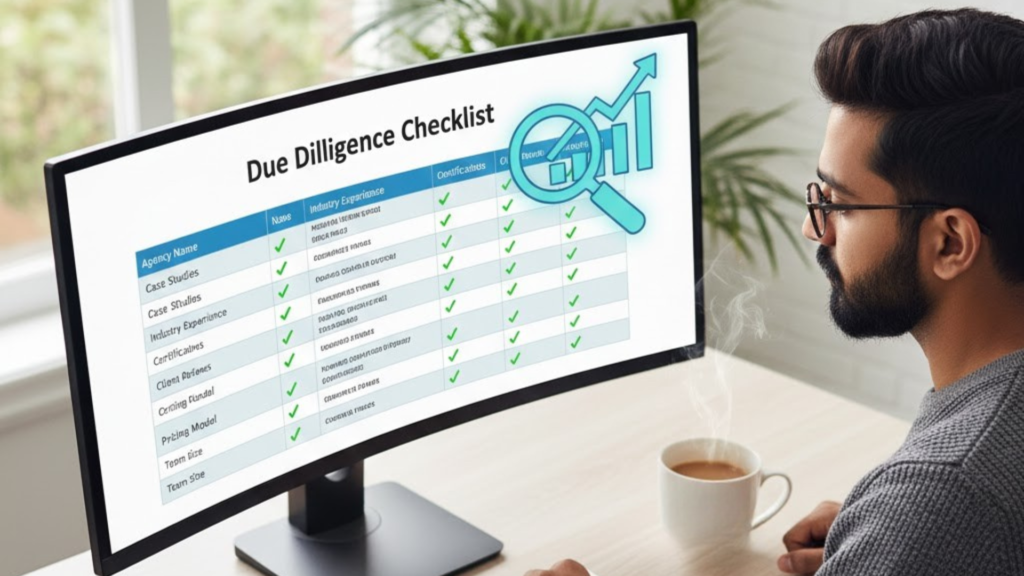
Once you have a list of potential partners, the vetting process must be rigorous and based on verifiable proof, not just glossy presentations.
2.1 The Portfolio and Case Study Deep Dive: How Top Online Marketing Companies Prove Their Expertise
A truly top-tier agency doesn’t just show off logos; they present compelling narratives of success.
- Look Beyond the ‘Big Names’: It’s easy to feature a well-known brand. Look for case studies that are relevant to your industry and your size.
- The “Before and After” Metrics: The study must quantify the results. Ask for the specific metrics achieved:
- SEO: Domain Authority (DA) increase, Keyword ranking positions, Organic Traffic (sessions).
- PPC: Return on Ad Spend (ROAS), Click-Through Rate (CTR), Conversion Rate (CVR).
- Social Media: Engagement Rate, Cost Per Lead (CPL), Audience Growth.
2.2 Certifications, Tools, and Technological Acumen: What Sets Top Online Marketing Companies Apart
Marketing is a blend of art and science. The science requires cutting-edge technology.
- Official Partnerships: Look for verifiable badges:
- Google Premier Partner: Indicates a high level of expertise in Google Ads.
- Meta Business Partner: Shows proficiency in Facebook and Instagram advertising.
- HubSpot/Salesforce Partnerships: Relevant if you need sophisticated CRM integration.
- Tech Stack Audit: Inquire about the premium, industry-standard tools they use for:
- SEO Research & Tracking: SEMrush, Ahrefs, Moz Pro.
- Analytics & Tagging: Google Analytics 4 (GA4), Google Tag Manager (GTM).
- Conversion Optimization: VWO (Visual Website Optimizer) or Optimizely.
2.3 Team Structure and Expertise: The Human Element
The people running your campaigns are more important than the agency name.
Key Personnel to Meet:
- Account Manager: The Single Point of Contact (SPOC) responsible for client communication.
- SEO Strategist: The expert responsible for organic ranking improvement.
- PPC Specialist: The person managing your advertising budgets and bids.
- Content Lead: The creator ensuring content meets the needs of the Indian market.
Part 3: Service Depth and Ethical Marketing Practices Followed by top online marketing companies
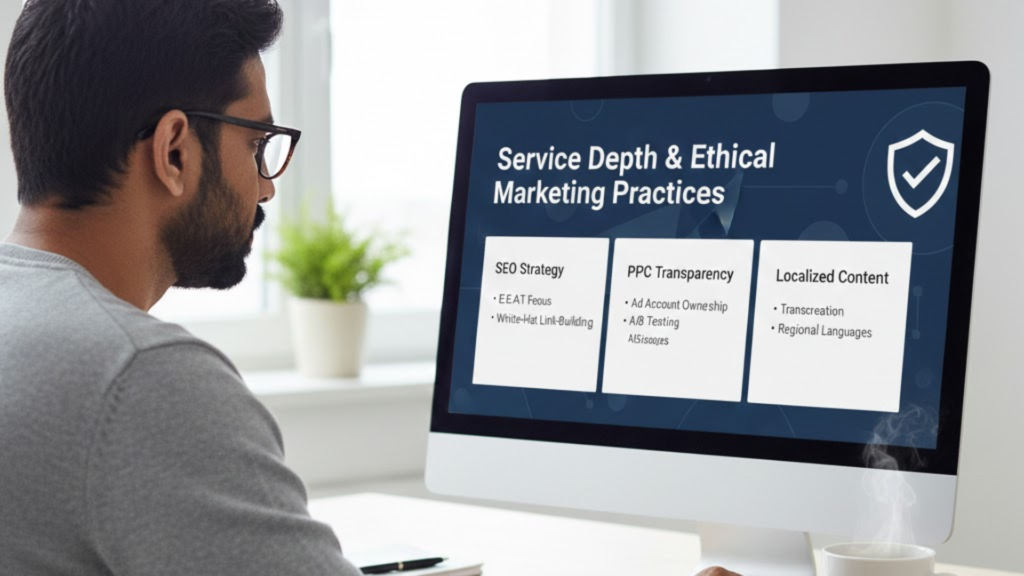
The true mark of a reliable partner is their commitment to ethical, sustainable growth.
3.1 Evaluating SEO Strategy: Quality Over Quantity
Avoid agencies that promise quick fixes. Top agencies refuse this approach.
- Ethical Link-Building: They should focus on earning high-quality, relevant links (Digital PR, content marketing) and not buying spammy links.
- E-E-A-T Focus: Their Content Strategy must prioritize creating helpful, reliable, and user-first content that satisfies Google’s Experience, Expertise, Authoritativeness, and Trustworthiness guidelines.
- Technical SEO: They must be capable of handling complex tasks like Core Web Vitals optimization and advanced schema markup implementation.
3.2 PPC and Ad Account Transparency
PPC (Pay-Per-Click) is where your money is spent directly. Maximum transparency is non-negotiable.
- Account Ownership: You must retain full administrative ownership and control of your Google Ads and other advertising accounts.
- Testing and Iteration: A top company is constantly running A/B tests on:
- Ad copy and creatives.
- Landing page design and messaging.
- Audience segmentation and targeting.
3.3 The Localized Content and Regional Language Advantage
For the Indian audience, localization is key. The agency must understand ‘Hinglish’ and regional nuances.
- Transcreation vs. Translation: Simple translation often fails. Transcreation is adapting content to the cultural and linguistic nuances of a specific region (e.g., using relevant festivals, local idioms).
- Optimization for Tier 2/3 Cities: Campaigns must be optimized for varying data speeds and mobile-first indexing, which is particularly relevant across smaller Indian cities.
Part 4: The Partnership Structure – Communication, Reporting, and Accountability
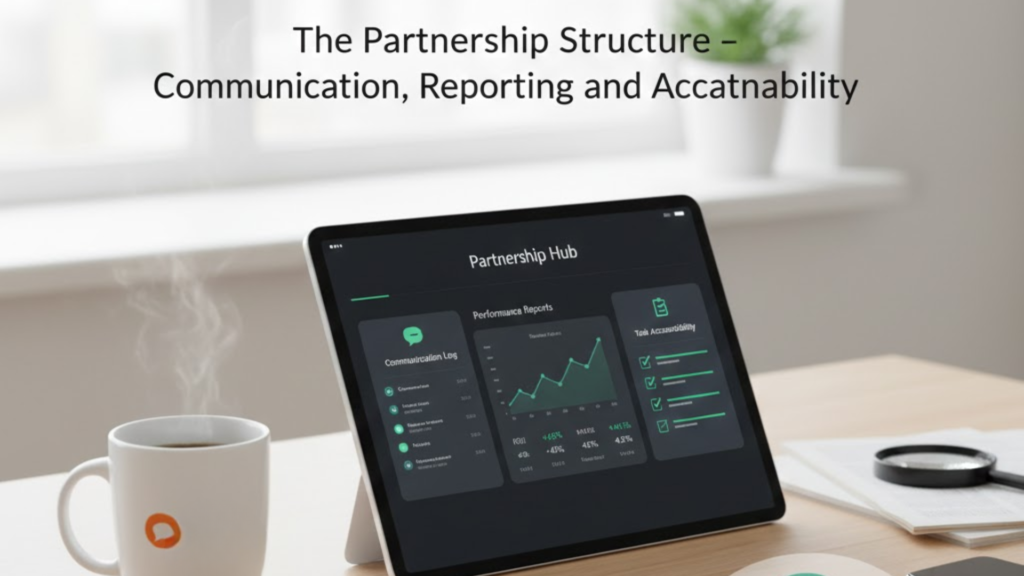
A contract is just a piece of paper; the partnership is built on reliable communication and concrete reporting.
4.1 Reporting Frequency and Depth
Reporting should move beyond vanity metrics (e.g., total likes) to focus on business impact (e.g., revenue generated).
Essential Reporting Elements:
- Performance vs. Goal (Did we meet the target? Why or why not?)
- Key Performance Indicators (KPIs) like ROI, CPA, and Lead Volume.
- Detailed breakdown of Media Spend vs. Service Fees.
- Proactive Strategic Insights (What will the agency do next month to address gaps?).
4.2 The Termination Clause and Flexibility
- Lock-in Period: Be wary of excessively long lock-in contracts (e.g., 12-18 months). Top agencies often offer shorter initial contracts (e.g., 3-6 months) based on performance.
- Data Handover: The contract must state that the agency will completely hand over all assets, data, ad account access, creative files, and documentation upon termination. Your digital assets belong to you.
Part 5: Final Evaluation – The Cultural and Trust Fit
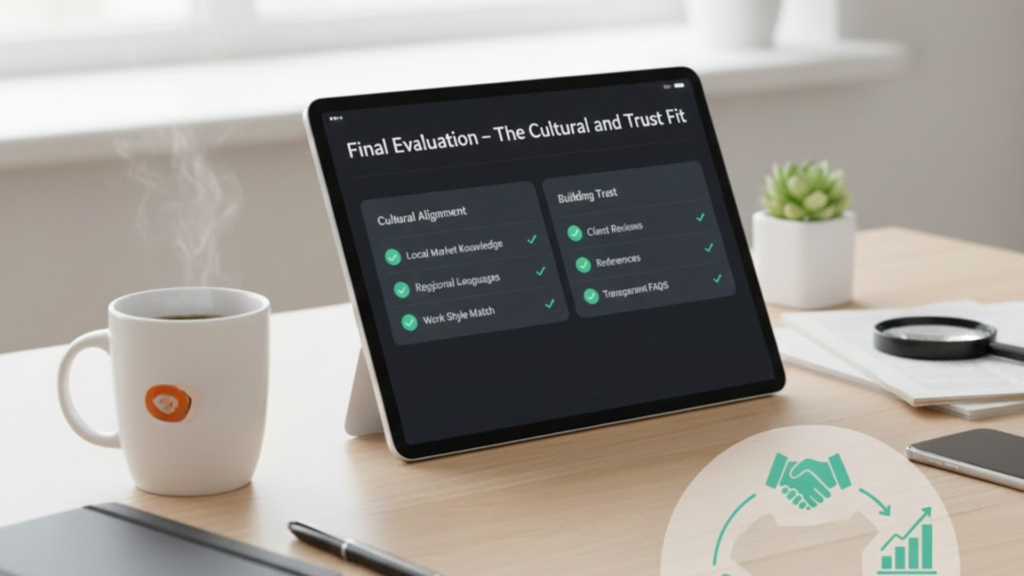
Ultimately, you are entering a relationship that requires a high degree of mutual trust.
5.1 Trustworthy Reviews and References
Beyond the website testimonials, conduct your own reference checks.
- Focus your questions on the following:
- How responsive and available is the team?
- Are the reports transparent and easy to understand?
- Did their service justify the cost (ROI)?
- Did they successfully achieve the goals initially set?
Frequently Asked Questions (FAQ)
Q1: What is the biggest red flag when selecting an online marketing company?
A: The biggest red flag is an agency that guarantees a #1 ranking on Google in 30 days or promises results that seem too good to be true. Sustainable, ethical growth takes time and hard work. Look for transparency, not unrealistic guarantees.
Q2: Should I choose a specialized agency (only SEO) or a full-service agency?
A: For most growing businesses in India (SMEs), a full-service agency is generally better. Digital marketing components (SEO, PPC, Social, Content) are heavily integrated. Using one agency ensures all efforts are coordinated and working towards a single goal, improving overall ROI.
Q3: How much budget should I allocate to media spend (ads) versus service fees?
A: This depends heavily on your industry. In general, for aggressive growth strategies, a common ratio for mid-sized campaigns is 70-80% media spend (the money paid to Google/Meta for ads) and 20-30% service fees (the agency’s management cost).
Q4: Why is Google Premier Partner status important for the Indian market?
A: Premier Partner status is Google’s highest tier and is reserved for the top 3% of agencies globally. In the competitive Indian landscape, it signals deep expertise, superior performance, and often access to Google’s early beta features and dedicated support, giving your campaigns an edge.
Conclusion
Choosing from the top online marketing companies in India is an investment, not an expense. The right partner will accelerate your business growth manifold, navigating the complexities of the diverse Indian digital landscape with expertise and integrity.
By diligently following this guide—focusing on clear goal definition, rigorous vetting of expertise and technology, adherence to ethical practices, and insistence on transparent communication—you will secure a trustworthy and result-driven alliance that ensures your business not only survives but thrives in the digital age.
Would you like me to create a specific scoring checklist based on these criteria that you can use when evaluating potential agencies?