If your agency, like many other online advertising companies, has successfully navigated the waters of B2C marketing—driving rapid clicks, social engagement, and quick e-commerce conversions—you’re ready for the next frontier: High-Value Enterprise Clients.
Winning large B2B contracts is not just about scaling your budget; it’s about a fundamental shift in strategy. The B2B sales cycle is longer, the decision-makers are more numerous, and the stakes are exponentially higher. Enterprise clients aren’t buying a service; they are buying a strategic partnership and a guaranteed ROI on their technology, marketing, or operations investment.
This comprehensive guide is designed to transform your existing service offerings into a robust B2B machine, providing the exact frameworks and strategies needed to attract, convert, and retain India’s top enterprise accounts.
1. Why Online Advertising Companies Need a New B2B Mindset
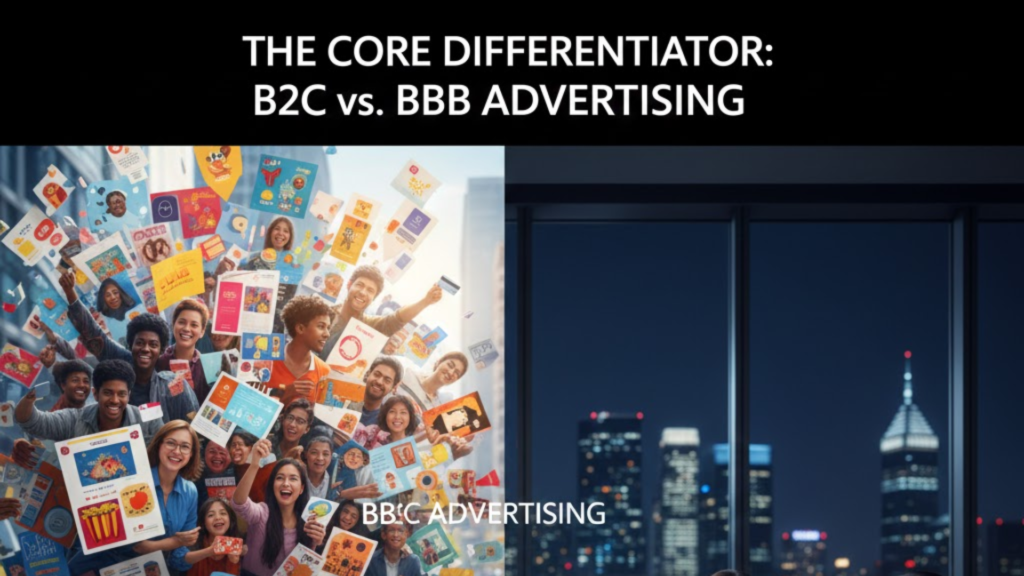
Many online advertising companies falter when transitioning to B2B because they treat it like a high-budget B2C campaign. The reality is profoundly different:
| Feature | B2C Advertising (Typical) | B2B Advertising (Enterprise Focus) |
| Decision Cycle | Short (Minutes to Days) | Long (3 to 18 Months) |
| Purchase Driver | Emotion, Price, Immediate Need | Logic, ROI, Risk Mitigation |
| Key Audience | Individual Consumer | Buying Committee (Multiple Stakeholders: IT Head, CFO, Marketing VP) |
| Primary Goal | High Volume of Transactions | High Quality of Leads (SQLs) and Revenue Attribution |
| Proof of Value | Low CPC/High CTR | Closed-Loop Reporting showing Revenue Generated |
Phase 1: How online advertising companies Use ABM for Precision Targeting
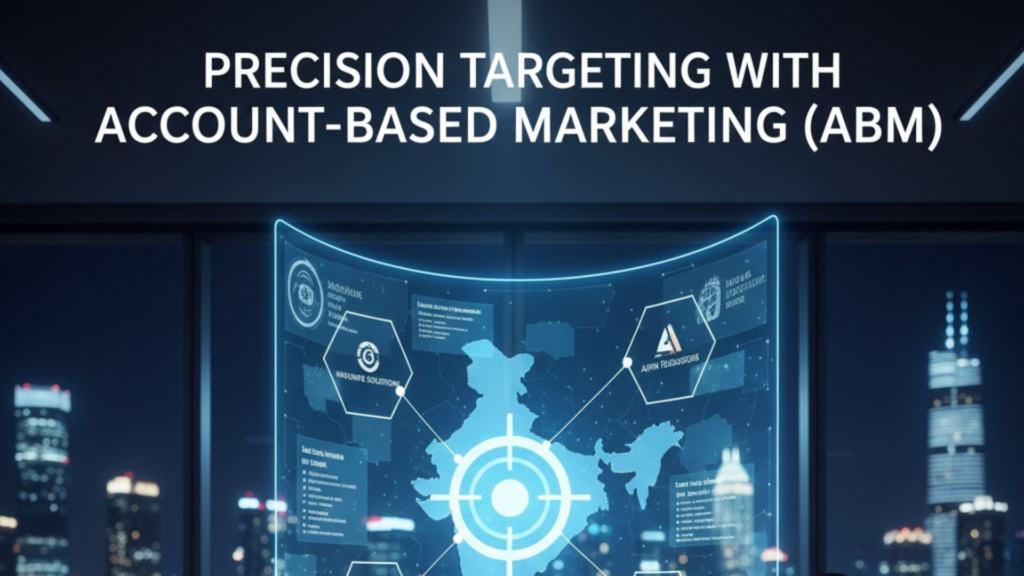
The era of spraying and praying is over. For enterprise clients, the most effective strategy is Account-Based Marketing (ABM), a strategy where marketing treats specific target accounts as markets of one.
A. Building an ICP for online advertising companies Targeting Enterprise Clients
Before spending a single rupee, define your Ideal Client Profile (ICP). This goes beyond demographics:
- Firmographics: Industry (e.g., FinTech, Manufacturing, Logistics), Employee Count Annual Revenue, and Technology Stack used.
- Technographics: What software (CRMs, Marketing Automation, ERPs) do they currently use? Agencies should target companies where their service plugs a technological gap.
- The “Why”: What specific, high-stakes problem do you solve for them?
Once the ICP is defined, create a list of the top 100-200 target accounts in the Indian market.
B. Channel Selection: The B2B Power Trio
As an online advertising company, your channel mix must shift away from reliance on broad Meta (Facebook/Instagram) targeting.
- LinkedIn Advertising (The Linchpin): Unbeatable for B2B. Target specific job titles, company names, industry groups, and even company size. Use high-value content (e.g., industry benchmark reports) to capture interest.
- Google Search Ads (Intent Capture): Target high-intent, long-tail keywords that signal a purchasing decision is imminent (e.g., “Best CRM for mid-sized IT company in Bangalore,” “Salesforce integration partners India”).
- Programmatic Retargeting (Brand Presence): Once a decision-maker from your target list visits your site (or the client’s site), follow them across the web with relevant banner ads and case studies. This ensures top-of-mind recall during their extended buying cycle.
Phase 2: Content Strategy – Establishing Trust and Authority

In B2B, the client’s agency selection is often a career decision for the stakeholders involved. They choose the agency they trust the most. Your content, supported by your ads, must build that trust.
A. Mapping Content to the B2B Sales Funnel
Your ads must serve different content at different stages of the customer journey.
| Sales Funnel Stage | Content Type to Promote | Best Ad Format/Channel |
| Awareness | Thought leadership articles, Industry Trends Reports, State of [Industry] in India. | LinkedIn Feed Ads, Native Ads, Display Ads. |
| Discovery | White Papers, Educational Webinars, Benchmarking Studies | LinkedIn Lead Forms, Gated Content Ads. |
| Evaluation | Detailed Case Studies Competitive Comparison Guides, Analyst Reports. | Retargeting Ads, Personalized Email Campaigns. |
| Intent/Purchase | Free Consultations, Customized Audit Offers, Live Demos, Pricing Guides. | Google Search Ads (High Intent), Direct Messaging on LinkedIn. |
*(Reference the stages: Awareness, Discovery, Evaluation, Intent, Purchase, Loyalty –
B. The Case Study Imperative
For an enterprise client, the most powerful content is a success story featuring a company similar to theirs. Online advertising companies must invest heavily in creating in-depth, quantitative case studies.
- Indian Context: Highlight case studies of successful transformations within the Indian regulatory and economic environment, as this builds immediate credibility with local stakeholders.
Phase 3: Conversion and Closing – The Pitch and the Proof
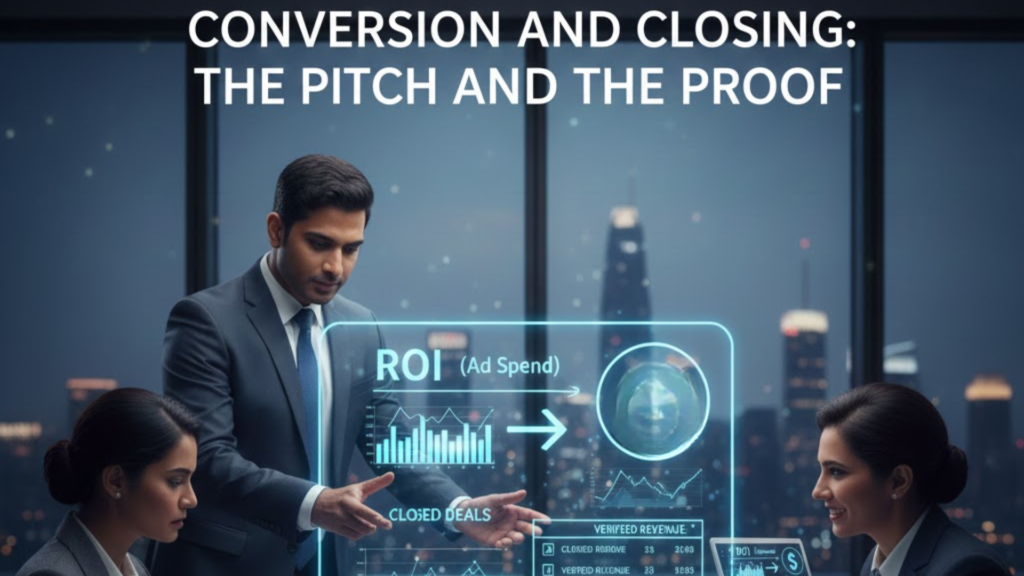
A high-value enterprise lead is not a conversion; it’s an opportunity for a high-stakes conversation. Your strategy must align your advertising results directly with the client’s revenue goals.
A. Moving from MQL to SQL (Marketing Qualified Lead to Sales Qualified Lead)
The goal of B2B advertising is to generate SQLs, not just MQLs. Your agency must implement rigorous lead scoring:
- Lead Scoring: Assign points based on the prospect’s actions (e.g., Downloaded White Paper: 10 points; Viewed Pricing Page: 25 points; Requested a Demo: 50 points).
- Hand-off Threshold: The moment a lead crosses the predefined score (e.g., 60 points), it is immediately handed to the sales team for personalized outreach.
B. The Power of Closed-Loop Reporting (CLR)
This is the single most important differentiator for top online advertising companies. Enterprise clients will not tolerate siloed data. They demand to know: “If I invest $X$ in your ads, how much verified revenue will I get back?”
- Integration: Seamlessly integrate your advertising platforms (Google Ads, LinkedIn) with the client’s CRM (e.g., Salesforce, HubSpot).
- Attribution: Set up a system (like a UTM structure combined with CRM tracking) that attributes every single lead, opportunity, and finally, closed deal back to the original ad campaign and keyword.
- Metrics to Track: Focus relentlessly on Customer Acquisition Cost (CAC) and Customer Lifetime Value (CLV) relative to ad spend. Show them the formula:
By presenting the data through the lens of verifiable revenue (the formula below), you move from being a vendor to a trusted financial partner.
Phase 4: Long-Term Retention and Scalability

Winning the first contract is only half the battle. Enterprise clients seek long-term partners for stability and scalability.
A. Strategic Quarterly Business Reviews (QBRs)
Replace routine monthly reporting with strategic QBRs. These meetings should focus not on last month’s clicks, but on next quarter’s strategic growth plan and market shifts.
Key Components of a Successful QBR:
- Market Analysis: Discussion of new competitors, technological advances (like AI in creative optimization), and regulatory changes.
- Proactive Recommendations: Present new growth channels (e.g., moving from pure Search to Connected TV/OTT advertising) that demonstrate your agency is thinking ahead of the curve.
- Action Plan: Clear, measurable goals for the upcoming quarter.
B. Building Trust with Transparency and Risk Mitigation
Enterprise deals often involve significant budget commitments. You must address their biggest fear: Risk.
- Pilot Programs: Offer structured pilot programs with clearly defined, measurable goals (e.g., “We guarantee 15 SQLs in the first 90 days.”)
- Operational Transparency: Clearly explain the agency’s operational processes, data security protocols, and who exactly will be managing their account (highlighting senior expertise). This human element builds confidence in a digital-first world.
Frequently Asked Questions (FAQ) for B2B Ad Agencies
Q1: What is the single biggest mistake online advertising companies make in B2B?
A: The biggest mistake is focusing on Volume over Quality. B2C optimizes for the lowest ; B2B must optimize for the lowest Cost Per Qualified Lead (CPQL).
Q2: How do we prove ROI when the sales cycle is 6+ months?
A: You must implement Closed-Loop Reporting (CLR). This involves integrating the ad platform data with the client’s CRM. This allows you to report on Pipeline Generated and Revenue Influenced, even if the deal hasn’t closed yet. This shows the client the immediate value of your advertising investment.
Q3: Which channel is most crucial for reaching the Indian B2B C-Suite?
A: LinkedIn Advertising is currently the most critical channel for reaching senior decision-makers in the Indian B2B landscape. However, its cost requires precise targeting and content must be high-value (White Papers, Webinars) to justify the spend.
Conclusion: Elevating Your Agency’s Status
The journey from a tactical online advertising company to an enterprise-focused strategic partner requires commitment, technological integration, and deep market understanding.
By implementing a rigorous ABM strategy, developing authority-based content that maps to the complex B2B sales cycle, and providing closed-loop reporting that ties every dollar spent to verified revenue, your agency will secure a seat at the table with India’s most valuable enterprise clients.