In the hyper-accelerated digital landscape of India, where technology adoption is surging and consumer behavior changes with every new app launch, the longevity of your Marketing Strategy is constantly under threat. What generated remarkable ROI yesterday might be obsolete tomorrow.
To succeed in 2026 and beyond, businesses operating in the Indian market must shift from reactive marketing to proactive, future-proof strategy design. Future-proofing means building a resilient, agile, and technologically adaptable framework.
This comprehensive guide delves into the seven essential pillars required to construct a truly future-proof Marketing Strategy tailored specifically for the Indian consumer.
Pillar 1: Marketing Strategy for the First-Party Data Mandate & Privacy Resilience

The global deprecation of third-party cookies and the implementation of strict data protection laws, such as India’s Digital Personal Data Protection Act (DPDP Act) 2023, have fundamentally changed data handling. A future-proof Marketing Strategy must be built on the bedrock of ethical, consent-driven, First-Party Data collection.
1.1 Marketing Strategy for Building a Robust First-Party Data Capture System
To secure reliable data sources, focus on:
- Own the Data Relationship: Utilize your owned assets (website, app, CRM) for direct data collection.
- Zero-Party Data Integration:Actively ask consumers for their preferences and intentions using:
- Quizzes and Polls
- Interactive Preference Centers
- Value-Exchange Registration Forms
- Transparent Consent: Ensure consent mechanisms are explicit, understandable, and compliant with the DPDP Act. Trust is the new currency.
1.2 Marketing Strategy Benefits of Investing in a CDP (Customer Data Platform)
For scale, a CDP is non-negotiable. It helps:
| CDP Function | Strategic Benefit (Indian Context) |
| Unification | Creates a single, comprehensive profile from fragmented regional data. |
| Activation | Enables hyper-personalized targeting across all channels. |
| Compliance | Centralizes data handling for easy regulatory alignment. |
Pillar 2: Marketing Strategy for the Agility Framework – Rapid Response Marketing
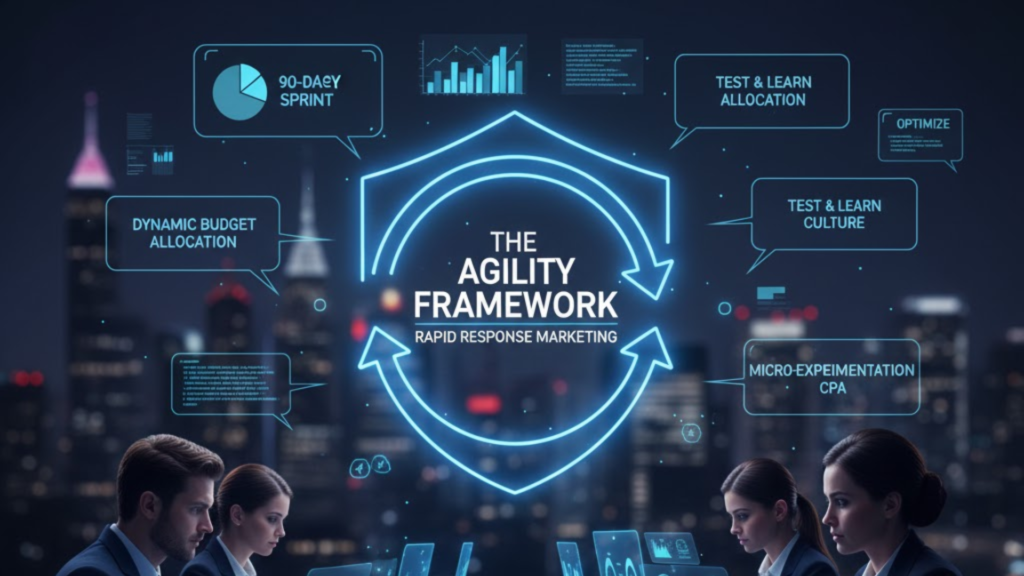
In the Indian market, speed is paramount. Rigid, 12-month annual plans are a liability.
2.1 Marketing Strategy for Implementing a Test-and-Learn Culture
Adopt a continuous improvement cycle:
- Micro-Experimentation: Dedicate a small, fixed budget portion (e.g., 5-10%) to testing new platforms (like emerging regional apps) and unconventional messaging.
- The 90-Day Strategy Sprint: Break the annual Marketing Strategy into quarterly sprints. At the end of each sprint, conduct a performance audit focusing on three core questions:
- What market signals require immediate strategic adjustment?
- Where should we immediately shift the budget?
- Which campaigns should be scaled or killed?
- Dynamic Budget Allocation: Adopt a fluid budget model, ready to reallocate funds instantly based on data. Be quick to double down on success.
Pillar 3: AI-Enabled Personalization and Efficiency

AI is the most powerful tool for future-proofing your Marketing Strategy, essential for handling India’s vast diversity.
3.1 Personalization at Scale
Leverage AI to achieve true one-on-one marketing:
- Predictive Analytics: Use AI to predict churn risk and the optimal next action for a customer.
- Dynamic Content Optimization (DCO): Automatically adjust website copy, email subject lines, and banner ads based on the individual visitor’s real-time characteristics.
- Hyper-Localized Recommendations: Ensure product/content recommendations are relevant to the user’s history, location, current weather, and local events.
3.2 Automated Workflows and Team Augmentation
- Generative AI for Content: Use tools to rapidly generate drafts for ad copy and outlines, freeing up human writers for strategic editing and localized finesse.
- Intelligent Optimization: Leverage AI-powered bidding in ad platforms to optimize campaign performance automatically.
- Conversational AI: Deploy sophisticated chatbots that can handle complex queries in multiple Indian languages, escalating only high-value issues to human agents.
Pillar 4: Deep Localization and Vernacular Dominance
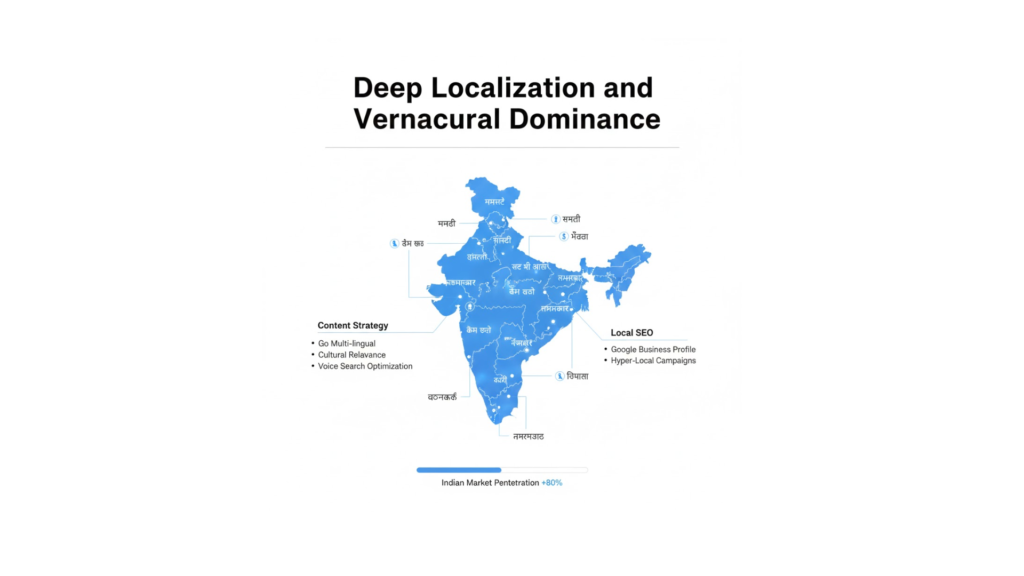
The next wave of Indian internet users comes from non-metro areas and consumes content in regional languages.
4.1 Vernacular Content Strategy
Localization requires strategic effort:
- Go Multi-lingual: Scale content beyond English/Hindi to Marathi, Bengali, Tamil, Telugu, and others.
- Cultural Relevance: Adapt imagery, cultural references, and seasonal context. A generic strategy will fail in India.
- Voice Search Optimization: Optimize content to answer questions phrased in a natural, conversational, vernacular style.
4.2 Local SEO and Geotargeting Mastery
- Google Business Profile (GBP) Dominance: Master GMB/GBP. Ensure listings are perfectly optimized and updated with regional holidays and hours.
- Hyper-Local Campaigns: Utilize geotargeting to run highly specific campaigns within a 1-5 km radius of physical locations.
Pillar 5: Diversifying Beyond Traditional Platforms
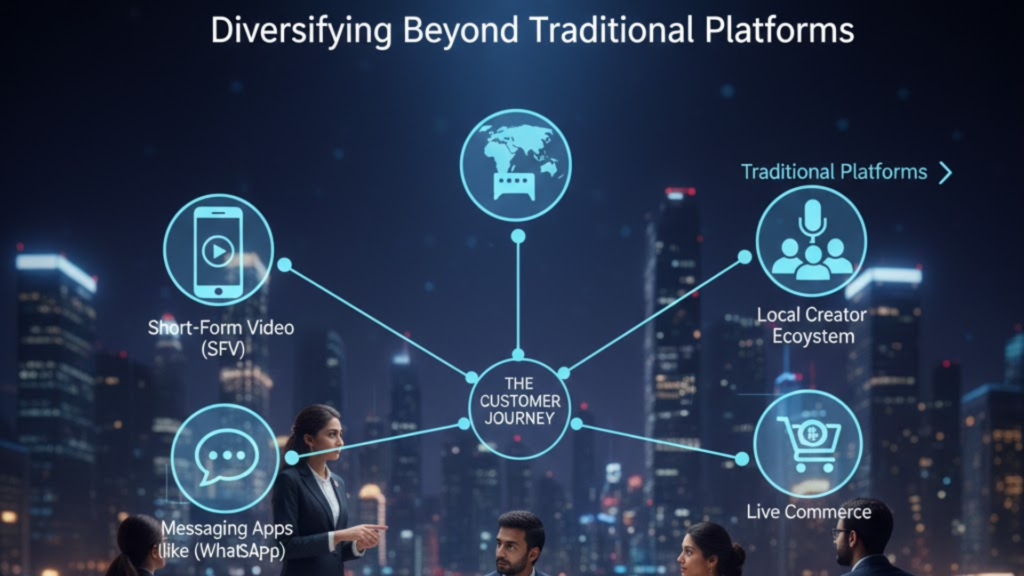
Over-reliance on any single platform is a major risk. Fragmented platforms require a fragmented, diverse strategy.
| Platform Type | Focus Area | Why it’s Critical for Future-Proofing |
| Short-Form Video (SFV) | Reels, YouTube Shorts | Primary consumption channel for young India; high engagement rates. |
| Messaging Apps | WhatsApp Business, Telegram | Direct, highly personal communication; high open rates. |
| Local Creator Ecosystem | Micro/Nano-Influencers | Higher trust, better niche engagement, and cost-effective reach. |
| Live Commerce | Amazon Live, dedicated streams | Blends entertainment, instant purchasing, and high conversion. |
Pillar 6: Measuring and Proving Long-Term Value
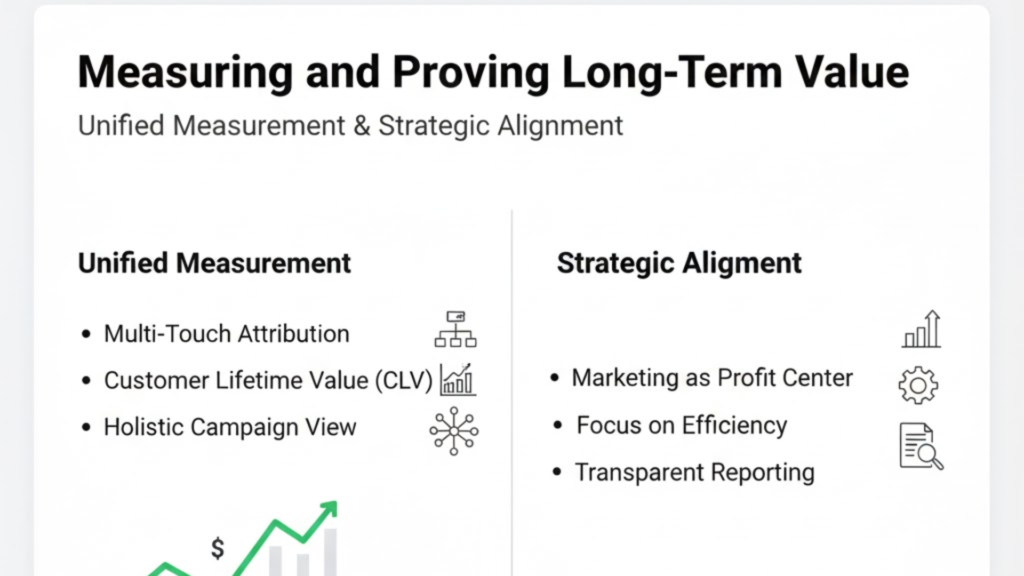
A future-proof Marketing Strategy prioritizes demonstrating long-term value over short-term gains.
6.1 Unified Measurement and Attribution
- Multi-Touch Attribution: Implement analytics that tracks the full customer journey across channels
- Customer Lifetime Value (CLV): CLV must be the ultimate metric. Prioritize activities that boost retention, repeat purchases, and referrals.
6.2 Strategic Alignment with Business Outcomes
- Marketing as a Profit Center: Frame your strategy as a direct revenue driver.
- Focus on Efficiency: Use marketing efforts to reduce costs (e.g., excellent FAQ content reduces customer service costs).
Frequently Asked Questions (FAQ)
Q1. What does ‘Future-Proofing’ mean for an Indian SME?
A1. For a Small and Medium Enterprise (SME) in India, future-proofing primarily means being agile and data-conscious. Focus less on massive ad spends and more on First-Party Data collection, mastering your local Google Business Profile, and investing in vernacular video content (Pillars 1, 4, and 5).
Q2. Is the DPDP Act 2023 only for large corporations?
A2. No. While large corporations face higher penalties, the DPDP Act’s principles of explicit consent and data minimization apply to almost all businesses that process Indian citizen data. Every marketer must review their consent forms.
Q3. How can I balance short-term sales with a long-term strategy?
A3. Dedicate a specific, smaller portion of your budget (e.g., 20%) to short-term, high-conversion campaigns (like flash sales). Dedicate the remaining 80% to long-term brand building, content creation, and data infrastructure (Pillars 3, 4, 6) which secure your future growth.
Conclusion: The Resilient Marketer
Future-proofing your Marketing Strategy in the Indian market is not about predicting the future; it’s about building a house strong enough to withstand any storm.
By focusing on ethical First-Party Data collection, embracing strategic Agility, augmenting human intelligence with AI, dominating Vernacular content, diversifying your platform mix, and accurately measuring Long-Term Value, you move your organization from merely surviving to strategically thriving in the coming decade.
The resilient marketer is the one who accepts constant change and incorporates the flexibility to adapt into the core DNA of their Marketing Strategy.