If you run a solar EPC, installation, or dealership business in India, you likely face this recurring roadblock: “We have the technical capacity to install, but where do we find genuine, high-intent customers every month?”Most solar companies rely on buying shared databases from aggregators like IndiaMART or Justdial. The outcome is almost always the same: five different installers call the same contact, the prospect gets irritated, or they say, “I just clicked to check the price, I’m not looking to buy.”Relying on recycled data prevents you from building a scalable, predictable business. If your goal is to generate 100+ high-intent, exclusive solar leads every month—prospects who want to work specifically with your brand—you need to build your own direct customer acquisition engine.
Here is a practical, field-tested guide on how Indian solar companies can build a predictable pipeline of exclusive solar leads.
Shared Leads vs. Exclusive Solar Leads: The Core Difference
Many business owners chase sheer lead volume rather than pipeline quality. The structural economics of the two models differ significantly:
| Parameter | Shared Leads (Third-Party Portals) | Exclusive Solar Leads (Self-Generated) |
| Competition | 4–6 local competitors call the exact same number | 100% exclusive to your company |
| Pricing Leverage | Fierce price wars; customer searches for the cheapest bid | Value-driven; customer trusts your specific brand |
| Conversion Rate | Typically 1% to 3% | Typically 8% to 15% |
| Customer Intent | Often casual browsers, students, or tenants | Verified homeowners actively planning an installation |
When you generate exclusive solar leads, homeowners recognize your brand name from the creative, making pickup rates, trust, and site-visit bookings significantly higher.
1. Meta Ads (Facebook & Instagram): Volume and Local Reach
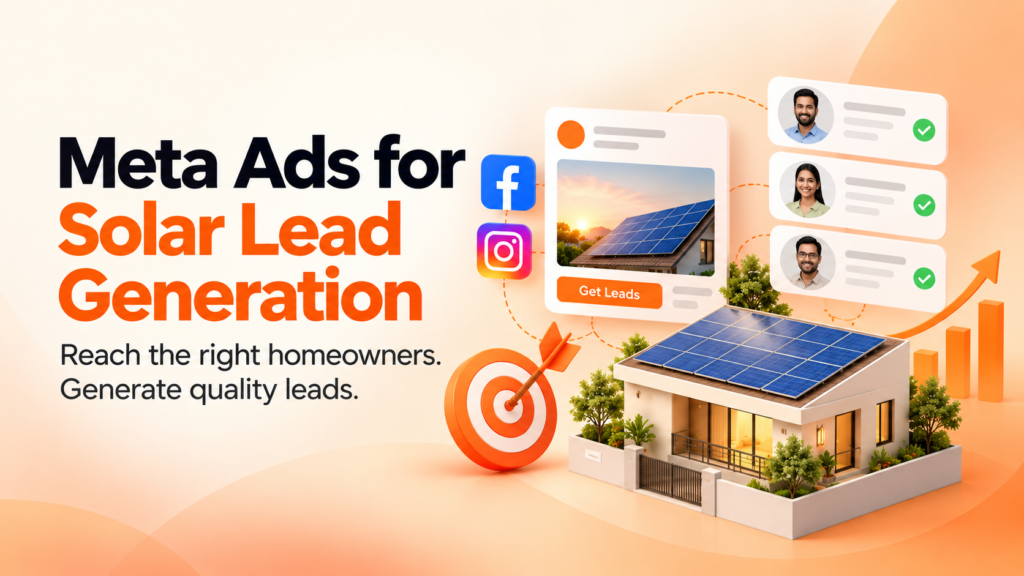
For residential rooftop systems (1kW to 10kW), Meta Ads remain the most cost-effective acquisition channel in India across Tier-1, Tier-2, and Tier-3 cities. Decision-makers aged 30–55 spend substantial daily time on these feeds.
Precise Setup Tactics
- Hyper-Local Targeting: Instead of running ads state-wide, target specific affluent PIN codes and established residential colonies with independent houses, villas, and bungalows.
- Age Group: 32 to 58 years old (the primary demographic controlling household capital expenditure).
- Demographic Filters: Exclude renters, college students, and generic low-intent audiences.
High-Converting Creative Angles
- Hyper-Local Social Proof: Run visual case studies from the same locality (e.g., “Mr. Sharma from Mansarovar reduced his monthly electricity bill to zero with a 3kW system”). Local references establish immediate trust.
- Government Subsidy Hooks: Highlight central support under schemes like the PM Surya Ghar: Muft Bijli Yojana (up to ₹78,000 central financial assistance) alongside net-metering advantages.
- Real Installation Videos: Avoid generic stock footage. Use short, 30-second clips of your actual installation crew mounting panels, testing inverters, and showcasing the final setup.
2. Qualifying Questions in Instant Forms: Eliminating Junk Data
A common mistake with Meta instant forms is requesting only a name and phone number. This invites accidental submissions and casual inquiries. To secure high-converting solar leads, add 2–3 mandatory screening questions:
- Do you own the property and roof? (Yes, own pucca roof / No, rented property)
- What is your average monthly electricity bill? (Under ₹1,500 / ₹1,500–₹3,000 / Above ₹3,000)
- When do you plan to install? (Immediately / Within 30 days / Just exploring)
Rule of Thumb: If an inquiry indicates a rented property or a bill below ₹1,000, divert that contact away from direct phone calls. Filtering at the form level saves your sales team 40–50% of wasted calling hours.
3. Google Ads: Capturing Active, Commercial-Intent Searchers
Prospects who search on Google are further down the purchase funnel than passive social media scrollers. When someone searches:
- “best rooftop solar panel installer near me”
- “3kw on-grid solar system price with subsidy in [City]”
They are actively seeking an installer, not browsing casually.
- Target Intent-Rich Long-Tail Keywords: Avoid bidding broadly on terms like “solar”. Instead, target exact and phrase matches like “residential rooftop solar installer in [City]” or “home solar subsidy consultant”.
- Dedicated Savings Calculator Page: Direct clicks to an interactive landing page where users enter their monthly bill amount to estimate system size (kW), required roof area, and expected annual savings.
4. Google Business Profile (Local SEO): Zero-Cost Inbound Calls
Local rooftop installations rely heavily on neighborhood credibility. An optimized Google Business Profile can generate consistent high-intent inbound inquiries without ongoing media spend.
- Accurate Primary Category: Set your main business category as Solar Energy Contractor or Solar Energy Equipment Supplier.
- Weekly Project Updates: Upload weekly geotagged photos of completed rooftops, clearly showing panel alignment, inverter wiring, and team members in branded safety gear.
- Structured Review Collection: Implement a standard operating procedure where technicians request a 5-star review and a brief homeowner testimonial immediately following grid synchronization.
5. The 100+ Monthly Lead Acquisition Mix
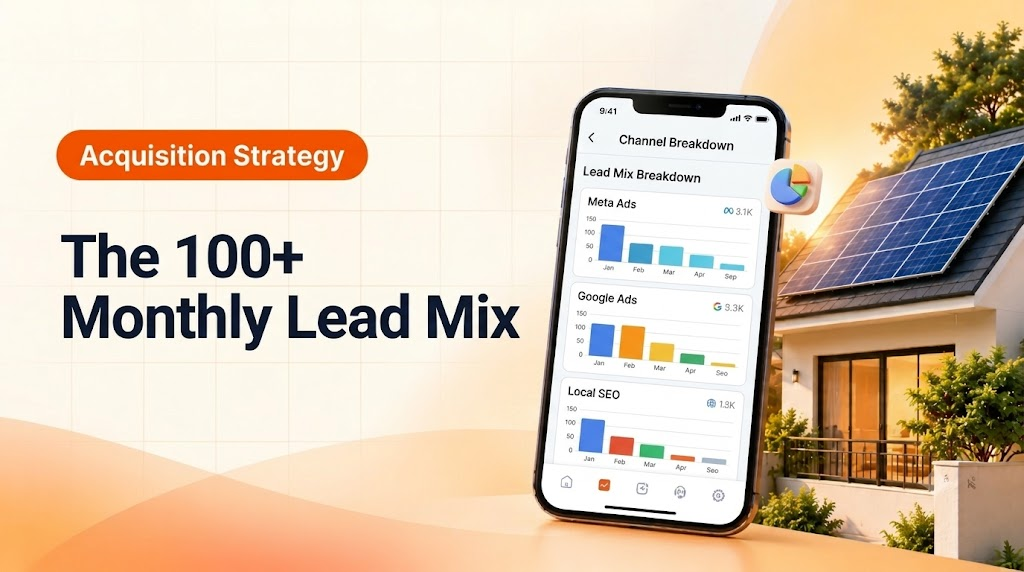
To reliably generate 100+ qualified leads per month, distribute your budget and channels across a balanced structure:
[Monthly Target: 100+ Qualified Leads]
│
├── Meta Ads (Facebook/Instagram) ─── 60–70 Leads (Avg. CPL: ₹180 – ₹350)
├── Google Search Ads ─────────────── 20–25 Leads (Avg. CPL: ₹450 – ₹850)
└── Google Maps / Local SEO ───────── 15–20 Inbound Calls (₹0 Organic Acquisition)
This distribution blends fast volume from social ads with the higher conversion velocity of search queries, while organic search keeps the blended Cost Per Lead (CPL) sustainable.
6. Closing the Loop: The Speed-to-Lead Protocol
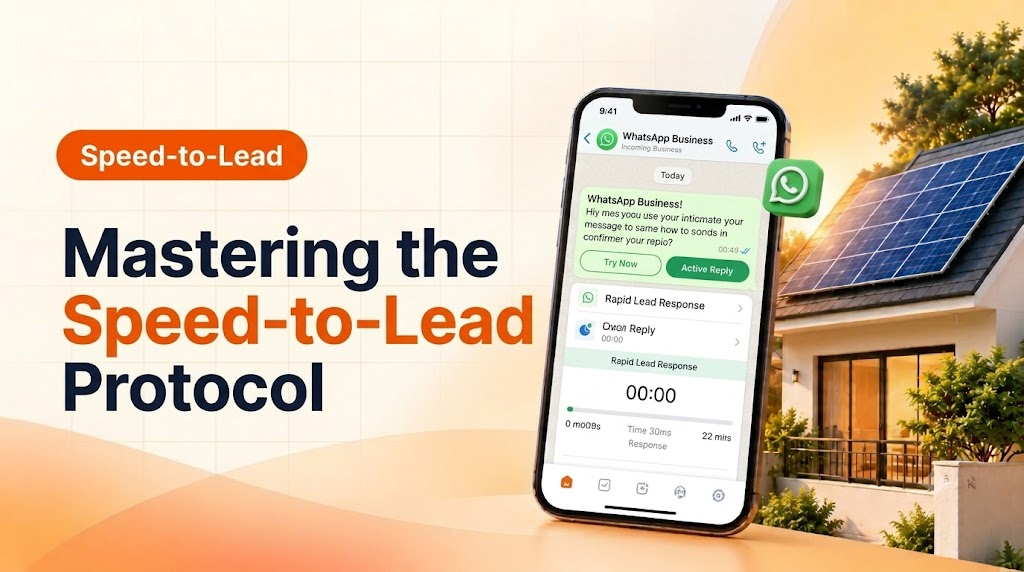
In the solar industry, up to 60% of viable deals are lost not to price competition, but to slow follow-ups.
- The 10-Minute Contact Rule: Aim to place the initial discovery call within 10 minutes of form submission during business hours. Lead responsiveness drops sharply after the first hour.
- Instant WhatsApp Acknowledgement: Automate an immediate message via WhatsApp:
“Hello [Name], thank you for reaching out to [Company]. We are preparing your rooftop solar savings and subsidy breakdown. Our solar technical advisor will call you within 15 minutes.” - The Goal of Call #1: Never attempt to close a ₹2–3 lakh contract over an initial cold call. The sole objective of the first conversation is to confirm roof ownership, verify the electricity bill, and book an on-site shadow analysis and roof survey. Once your technician physically measures the roof, deal conversion probability rises sharply.
Frequently Asked Questions (FAQs)
Q1. What is the average Cost Per Lead (CPL) for residential solar in India?
Well-optimized Meta Lead campaigns in India typically produce qualified residential inquiries between ₹180 and ₹350. Google Search Ads carry a higher CPL—often ₹450 to ₹850—due to direct commercial search intent and higher conversion velocity.
Q2. Are online ads effective for solar lead generation in Tier-2 and Tier-3 cities?
Yes. Awareness driven by government rooftop subsidy programs has created strong demand outside metro areas. Short, straightforward video ads shot on actual job sites and delivered in regional languages frequently outperform slick corporate graphics in these markets.
Q3. What is a realistic lead-to-installation conversion benchmark?
For self-generated, exclusive leads that undergo an on-site survey within 48 hours, a structured sales team typically converts 8% to 12% into signed installation contracts.