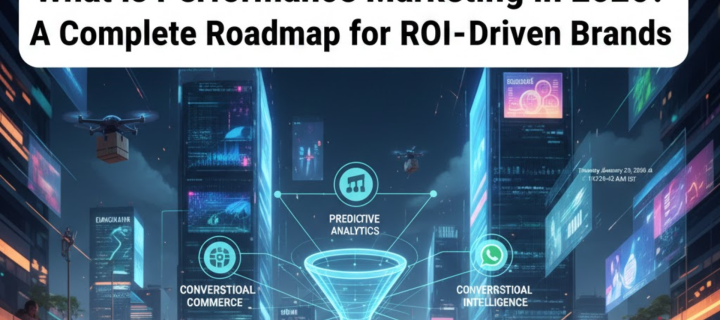
The digital marketing landscape in India has officially entered the “Intelligence Era.” If you are asking “what is performance marketing in 2026,” you aren’t just looking for a definition; you are looking for a survival guide. In a world where AI agents negotiate ad placements and privacy laws have reshaped tracking, performance marketing has become the ultimate bridge between “Brand Spending” and “Business Revenue.”
1. The 2026 Shift: From Clicks to Conversational Commerce – What Is Performance Marketing in 2026?
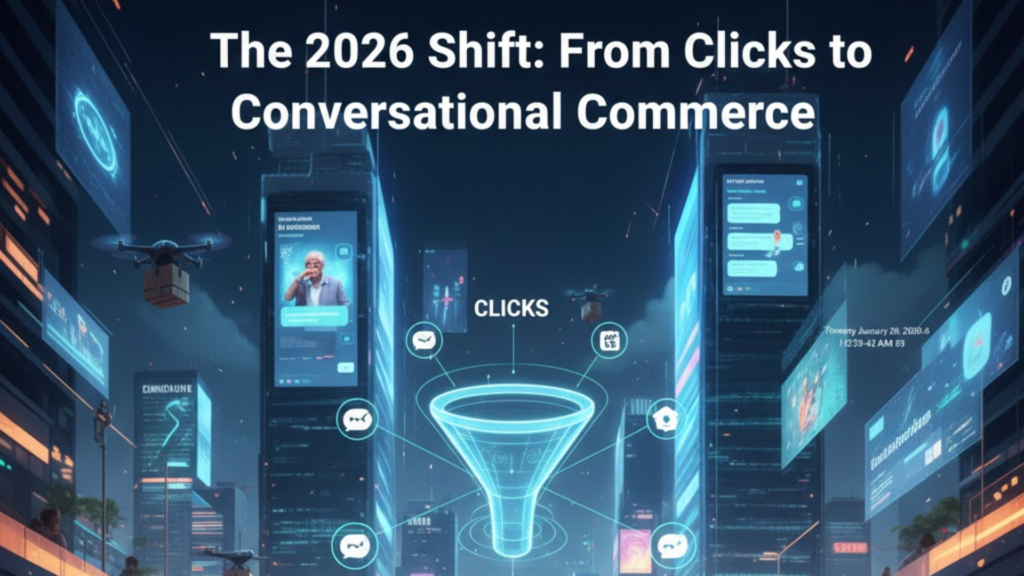
In 2026, the traditional marketing funnel has collapsed. The journey from “Discovery” to “Purchase” now happens in seconds, often within a single app like WhatsApp or Instagram.
The Evolution of the Metric
For years, marketers were obsessed with CTR (Click-Through Rate) and CPC (Cost Per Click). However, in 2026, these are considered “vanity metrics.” Indian brands have realized that a click doesn’t pay the bills—profit does.
Performance Marketing today is a data-driven strategy where every rupee spent is tied to a specific, measurable outcome. But unlike the past, these outcomes are now driven by Autonomous AI Orchestration. We have moved from “Spray and Pray” to “Predict and Provide.”
Why 2026 is Different for India
With over 900 million internet users, India is the world’s most competitive digital battleground. Performance marketing in 2026 must account for:
- The Data Privacy Act (DPDP): Strict Indian regulations on how consumer data is handled.
- The UPI Revolution: Instant payments making high-velocity commerce possible.
- The Bandwidth Leap: 6G trials in metros making AR/VR ads a reality.
2. The Core Pillars of Performance Marketing in 2026: What Is Performance Marketing in 2026?
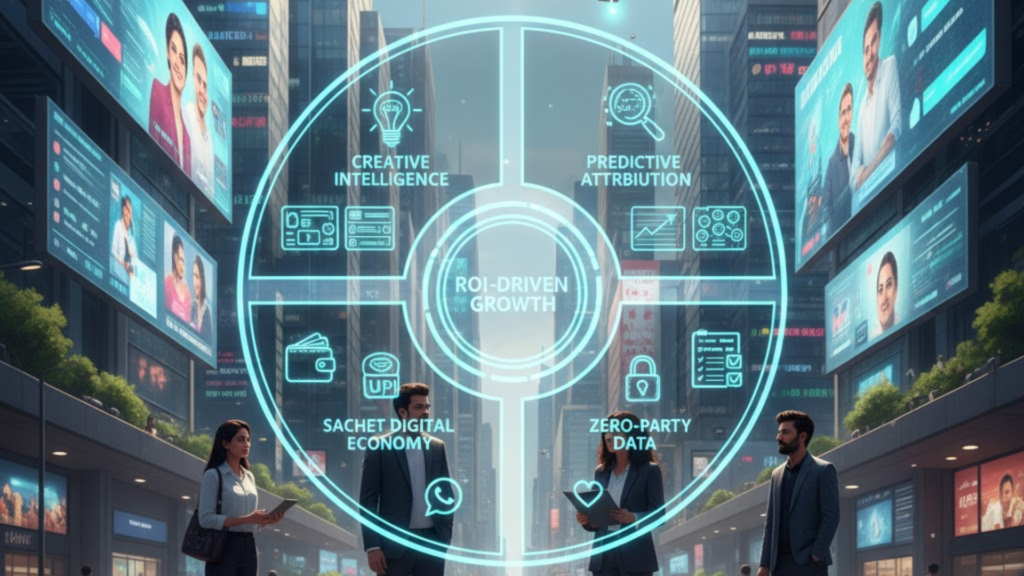
To understand the current ecosystem, we must look at the four pillars that support every successful Indian brand today:
A. Creative Intelligence (The New Targeting)
In the “Cookie-less” world of 2026, you can no longer “stalk” users across the web using third-party data. Instead, the creative does the targeting.
- Dynamic Creative Optimization (DCO): AI now generates 1,000+ versions of a single ad, testing different hooks, colors, and languages (Hindi, Tamil, Bengali) in real-time based on who is watching.
- The 1.5-Second Hook: In 2026, the human attention span has stabilized at a very low level. Performance ads now use “Micro-Psychology” to grab attention in less than two seconds.
- Interactive Ads: 2026 is the year of “Gamified Ads” where users interact with the creative (swipe to dress a model, tilt to see a product) to get a personalized discount.
B. Predictive Attribution Models
We have moved past “Last-Click Attribution.” Modern Indian brands use Marketing Mix Modeling (MMM) combined with AI to predict how an ad shown on a Connected TV (CTV) during a cricket match influenced a purchase made on a mobile phone three days later.
C. The “Sachet” Digital Economy
In India, performance marketing thrives on the micro-transaction model. Brands are using performance ads to sell low-ticket “entry” products (the digital version of a ₹1 shampoo sachet) via UPI, then using AI-driven WhatsApp automation to upsell high-ticket items.
3. Comparing the Evolution: 2024 vs. 2026
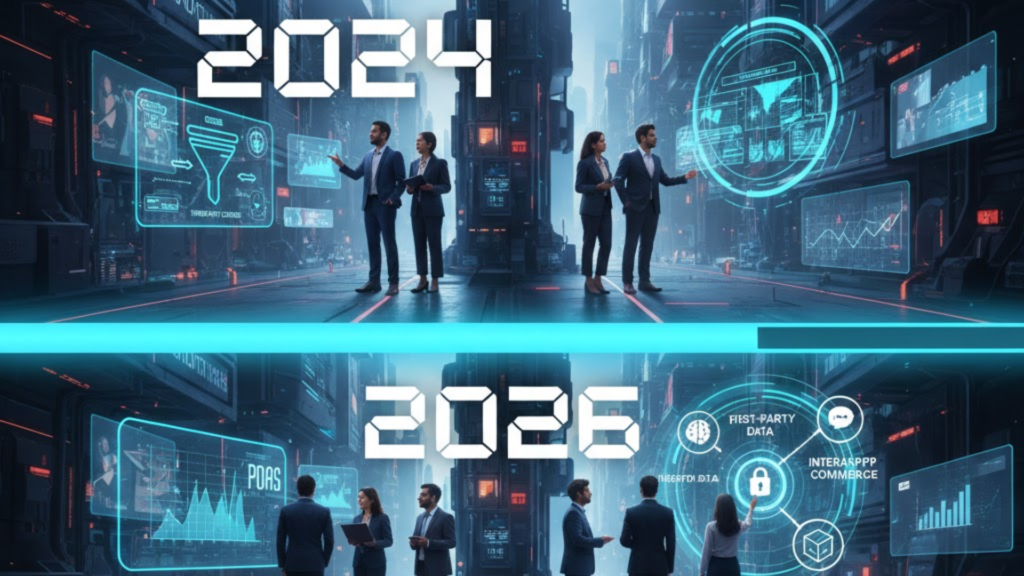
To succeed, you must understand how the mechanics of advertising have evolved. This table breaks down the tectonic shifts:
| Feature | Performance Marketing (2024) | Performance Marketing (2026) |
| Primary Driver | Manual Bidding & Keywords | AI-Agent Autonomous Bidding |
| Tracking | Third-Party Cookies | First-Party Data & Server-Side API |
| Primary Platform | Google Search & Meta Feed | WhatsApp, CTV, & Retail Media |
| Content Type | Static Images & Video | Interactive & Shoppable AR/VR |
| Focus Metric | ROAS (Return on Ad Spend) | POAS (Profit on Ad Spend) |
| Targeting | Interest-based (Demographics) | Intent-based (Behavioral AI) |
| Customer Journey | Linear (Ad -> Site -> Buy) | Non-Linear (Omnichannel Presence) |
4. Deep-Dive Strategies for ROI-Driven Indian Brands
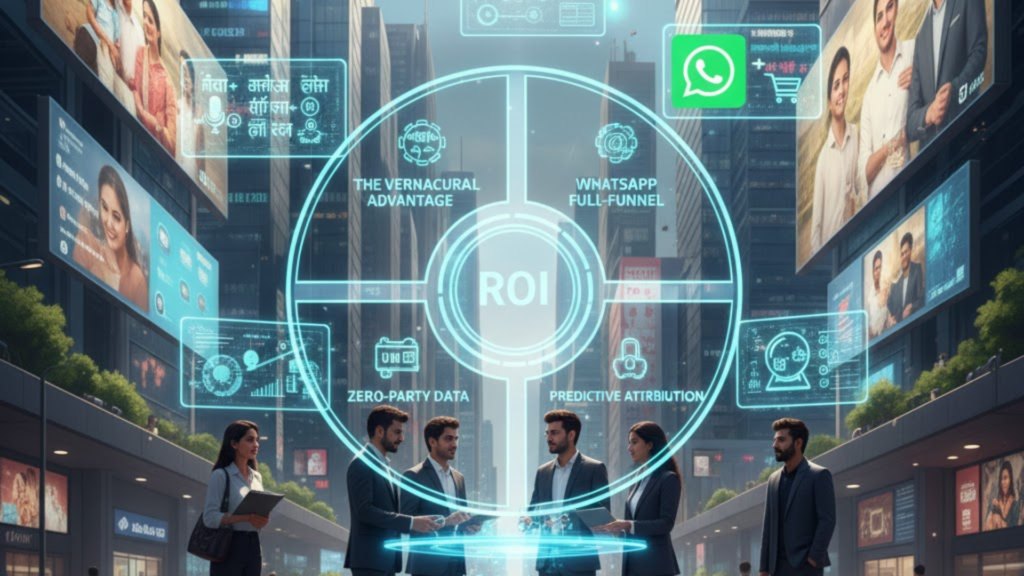
If you want to scale a brand in India today, your roadmap must include these specific, high-word-count strategies:
1. The “Vernacular” Advantage: Decoding Bharat
English-speaking audiences in India are a saturated market. The real growth in 2026 is in Bharat (Tier 2 & 3 cities).
- Action: It is not enough to just translate English ads into Hindi. You must Transcreate. This involves changing the cultural context, the jokes, and the visual cues.
- Voice Search Performance: 60% of new internet users in India use voice search in their native language. Performance marketing now includes optimizing for queries like “Sabse accha waterproof phone kaunsa hai?”
- Result: 2026 data shows that vernacular ads have a 35% lower CAC (Customer Acquisition Cost) than English ads.
2. WhatsApp as a Full-Funnel Tool
WhatsApp is no longer just for support; it is a Performance Powerhouse. * Click-to-WhatsApp Ads: These ads bypass the high-friction landing page entirely. The user clicks an ad on Instagram and lands in a WhatsApp chat where a LLM-powered Chatbot assists them.
- Native Payments: With UPI (Unified Payments Interface) deeply integrated into chat, the conversion rate for “Conversational Commerce” has jumped by 200% compared to traditional mobile websites.
- Remarketing: Using WhatsApp for “Abandoned Cart” recovery in 2026 sees an open rate of 98%, compared to 10% for email.
3. Zero-Party Data Collection (The Trust Economy)
Since you can’t rely on platform data, you must own your data. This is where Zero-Party Data comes in.
- Incentivized Quizzes: A skincare brand might run a performance ad for a “Skin Type Quiz.” The user gets a free routine; the brand gets the user’s skin type, age, and concerns.
- Loyalty Loops: Performance ads in 2026 are often used to drive users into a “Community” (Discord or Telegram) where the brand can market to them for free forever.
5. The Role of Artificial Intelligence in 2026 Performance Marketing
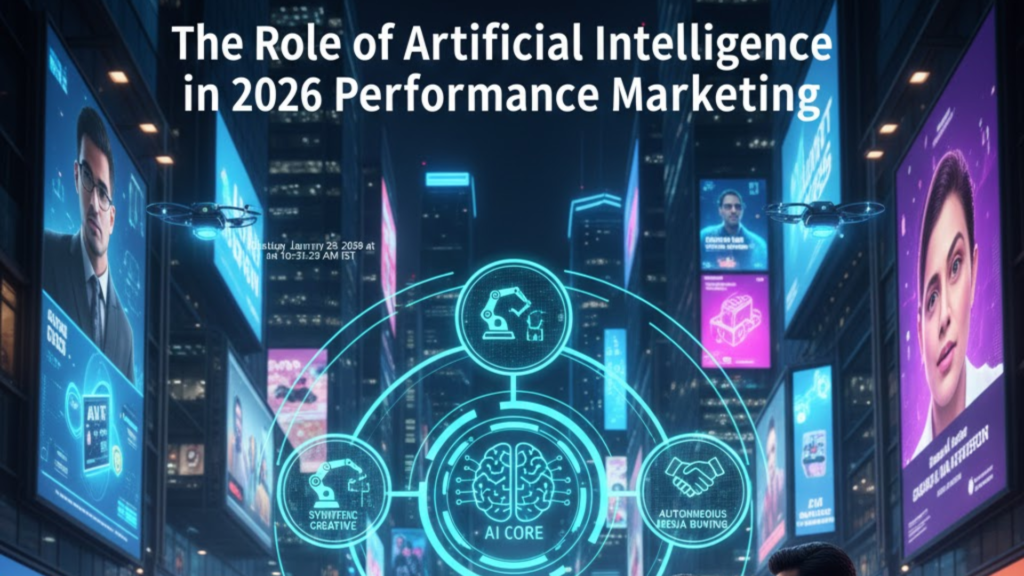
AI is no longer a “feature”—it is the foundation. In 2026, AI handles:
- Autonomous Media Buying: AI agents negotiate with ad exchanges to buy impressions at the lowest possible price for the highest possible intent.
- Predictive Churn: Performance models can now tell you which customer is about to stop buying from you, allowing you to trigger a “win-back” ad before they leave.
- Synthetic Creative: AI models create realistic human avatars to “speak” to the customer in their local dialect, making ads feel personal rather than corporate.
6. Technical Checklist for 2026 Performance Marketers
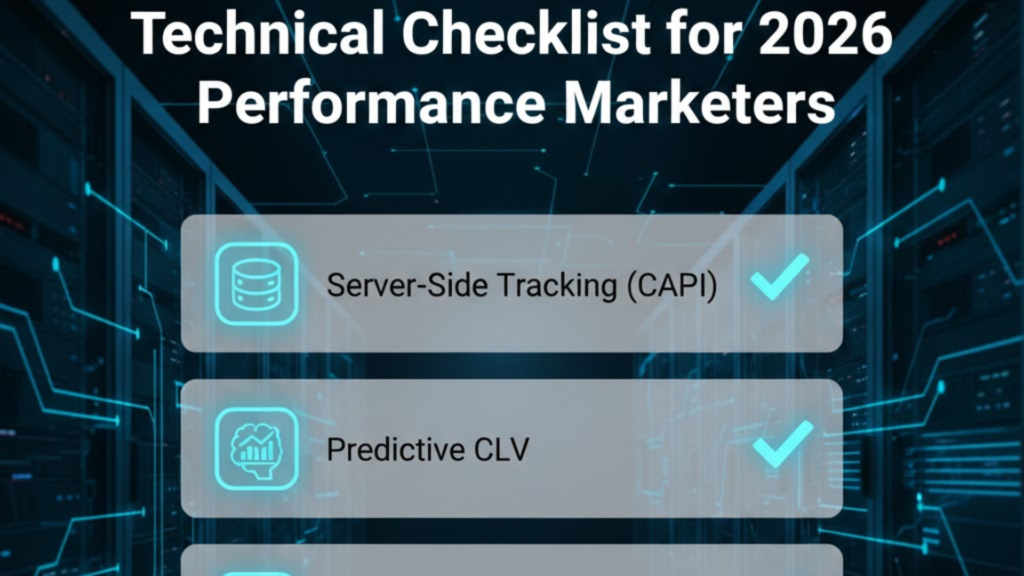
To ensure your brand is “AI-Ready,” check these boxes. These are the technical requirements that separate the amateurs from the pros:
- [ ] Server-Side Tracking (CAPI): Move away from browser-based tracking. Ensure your Meta and Google Conversions APIs are synced directly with your server.
- [ ] Predictive CLV (Customer Lifetime Value): Does your dashboard calculate the Projected 12-month value of a new lead within 24 hours of acquisition?
- [ ] Unified Identity Resolution: Can you identify that “User A” on a laptop is the same as “User B” on a smart fridge?
- [ ] Clean Room Data: Are you using “Data Clean Rooms” to collaborate with platforms like Amazon or Flipkart to see how your social ads drive retail sales?
7. Frequently Asked Questions (FAQ)
Q1: What is the most important skill for a performance marketer in 2026?
Answer: It’s no longer about setting up campaigns; it’s about Data Storytelling and Creative Direction. You need to understand what the data is saying and tell the AI how to pivot the creative strategy.
Q2: Is Performance Marketing better than Brand Marketing?
Answer: In 2026, the two have merged into “Brandformance.” Performance ads help build the brand by ensuring the right people see it, and a strong brand reduces your CAC in performance campaigns. You cannot have one without the other.
Q3: What is a “Good” ROAS in 2026?
Answer: ROAS is relative. In 2026, we look at POAS (Profit on Ad Spend). A 4x ROAS might be bad if your margins are thin, whereas a 2x ROAS might be excellent if the Customer Lifetime Value (LTV) is high. For Indian E-commerce, a 3.5x to 5x ROAS is generally the benchmark for scaling.
Q4: How does 6G/5G impact Performance Marketing?
Answer: High-speed internet allows for High-Fidelity Video and Augmented Reality (AR) ads. In 2026, a user can “try on” a pair of sunglasses via an ad in 4K resolution with zero lag. This reduces return rates by nearly 40%.
Q5: Which platform should a new Indian brand start with?
Answer: If you have a visual product, Meta (Instagram) is best. If you have a high-intent service, Google Search is king. If you sell FMCG, Amazon/Flipkart Ads are mandatory.
Conclusion: The Human Touch in a Machine World
As we look at what is performance marketing in 2026, it’s easy to get overwhelmed by the technology. But remember: Technology is the “How,” but Humans are the “Why.”
The most successful Indian brands in 2026 aren’t just those with the biggest AI budgets; they are the ones that understand the Indian consumer’s heart. They use AI to be efficient, but they use human empathy to be effective.
Performance Marketing is no longer a department; it is a growth mindset. It is the relentless pursuit of efficiency through data, fueled by the power of creativity.
Ready to Revolutionize Your Growth?
The future moves fast, and 2026 is already here. Don’t let your brand get left behind in the manual era of 2024.