In today’s hyper-connected world, having a robust online presence is non-negotiable for business survival. Yet, for many entrepreneurs and marketing professionals, the term “digital marketing” feels like a sprawling, confusing landscape. Is it just social media? Is it Google Ads? The truth is, it’s neither—and it’s both.Digital marketing is a powerful ecosystem of specialized tools, and mastering it requires understanding the distinct types of digital marketing that exist. Choosing the right channel isn’t about following trends; it’s about aligning your efforts with where your customers are and how they prefer to interact with your brand. A mismatched strategy is the fastest way to drain your budget without seeing results.
This comprehensive guide will not only break down the major and minor digital marketing disciplines but will also provide a strategic framework to help you determine which specific combination of these types of digital marketing is perfectly suited for your unique business goals. We will cover the core pillars, niche strategies, and essential integration points required to build a sustainable, high-ROI marketing machine.
Part I: The Core Pillars – Foundational types of digital marketing
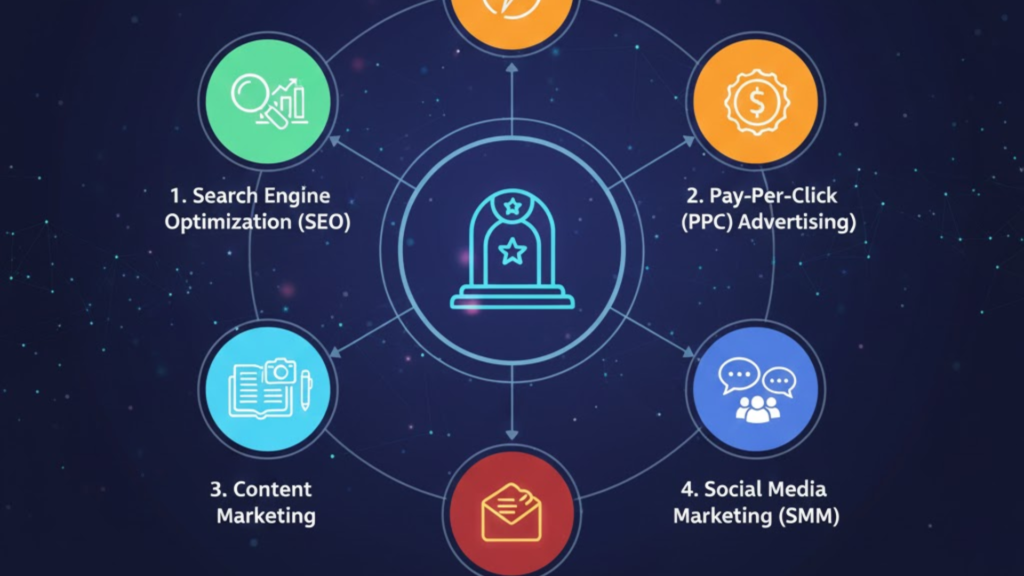
These five disciplines form the bedrock of almost every successful digital strategy. Ignoring any of these is a missed opportunity for sustainable growth.
1. Search Engine Optimization (SEO): The Long-Term Play
SEO is the process of optimizing your website content and technical structure so that search engines (like Google) rank your pages higher in organic (non-paid) search results.
Why SEO is Crucial:
SEO is often called the “digital foundation.” It ensures that when potential customers actively search for solutions, products, or information related to your business, your site is the trusted authority they find first. This channel delivers the highest quality traffic because the user has high intent (they are actively looking for a solution).
- Key Pillars of SEO Mastery:
- Technical SEO: Focuses on the backend structure—site speed, mobile-friendliness, secure socket layer (SSL), and creating accurate XML sitemaps to ensure search engines can crawl and index your site efficiently.
- On-Page SEO: Involves optimizing elements visible to the user—high-quality content creation, strategic placement of target keywords, optimizing title tags, meta descriptions, and image alt text.
- Off-Page SEO: Primarily involves link building, which means acquiring high-authority backlinks from other reputable websites. This signals to Google that your site is trustworthy and authoritative.
2. Pay-Per-Click (PPC) Advertising: The Instant Booster
PPC is an online advertising model where advertisers pay a fee each time one of their ads is clicked. This is the mechanism behind Google Ads, Microsoft Advertising, and Paid Social Ads.
Why PPC is Crucial:
While SEO is a long-term play, PPC offers immediate visibility and scalability. It’s the fastest way to test market demand, drive targeted traffic, and capture leads right now. It’s highly measurable, allowing for precise control over your budget, targeting (by location, device, time of day), and return on ad spend (ROAS).
- Key PPC Platforms and Types:
- Search Ads: Text ads appearing on Google/Bing search results based on keyword bids.
- Shopping Ads (Product Listing Ads – PLA): Visual product listings with images and prices—crucial for e-commerce.
- Remarketing/Retargeting: Showing ads to users who have previously visited your website but didn’t convert, significantly boosting conversion rates.
| Feature | SEO (Organic) | PPC (Paid) |
| Speed of Results | Slow (3-6+ Months) | Instant (Days/Weeks) |
| Cost | Time, Labor, Content Investment | Per Click (Direct Budget Expense) |
| Control | Low (Algorithm Dependent) | High (Full Control over Ad Placement & Budget) |
| Credibility | Very High (Trusted by Users) | Moderate (Recognized as Ads) |
| Longevity | Permanent, Sustained Traffic | Stops When Budget Runs Out |
3. Content Marketing: Value and Authority
Content Marketing involves the creation and distribution of valuable, relevant, and consistent content (blogs, videos, guides, podcasts) to attract and retain a clearly defined audience.
Why Content is the Kingmaker:
Content is the fuel that powers almost all other types of digital marketing. It provides the pages that SEO optimizes, the posts that SMM shares, and the value that drives email sign-ups. It helps establish your brand as an industry thought leader.
- Essential Content Marketing Deliverables:
- Pillar Pages and Topic Clusters: Large, authoritative guides that cover broad topics, linking to smaller, related blog posts to establish topical authority for SEO.
- Gated Content (eBooks, Whitepapers): High-value resources that require a user’s email address to access, serving as a powerful lead generation tool.
- Video Content (Tutorials & Explainers): Highly engaging content that addresses user pain points and builds personal connection.
4. Social Media Marketing (SMM): Connection and Community
SMM utilizes social networking sites (Facebook, Instagram, LinkedIn, TikTok) to connect with your audience and drive engagement.
The Dual Approach of SMM:
- Organic Social: Focuses on relationship building through genuine interaction, timely responses to comments/DMs, and providing entertainment or educational value. This is how you build a loyal community.
- Paid Social: Leverages the advanced targeting features of platforms like Meta (Facebook/Instagram) and LinkedIn to deliver highly personalized ad experiences. This is excellent for brand awareness and direct sales funnels.
5. Email Marketing: The Highest ROI Channel
Email marketing is the process of sending commercial messages to groups of people via email. It is a direct communication channel you own, meaning you are not dependent on external algorithms.
Why Email Dominates ROI:
The average ROI for email marketing often surpasses $40 for every $1 spent. This is because it targets the warmest leads—people who have already willingly shared their contact information, demonstrating clear interest in your brand.
- Essential Email Automation Sequences:
- Welcome Series: Onboarding new subscribers, setting expectations, and often providing a first-purchase discount to accelerate conversion.
- Abandoned Cart: Triggered automatically when a shopper leaves items in their cart, directly recovering lost sales.
- Post-Purchase Follow-up: Used for customer service, soliciting reviews, and upselling related products to increase Customer Lifetime Value (CLV).
Part II: The Specialized Disciplines – Evolving types of digital marketing
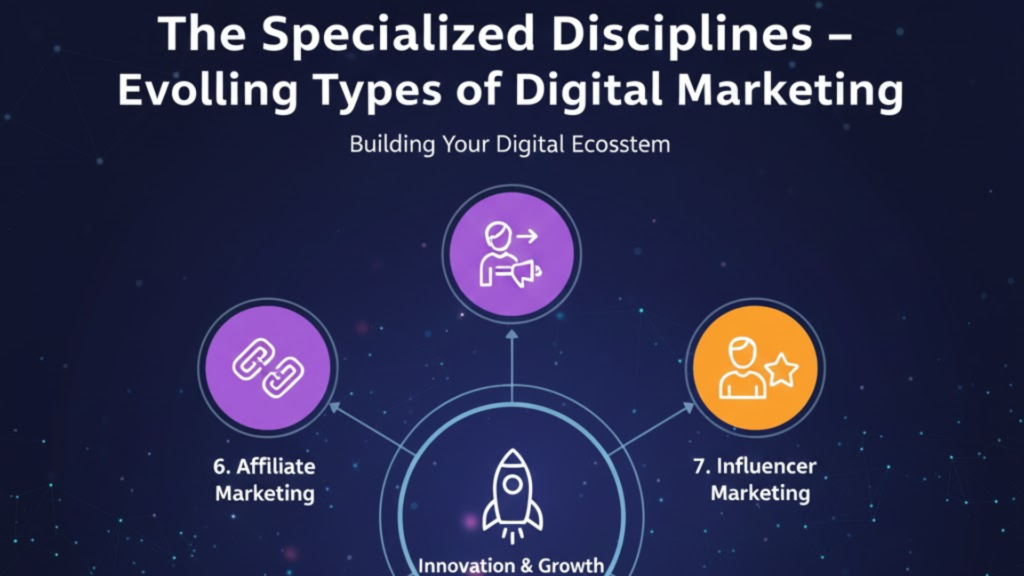
These advanced types of digital marketing can provide a strong competitive advantage when integrated correctly with the core pillars.
6. Affiliate Marketing: Performance-Based Growth
This involves partnering with third-party publishers (affiliates) who promote your products or services and earn a commission only for sales or leads generated through their unique referral link.
- Benefit: Low risk—it’s entirely performance-based (Cost Per Acquisition – CPA). It leverages the affiliate’s existing trust and audience.
- Key Components: Strong tracking software, clear commission structures, and robust partner management.
7. Influencer Marketing: Trust via Third-Party Validation
This is a specific type of SMM that focuses on leveraging individuals who have established credibility and high engagement with an audience.
- Evolution: The trend has shifted from massive celebrities to micro-influencers (5K to 50K followers). Micro-influencers often yield better engagement and higher conversion rates because their audience feels a more authentic connection to them.
8. Video Marketing: The Engagement Champion
Video is now the most consumed form of online content. It encompasses everything from short-form clips on TikTok/Reels to long-form tutorials on YouTube and live webinars.
- Benefit: Video delivers complex information quickly, builds empathy, and significantly boosts dwell time on your website (a positive signal for SEO). YouTube is the world’s second-largest search engine, making video an essential SEO type.
9. Native Advertising and Display Advertising
- Display Ads (Banners): Standard visual advertisements placed across the web. They are primarily used for broad brand awareness and retargeting purposes.
- Native Ads: Designed to blend seamlessly into the editorial content of a platform (e.g., promoted articles on news sites). They bypass ad fatigue by not looking like traditional advertisements, often resulting in higher click-through rates (CTR).
Part III: Strategic Alignment – Which Strategy is Right for Your Business?
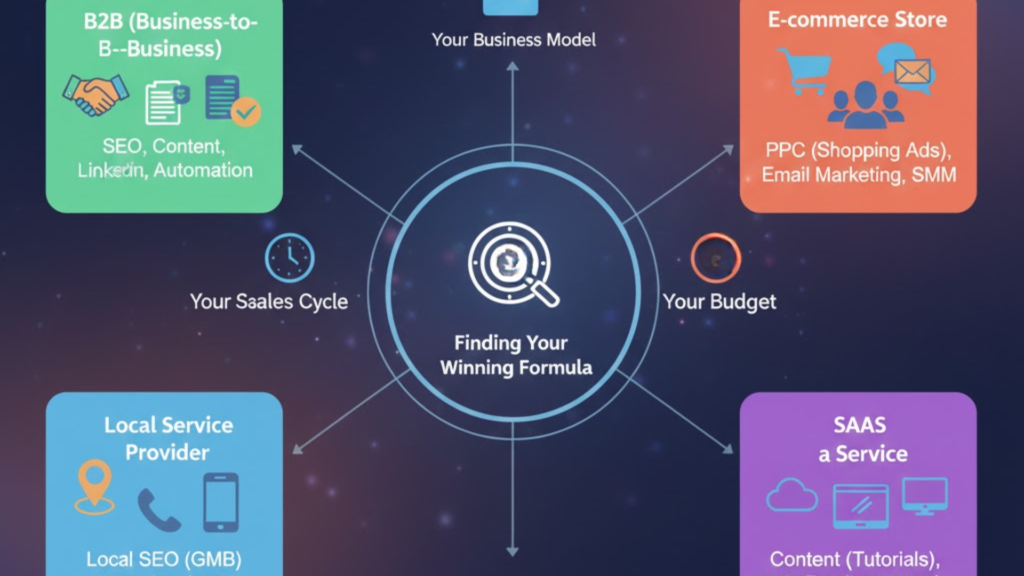
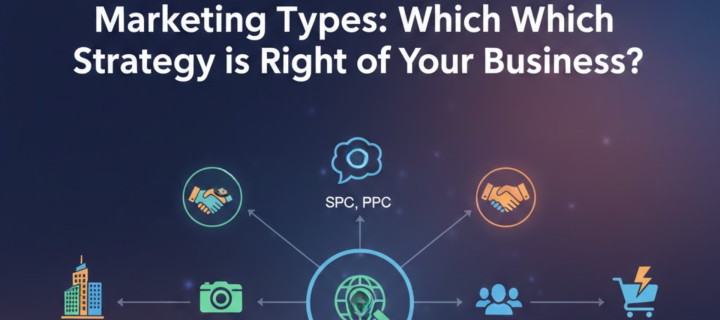
The ultimate goal is to move past simply listing the types of digital marketing and create an integrated, multi-channel strategy. Your winning formula is based on three critical factors: your business model, your sales cycle, and your budget.
Strategy Blueprint by Business Type:
| Business Type | Primary Goal | Core Strategy Mix | Key Focus and Rationale |
| B2B (Business-to-Business) | High-Value Lead Generation | SEO, Content Marketing, LinkedIn SMM, Email Automation | The long sales cycle requires deep education, credibility (Content/SEO), and professional networking (LinkedIn) to secure high-ticket contracts. |
| E-commerce Store | Transactions & CLV | PPC (Shopping Ads), Email Marketing, SMM (Paid & Organic) | Need instant product visibility (PPC), must recapture lost sales (Email Automation), and drive impulse buying and loyalty through visual channels (SMM). |
| Local Service Provider | Local Calls/Foot Traffic | Local SEO (GMB), Hyper-local PPC, Review Management | Dominate the “Near Me” searches. The user intent is immediate; prioritize Google My Business (GMB) optimization and accumulating genuine reviews. |
| SaaS (Software as a Service) | Free Trial Sign-ups | Content Marketing (Tutorials), PPC (Specific Features), Email Automation | Requires detailed product explanation (Content) and long-term customer engagement to prevent churn and increase subscription value (Email Automation). |
The Interplay: How The Types Work Together
The power of digital marketing is multiplication, not addition.
- Content + SEO: Content provides the text/video, and SEO makes sure Google finds it, leading to free traffic.
- SEO + Email: SEO drives traffic to a valuable resource (Content), where a pop-up encourages an email sign-up, converting an anonymous visitor into a warm lead.
- PPC + Retargeting: PPC brings cold traffic to your site; retargeting uses that initial exposure to show follow-up ads (often via Paid Social), drastically lowering the cost of final conversion.
Frequently Asked Questions (FAQ)
Q1: What is the biggest difference between SEO and Content Marketing?
A: They are distinct but inseparable. Content Marketing is the act of creating valuable assets (the blog post, the video). SEO is the process of optimizing that asset (using keywords, building links) so that search engines find it and rank it highly. Content is the what, and SEO is the how.
Q2: Is conversion rate optimization (CRO) considered one of the types of digital marketing ?
A: While not a channel like SEO or PPC, CRO is a critical discipline that applies to all types. CRO is the systematic process of increasing the percentage of website visitors who take a desired action (like making a purchase or filling out a form). Without strong CRO, all your traffic-driving efforts (SEO, PPC, SMM) are wasted.
Q3: How do I measure the ROI of my content marketing efforts?
A: Measuring Content Marketing ROI can be complex because it’s an indirect driver. You should track:
- Lead Generation: How many leads did a piece of gated content produce?
- Attributed Revenue: Use analytics to track how many customers read a specific blog post before converting months later (multi-touch attribution).
- SEO Performance: Increased organic traffic and higher keyword rankings resulting from the content.
Q4: Should a brand use both micro- and macro-influencers?
A: Yes, a balanced approach is best. Macro-influencers (large following) are great for rapid brand awareness and reach. Micro-influencers (smaller, highly engaged niches) are better for driving specific conversions and generating authentic user-generated content.
Q5: What is Marketing Automation and where does it fit into these types?
A: Marketing Automation is the software (e.g., HubSpot, Mailchimp) that streamlines, automates, and measures marketing tasks and workflows. It’s not a marketing type itself, but it is the tool that makes Email Marketing and Lead Nurturing scalable. It automatically sends the welcome email, the abandoned cart reminder, or the sales follow-up based on user behavior.
Conclusion: The Path to Digital Mastery
Understanding the various types of digital marketing is not enough; true digital mastery lies in creating a cohesive ecosystem where every channel supports the others. Your Content fuels your SEO, your SEO drives traffic that you capture via Email, and your Email marketing drives sales that you can then retarget via Paid Social.
Stop asking what the best type of digital marketing is, and start asking, “Which combination of these powerful types will best help my unique business serve its customers?” The answer to that question, refined through constant testing and data analysis, is your ultimate, winning strategy.