In the dynamic landscape of modern commerce, simply having a product or service is no longer enough. The traditional approach to marketing—where efforts were loosely tied to brand visibility—is obsolete. Today, every rupee, dollar, or pound spent must be accountable and deliver a high return on investment (ROI). Businesses are demanding quantifiable returns. They need result-driven marketing solutions.
A result-driven strategy shifts the focus from vanity metrics (like page views or general likes) to concrete, bottom-line metrics such as qualified leads, conversions, and customer lifetime value (CLV). This comprehensive guide delves into the top five strategic solutions that move the needle, ensuring your marketing budget delivers maximum, measurable profit.
1. Conversion Rate Optimization (CRO): A Powerful result-driven marketing solutions to Maximize Value from Existing Traffic
The most overlooked area for immediate ROI improvement is often right under your nose: your existing website traffic. Many businesses invest in SEO or advertising to drive visitors, yet fail to optimize the very destination where conversions are supposed to happen. CRO is the process of increasing the percentage of website visitors who take a desired action.
Why CRO Is the Fastest Path to Results in Result-Driven Marketing Solutions
CRO is highly result-driven because it leverages resources you already possess (your website and traffic). You don’t need to spend more on ads; you simply make your existing assets work harder and smarter.
Key CRO Strategies for High ROI:
- A/B Testing and Heatmaps:
- Never guess. Formulate testable hypotheses (e.g., “Changing the button text to ‘Start Earning Now’ will increase clicks by 15%“).
- Use heatmaps and session recordings to understand user behavior—where they click, how far they scroll, and where they abandon the page.
- Streamlining the Checkout/Lead Capture Process:
- Fewer Fields, Higher Conversions: For lead forms, reduce friction by only asking for essential information (Name, Email, Phone).
- Frictionless Checkout: Offer guest checkout options and integrate locally popular payment methods seamlessly (e.g., UPI, Net Banking in India).
- Enhancing Trust Signals:
- Social Proof is King: Display testimonials, customer photos, and security certificates prominently near the Call to Action (CTA).
Clarity over Cleverness: Your value proposition must be crystal clear within the first three seconds.
2. Data-Driven Content Marketing: From Impressions to Intent and Income
Traditional content marketing often fails because it focuses on volume rather than strategic purpose. A truly result-driven approach treats content as a strategic asset designed to solve a specific customer problem at a specific stage of their journey, directly driving measurable outcomes.
The Shift from Generic to Intent-Based Content
Effective content marketing is fundamentally about serving user intent, which directly correlates with search engine optimization (SEO) and conversion rates.
| Content Type | Buyer’s Journey Stage | Primary Goal/Result |
| Blog Posts, Guides, How-Tos | Awareness (Top of Funnel) | Attract and Educate (Low commitment) |
| Comparison Articles, Case Studies | Consideration (Middle of Funnel) | Build Trust and Showcase Value (Lead Generation) |
| Product Pages, Pricing, Demo | Decision (Bottom of Funnel) | Drive Conversion/Sale (High ROI) |
A. Advanced Keyword and Intent Mapping
- Target Commercial Intent Keywords: Focus on terms that show a readiness to buy (e.g., “best project management software pricing,” “review of [Product X] vs [Product Y]”).
- Align with the Funnel: Ensure every piece of content maps to one of the three stages listed above.
B. Content Audits Focused on ROI
- Amplify Success: Invest more in updating and promoting the content that consistently brings in high-quality leads.
- Optimize Underperformers: Update low-performing content with fresh data and stronger CTAs.
3. High-ROI Performance Marketing (PPC & Paid Social)
PPC and paid social advertising are the epitome of result-driven marketing because you pay specifically for performance. However, poor strategy leads to wasted budget. The key is micro-targeting and relentless optimization.
Strategic Implementation for Maximum Returns
A. The Power of Micro-Targeting and Audience Segmentation
- Use Negative Keywords Aggressively: Exclude terms like “cheap,” “free,” or “second hand” to save budget and ensure your ads are seen only by high-intent users.
- Custom Audiences: Upload your customer lists to platforms like Meta and Google to create high-value Lookalike Audiences—users who share characteristics with your best existing customers.
- Geographic Specificity: Use ultra-precise radius targeting to ensure ads are seen only by potential local customers, especially crucial for physical businesses.
B. Retargeting/Remarketing Campaigns
Retargeting is the most result-driven form of advertising, as previous visitors are significantly more likely to convert.
- Sequential Messaging: Users who abandoned a cart should see an ad highlighting free shipping or a small discount.
- Time-Based Retargeting: Target recent visitors (1-7 days ago) with high-urgency offers.
4. Marketing Automation and CRM Integration

Scalability is crucial for result-driven growth. Marketing Automation platforms, integrated with a robust CRM (Customer Relationship Management) system, provide the backbone for scalable, personalized results.
The Mechanism of Automated Results
A. Automated Lead Scoring
Automation platforms assign a ‘score’ to each lead based on their actions.
| Action Taken | Score Added | Result |
| Visited Pricing Page | +15 Points | Indicates high commercial interest. |
| Downloaded Generic Ebook | +5 Points | Indicates informational interest. |
| Opened 5 Emails | +10 Points | Indicates engagement. |
Sales-Ready Leads (SQLs): Once a lead hits a predetermined score (e.g., 50 points), they are automatically flagged and transferred to the sales team for immediate follow-up.- Nurturing Leads: Leads below the threshold remain in an automated nurturing sequence.
B. Personalized Nurturing Sequences
Automate email workflows that deliver hyper-personalized content:
- Abandoned Cart Recovery: Trigger an email 1 hour after cart abandonment.
- Re-engagement Campaigns: Automatically send special offers to customers who haven’t purchased in 90 days.
5. Micro-Influencer and Community-Based Marketing
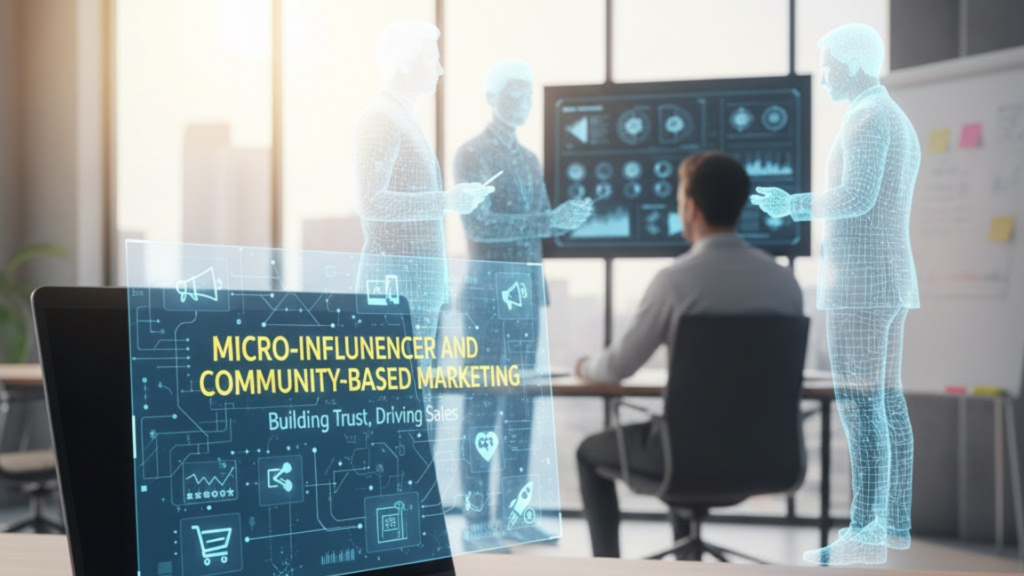
In a world saturated with digital ads, the most trusted source of information remains a peer or a relatable, genuine voice. For result-driven marketing, embrace credible Micro-Influencers and community engagement.
Building Trust, Driving Sales
A. Authenticity Over Reach
- Higher Engagement: Micro-influencers (1,000 to 50,000 followers) are viewed as more trustworthy and have higher engagement rates.
- Trackable Results: Use unique, trackable discount codes for each collaboration to provide an unarguable ROI metric.
B. Community Building and User-Generated Content (UGC)
- Brand Advocates: Offer incentives for referrals or honest reviews.
- Interactive Content: Solicit video testimonials and user photo contests. UGC converts at a higher rate because it features a relatable peer’s voice.
Frequently Asked Questions (FAQ)
Q1. What is the single most important metric for result-driven marketing?
The single most important metric is Customer Lifetime Value (CLV). While Cost Per Acquisition (CPA) and Conversion Rate are vital, CLV tells you the long-term profitability of the customer you acquired. A higher CLV justifies a higher CPA, allowing you to scale your campaigns more aggressively.
Q2. How often should I perform CRO on my website?
CRO is not a one-time project; it’s a continuous process. You should be running at least one A/B test on a critical page (like the homepage or checkout page) at all times. Quarterly, you should perform a comprehensive review of all top-performing and underperforming pages based on behavioral data (heatmaps and session recordings).
Q3. Is it better to spend money on SEO or PPC for immediate results?
For immediate, short-term results and traffic, PPC (Performance Marketing) is the better solution as it starts driving traffic as soon as the campaign launches. However, for sustainable, long-term, and cost-effective results, SEO (driven by quality content and technical optimization) offers a better long-term ROI. The best strategy is always a blend of both.
Conclusion: The Mandate for Measurable Marketing
The era of “hope marketing” is over. To truly succeed, you must adopt result-driven marketing solutions. This means a cultural shift within your organization—from guessing to measuring, from vanity metrics to financial outcomes.
By focusing on CRO (optimizing the experience), Data-Driven Content (driving high-intent traffic), High-ROI Performance Marketing (efficient budget allocation), Automation (scaling personalization), and Authentic Community Building (leveraging trust), you establish a marketing ecosystem where every action is tied to a measurable financial result.
Implement these five strategies with discipline and relentless analysis, and you won’t just see growth; you will see predictable, scalable, and maximized ROI.