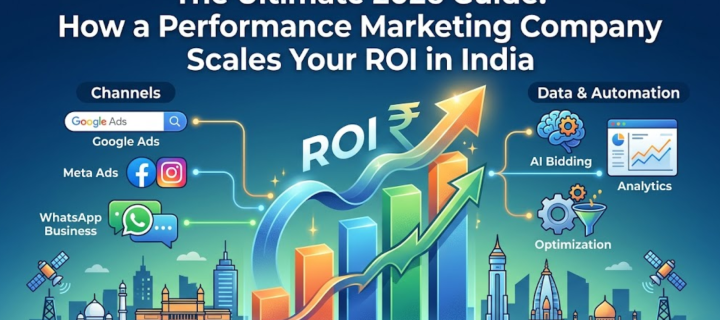
In the modern digital economy, traditional advertising is slowly dying. The days of spending lakhs on a hoarding in Gurgaon or a full-page ad in a newspaper without knowing the exact return are over. Today, data is the new oil, and a performance marketing company is the refinery that turns that raw data into pure profit.
1. Defining the Core: What is Performance Marketing?
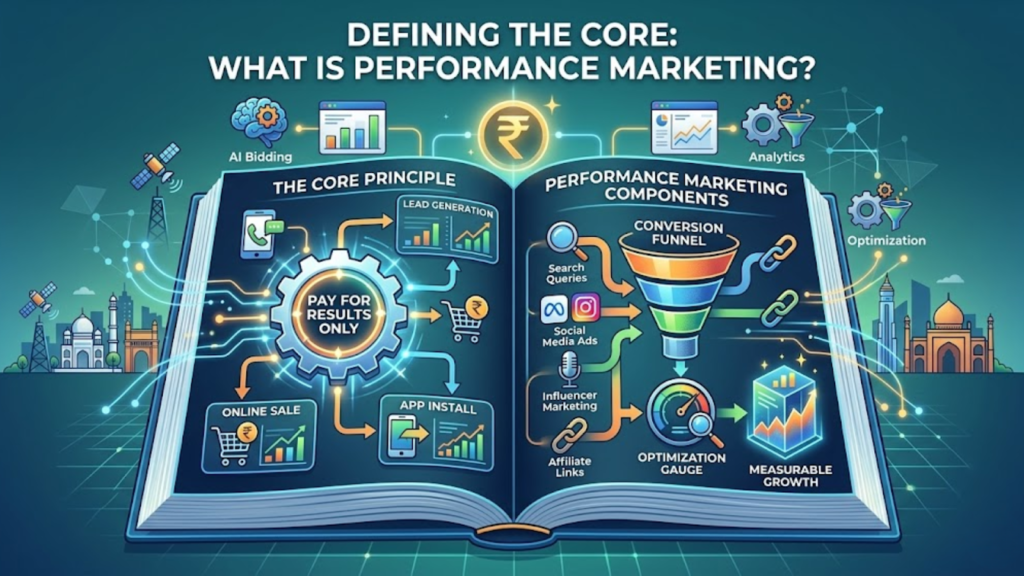
Performance marketing is a results-oriented digital marketing strategy where the advertiser (the business) only pays the performance marketing company when a specific, pre-defined action is completed.
The Breakdown of “Actions”
In a performance-driven model, we don’t track “vanity metrics” like likes or follows. We track:
- CPL (Cost Per Lead): The price paid for a potential customer’s contact details.
- CPA (Cost Per Acquisition): The cost to acquire a paying customer.
- CPS (Cost Per Sale): Common in E-commerce, where you pay a commission on every successful transaction.
- CPI (Cost Per Install): Essential for mobile apps like UPI-based fintech or gaming apps.
The Ecosystem: Who is Involved?
- The Merchant (You): The business owner looking for growth.
- The Performance Marketing Company: The strategic partner managing your budget, creative, and data.
- The Network/Platform: Google Ads, Meta Ads (Facebook/Instagram), LinkedIn, or Affiliate Networks.
- The Consumer: The Indian user browsing their feed or searching on Google.
2. Performance Marketing vs. Traditional Agencies
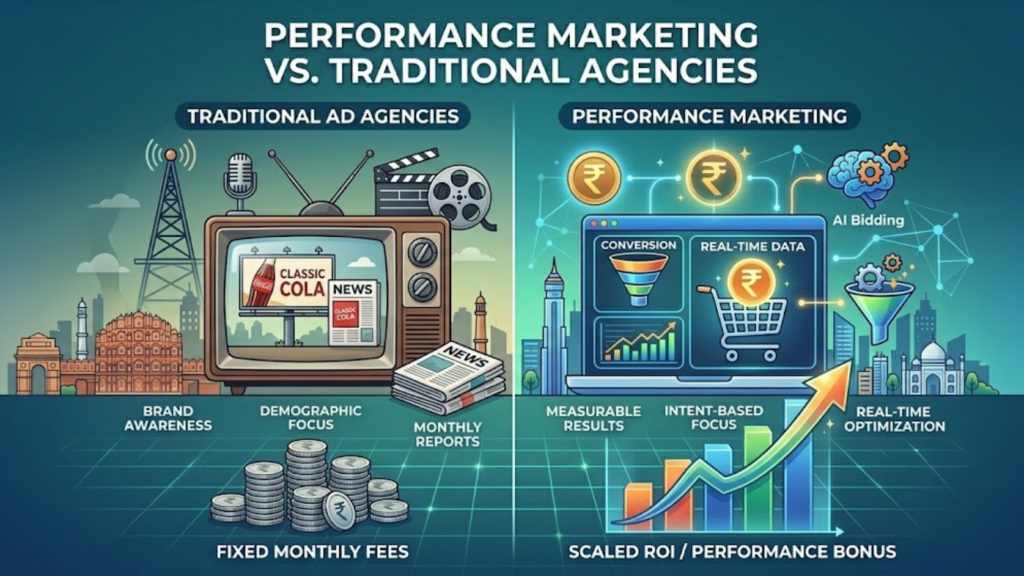
The biggest difference lies in Accountability. A traditional agency might say, “Your brand looks great!” A performance marketing company says, “We spent ₹1,00,000 and generated ₹5,00,000 in revenue.”
Comparison Table: Why Results Matter
| Feature | Brand Agency | Performance Marketing Company |
| Main KPI | Reach & Impressions | ROI, ROAS, & Conversions |
| Budgeting | Fixed Monthly Fees | Scale based on Performance |
| Data Usage | Demographic-based | Intent-based & Behavioral |
| Feedback Loop | Monthly Reports | Real-time Dashboard Access |
| Primary Tool | Creative Design | Data Analytics & AI Bidding |
3. The Psychology of the Indian Digital Consumer
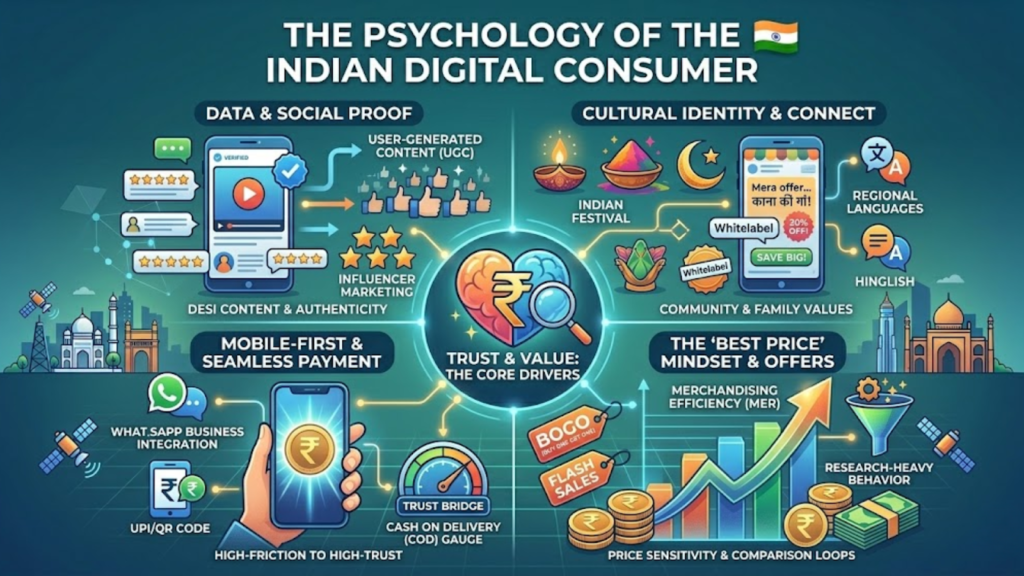
To succeed as a performance marketing company in India, one must understand the “Desi” mindset. The Indian consumer is value-conscious, research-heavy, and trust-driven.
A. The “Trust” Barrier
Indian users are often skeptical of online ads due to past scams. A top-tier agency overcomes this by:
- Social Proof: Using UGC (User Generated Content) and video testimonials from real Indian customers.
- Local Language: Using “Hinglish” or regional languages (Hindi, Tamil, Marathi) to create a personal connection.
- WhatsApp Integration: In India, WhatsApp is the “Trust App.” Performance marketing funnels that lead to a WhatsApp chat often convert 3x better than standard landing pages.
B. Price Sensitivity & Offers
“What’s the best price?” is the national question. Performance marketing leverages this by focusing on:
- BOGO (Buy One Get One) or heavy discount triggers in the ad copy.
- Cash on Delivery (COD): Highlighting COD options to reduce the friction of online payments.
4. Technical Strategy: Scaling ROI Step-by-Step
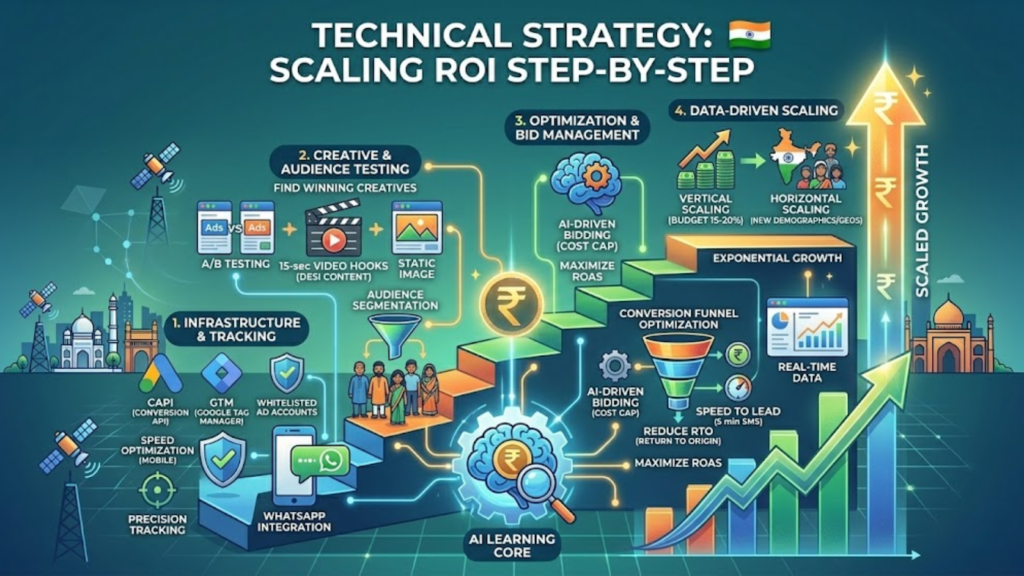
How does a performance marketing company actually take a brand from ₹10k/day to ₹10 Lakh/day? It follows a rigorous technical process.
Phase 1: Tracking & Infrastructure
You cannot scale what you cannot measure.
- Pixel Integration: Installing Meta Pixel, Google Tag Manager (GTM), and Conversion API (CAPI).
- Attribution Modeling: Determining which ad gets credit—the first click or the last click?
- Event Tracking: Tracking specific “Micro-Conversions” like “Add to Cart” or “Form Started” to understand where users drop off.
Phase 2: Creative Testing (The “Creative is the New Targeting”)
In 2026, AI handles most of the targeting. The real winner is the creative.
- A/B Testing: Testing two different headlines or images to see which has a lower CPC (Cost Per Click).
- Video Hooks: Creating 15-second “Scroll Stoppers” that grab attention in the first 2 seconds.
Phase 3: The Scaling Formula
A professional performance marketing company uses two types of scaling:
- Vertical Scaling: Increasing the daily budget on a winning ad set by 15%–20% every 48 hours.
- Horizontal Scaling: Taking a winning audience and testing it in new locations (e.g., expanding from Jaipur to all of Rajasthan).
5. Industry-Specific Mastery: Why Niche Performance Marketing is the Future
Many businesses make the mistake of hiring a “general” agency. However, a specialized performance marketing company understands that a Lead for a Real Estate project in Jaipur is handled very differently than a Sale for an E-commerce brand in Mumbai.
In this section, we break down how performance marketing adapts to different Indian industries to scale ROI.
A. E-commerce & D2C (Direct-to-Consumer)
For Indian D2C brands, the goal is simple: Maximum Sales at the Lowest CAC.
- The Problem: High RTO (Return to Origin) in India. Many customers order “Cash on Delivery” and then refuse the package.
- The Performance Solution: A professional agency doesn’t just track “Orders”; they track “Delivered Orders.” They use data to:
- Filter High-Risk Zip Codes: Stop showing ads in areas with high RTO rates.
- Pre-Paid Incentives: Run “Pre-paid only” ads with a 5% extra discount to ensure committed buyers.
- Retention Marketing: Using WhatsApp and Email sequences to turn a one-time buyer into a repeat customer, significantly increasing the LTV (Lifetime Value).
B. Real Estate & High-Ticket Lead Gen
Selling a ₹1 Crore flat or a premium solar installation requires a “High-Touch” funnel.
- The Strategy: You cannot sell a house with a “Buy Now” button. A performance marketing company builds a “Trust Funnel.”
- Step 1 (Awareness): Educational video ads showing the lifestyle or the ROI of the investment.
- Step 2 (Consideration): Lead forms that ask qualifying questions (e.g., “What is your budget?” or “Are you looking for 2BHK or 3BHK?”).
- Step 3 (Nurturing): Retargeting ads featuring “Construction Updates” or “Happy Customer Interviews” to keep the brand top-of-mind during the long decision-making process.
C. Healthcare & Special Needs Clinics
For specialized clinics (like those treating Cerebral Palsy, Autism, or Acupressure), the marketing must be empathetic yet data-driven.
- Trust-First Approach: A performance marketing company focuses on “Outcome-Based Ads.” Instead of selling a service, they market a “Success Story.”
- Educational Blogging: Creating deep-dive content (like this blog) that answers parents’ biggest fears.
- Local SEO + Performance: Combining Google Search Ads with local map listings so that when a parent searches for “Special needs clinic near me,” your center is the first thing they see.
Frequently Asked Questions (FAQ)
Q: Is Performance Marketing better than SEO? A: SEO is a long-term investment (6-12 months). Performance marketing is an “on-off switch.” If you need leads today, you need a performance marketing company. Ideally, you should do both.
Q: Why are my leads not converting? A: This is usually due to “Lead Decay.” In India, if you don’t call a lead within 5–10 minutes, the conversion rate drops by 80%. A good performance agency helps you automate this.
Q: Which platform is best for B2B in India? A: Google Search Ads are best for “High Intent” (people searching for a solution), while LinkedIn is best for targeting decision-makers (CEOs, Founders, HR Heads).
Q: Can I do this myself? A: You can, but performance marketing is highly technical. A specialized performance marketing company uses expensive AI tools and has “Whitelisted” accounts that prevent your ads from getting banned.