In the competitive Indian business ecosystem of 2026, the digital landscape has shifted. Gone are the days when a simple Facebook post or a basic website was enough to sustain a business. Today, whether you are a Solar EPC contractor in Jaipur, an industrial manufacturer in Gujarat, or a healthcare provider in Delhi, the digital space is your primary battlefield for growth.Finding a digital marketing agency in India is easy—there are thousands. But finding a performance-driven partner that treats your marketing budget like an investment rather than an expense is rare. This guide explores how high-level performance marketing delivers a scalable Return on Investment (ROI) specifically for the Indian market.
1. The Anatomy of Performance Marketing in India

Performance marketing is an umbrella term for online marketing programs in which advertisers pay only when a specific action is completed, such as a lead, a sale, or a click.
Why Performance Matters More Than “Branding”
For most Indian SMEs (Small and Medium Enterprises), cash flow is king. You cannot wait six months for “brand awareness” to turn into revenue. You need a system that generates verified inquiries today.
- Accountability: Every rupee spent is tracked.
- Scalability: If a campaign works in Ajmer, a performance agency knows how to scale it to the rest of Rajasthan or even nationwide.
- Data-Driven: Decisions are based on what the data says, not what “looks pretty.”
2. Comparing Agency Models: General vs. Performance-Driven
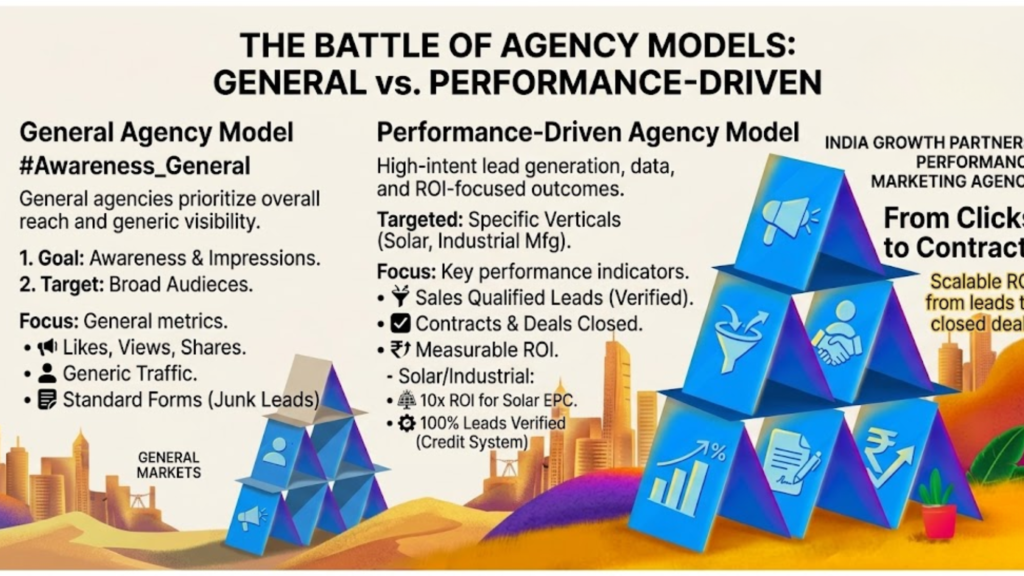
Before hiring a digital marketing agency in India, it is vital to understand the difference in their approach.
| Feature | General Marketing Agency | Performance-Driven Agency (Mocaup Style) |
| Primary Goal | Awareness & Impressions | Conversions & ROI |
| Key Metric | Likes, Shares, Reach | Leads, Sales, CPL (Cost Per Lead) |
| Content Focus | Creative & Aesthetic | Psychological & Conversion-Oriented |
| Strategy | Broad Targeting | High-Intent & Niche Targeting |
| Tech Stack | Basic Analytics | AI-driven GEO, CRM Integration, Heatmaps |
3. Deep Dive: Targeting High-Intent Keywords
A high-intent keyword is a search query that indicates a user is ready to buy or take action. For example:
- Low Intent: “What is solar energy?” (Information seeking)
- High Intent: “Solar panel installation price in Jaipur” (Ready to buy)
How We Identify High-Intent Opportunities
A professional digital marketing agency in India uses advanced tools to find “money keywords.” We look for:
- Commercial Investigation: Users comparing brands (e.g., “Best IP67 junction box brands in India”).
- Transactional Queries: Users looking for vendors (e.g., “Digital marketing agency near me“).
- Localized Queries: Users looking for regional service providers (e.g., “Interior designers in Jhunjhunu”).
4. The 2026 Shift: Generative Engine Optimization (GEO)
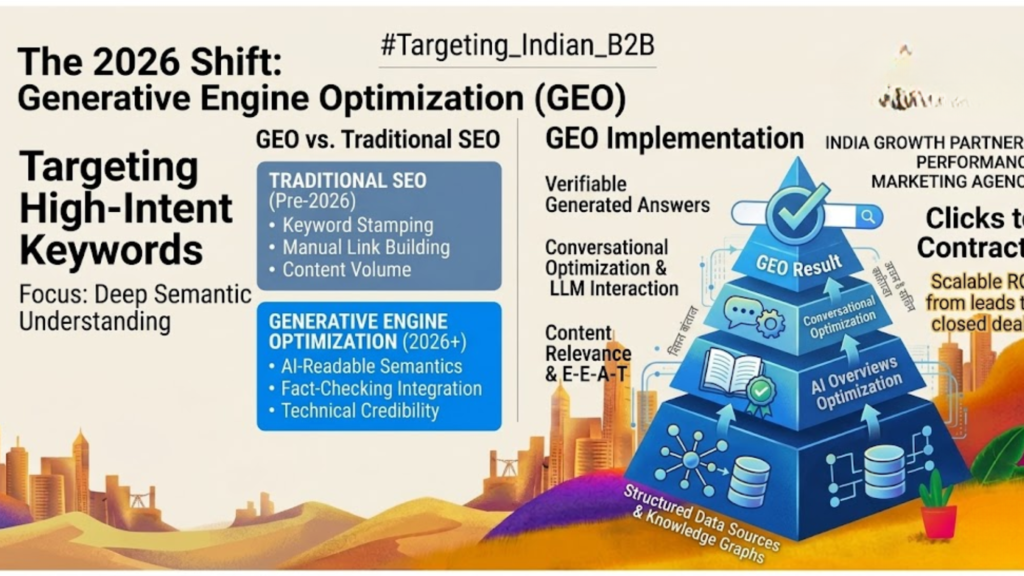
By 2026, SEO has evolved into GEO. Search engines like Google now use AI to summarize answers. If your agency isn’t optimizing for AI Overviews, you are losing 60% of your potential traffic.
Strategic Steps for GEO Success:
- Entity Linking: Making sure your brand (like Mocaup or ESA) is recognized as an “Entity” by Google’s Knowledge Graph.
- Authoritative Content: Writing deep-dive technical articles that AI models find “citation-worthy.”
- FAQ Optimization: Answering specific user questions in a concise, structured format.
5. Industry Focus: Scaling the Solar & Industrial Sectors in 2026
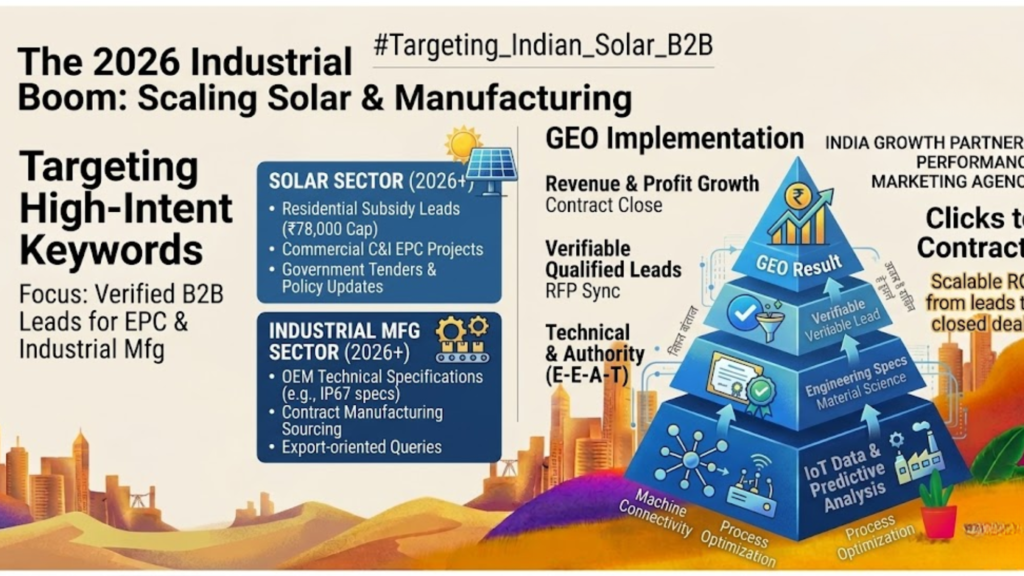
The Indian government’s push for renewable energy, especially the PM-Surya Ghar: Muft Bijli Yojana, has created a gold rush. However, for a digital marketing agency in India, the challenge is no longer just “getting clicks”—it is about filtering out the noise.
A. The Solar Lead Generation Blueprint
In 2026, residential and commercial solar buyers are highly educated. They aren’t just looking for “panels”; they are looking for subsidies and savings. To deliver ROI, we optimize for the following:
- Subsidy-Driven Copywriting: We target keywords related to the ₹78,000 subsidy for systems up to 3kW. By addressing the financial “pain points” immediately, we reduce the bounce rate.
- The “Digital Twin” Proposal: Performance marketing in 2026 involves showing, not telling. We use ad creatives that explain Net Metering and show 3D-modeled rooftops.
- Tiered Verification (The Credit System):
- Basic Leads: Name and Number (High volume, lower intent).
- Advance Leads: Includes monthly electricity bill amount and roof type.
- Premium Leads: OTP verified with a confirmed site visit request.
- Result: Your sales team spends time closing, not cold-calling.
B. Industrial Marketing for Electrical & Infrastructure
Marketing technical products like IP67 thermoplastic junction boxes or polycarbonate enclosures requires a “Scientific SEO” approach. Most agencies fail here because they don’t understand the engineering.
- Material Science as a USP: We don’t just say a box is “strong.” We highlight IK10 Impact Ratings, UL 94-V0 Flame Retardancy, and UV Stabilization. In the harsh Indian climate (from 50°C in Rajasthan to high humidity in Kerala), these specs are what an engineer looks for.
- B2B Content Funnels: An industrial buyer’s journey starts with a technical problem (e.g., “corrosion in chemical plants”). We create whitepapers and technical blogs that position your brand as the solution before the buyer even looks at the price tag.
- Comparison Tables: We create “Metal vs. Thermoplastic” comparison charts. By showing that high-quality plastic won’t rust and offers better insulation, we shift the buyer’s mindset from “cheapest” to “most durable.”
6. The Psychological Roadmap of the Indian B2B Buyer
Understanding the “Indian Mindset” is what separates a local digital marketing agency in India from a global one. In 2026, the B2B buying committee in India has grown; it’s no longer just the owner making decisions, but a team of 8–10 people including finance, tech, and operations.
I. The “Sahi Hai” Factor (Social Proof & Trust)
In India, “Trust” is a currency. To build this digitally, we use:
- Regional Testimonials: A video of a factory owner in Bhadra or Jaipur speaking in the local dialect about your service carries 10x more weight than a polished corporate video.
- Certifications & Approvals: We prominently display MNRE approvals, ISO certifications, and MSME registrations. For an Indian business, these are the ultimate “Trust Signals.”
II. The “Value-First” Logic
The Indian buyer is value-conscious, not just price-conscious. Our performance-driven content focuses on Total Cost of Ownership (TCO).
- Example: For a Solar EPC, we emphasize the 4-year payback period and the 25-year warranty.
- Example: For Industrial Enclosures, we highlight zero maintenance costs compared to metal boxes that need frequent painting and rust-proofing.
III. The “Frictionless” Funnel (WhatsApp is King)
India is a mobile-first, WhatsApp-first nation. A professional digital marketing agency in India must integrate WhatsApp at every stage:
- Click-to-WhatsApp Ads: This allows the buyer to start a conversation instantly. In 2026, a buyer who messages you on WhatsApp is 7x more likely to convert than one who fills out a long website form.
- Automated Nurturing: We use AI chatbots to answer standard questions about price, delivery time, and technical specs 24/7, ensuring the lead doesn’t “go cold.”
IV. The “Committee-Ready” Content
Since decisions are made by groups, we provide “Shareable Assets.” These are PDF summaries or comparison sheets that your primary contact can easily share with their boss or finance department to get a “Yes” faster.
FAQ: Common Questions for Indian Business Owners
Q5: My business is very technical (e.g., electrical components). Can a digital agency really understand my product? A: Only if they are a “Niche Expert.” General agencies will fail. You need an agency that employs technical writers who can explain things like IP ratings, heat dissipation, and dielectric strength to an engineering audience.
Q6: Is Google Ads better than Meta (Facebook/Instagram) for Indian B2B? A: Google Ads is better for Immediate Intent (someone searching for “Buy solar panels”). Meta is better for Demand Generation (educating a factory owner that they could save money with your product). A performance-driven strategy uses both.
Q7: What is the most common mistake Indian brands make in digital marketing? A: Chasing the “lowest lead price.” If you pay for cheap ₹10 leads, your sales team will waste months on people who don’t have a roof or the budget. Investing in ₹300 verified leads is much more profitable.
Q8: How does GEO (AI Search) impact my local business in Rajasthan? A: If someone asks their AI assistant, “Who is the most reliable solar installer in Jaipur?”, GEO ensures that your business’s reviews, project photos, and technical blogs are the source of that answer.
Conclusion: Partnering for 2026 and Beyond
The digital economy in India is maturing. To stay ahead, you need a partner like Mocaup that understands the intersection of material science, government policy, and consumer psychology. By focusing on high-intent lead generation, technical authority, and frictionless WhatsApp funnels, you can transform your digital presence from a “cost center” into a “profit engine.”
Don’t leave your ROI to chance. Partner with a digital marketing agency in India that builds for the future.