In the Indian B2B landscape, the journey from a “handshake” to a “signed contract” has moved from physical offices to digital screens. Whether you are selling SaaS, solar installations, or manufacturing equipment, your success depends on one thing: B2B lead generation.
This guide explores how to build a robust funnel that doesn’t just attract clicks, but builds genuine trust with Indian decision-makers.
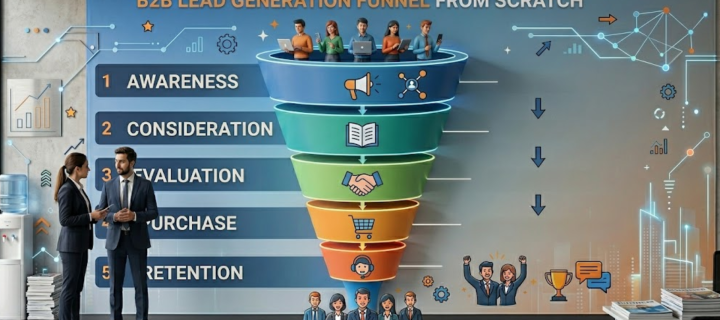
1. Understanding the B2B Lead Generation Sales Funnel Architecture
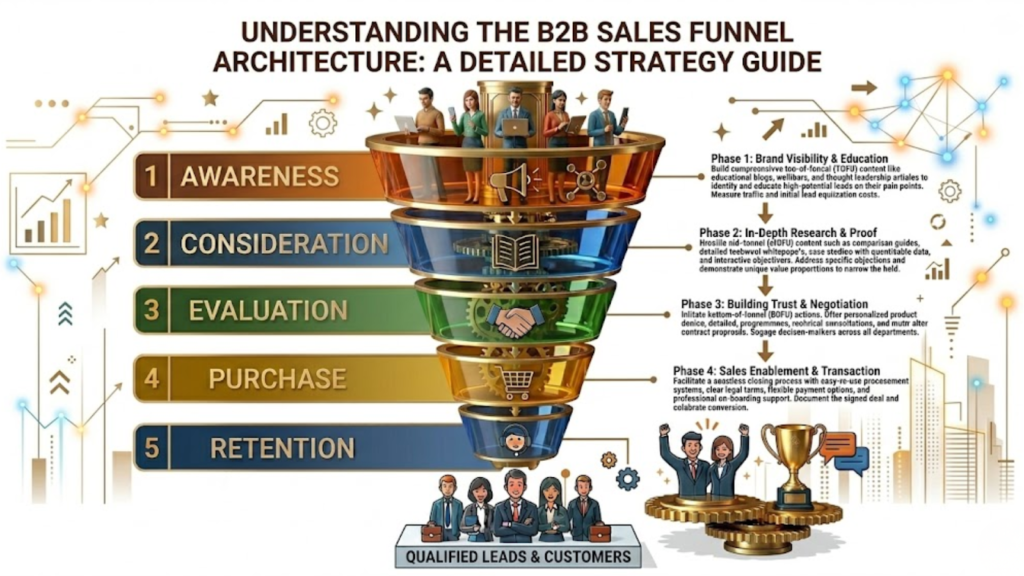
Unlike B2C, where a customer might buy a shirt in 30 seconds, B2B involves high ticket sizes and multiple stakeholders. You need a funnel that educates before it sells.
The Three Pillars of the Funnel
| Funnel Stage | Goal | Content Type |
| TOFU (Top) | Awareness & Education | Blogs, Social Media, Infographics |
| MOFU (Middle) | Trust & Evaluation | Case Studies, Webinars, Whitepapers |
| BOFU (Bottom) | Conversion & Closing | Free Trials, Audits, Product Demos |
2. Defining Your Ideal Customer Profile (ICP) for B2B Lead Generation
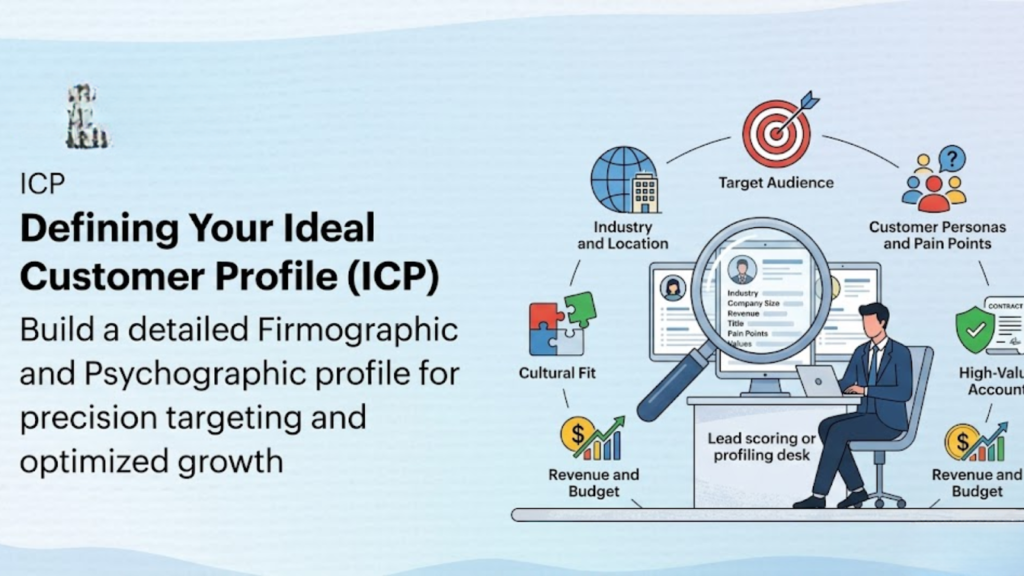
You cannot target everyone. In India, a “CEO” of a 5-person startup has different pain points than a “Purchasing Manager” at a Tata or Reliance-level firm.
Key Factors for Indian ICP:
- Industry Verticals: (e.g., Real Estate, Healthcare, Solar, IT).
- Company Size: Startup vs. MSME vs. Enterprise.
- Geography: Tier 1 cities (Bangalore/Mumbai) vs. Tier 2 hubs (Jaipur/Indore).
- Decision Makers: Who signs the cheque? Who uses the product?
3. Step-by-Step Implementation Strategy
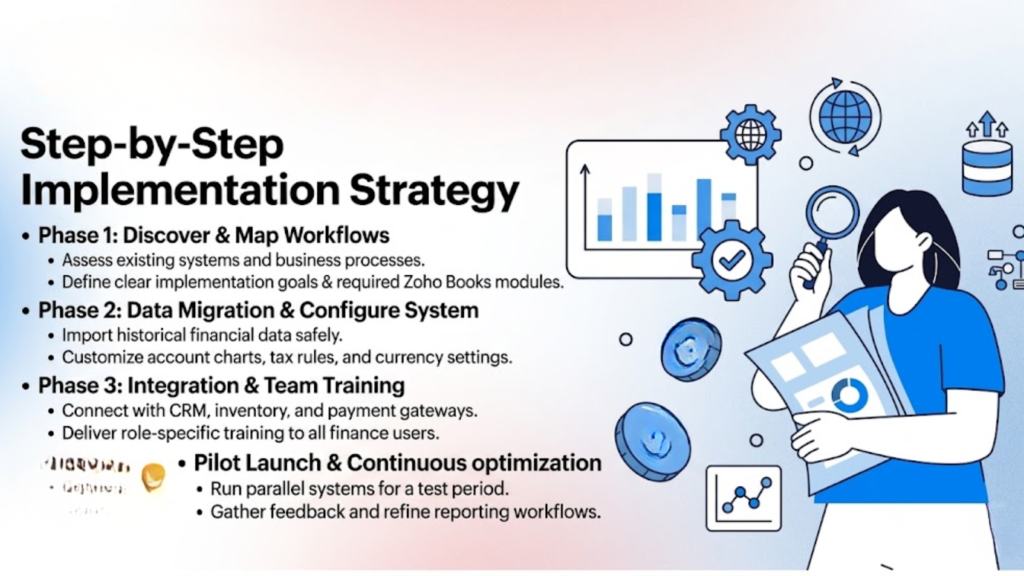
Step 1: Keyword Research & SEO Groundwork
To rank for “B2B lead generation”, you must answer the questions your customers are asking on Google.
- Focus on Intent: Don’t just target “leads.” Target “How to get high-quality B2B leads in India.”
- Long-tail Keywords: Use phrases like “B2B marketing strategies for manufacturing companies.”
Step 2: Creating Irresistible Lead Magnets
In the Indian market, value must be immediate. A lead magnet is a “bribe” for an email address.
- The “How-To” Guide: e.g., “The Complete Guide to Solar Subsidy in Rajasthan.”
- Calculators: e.g., “ROI Calculator for CRM Software.”
- Checklists: e.g., “15 Point Security Audit for Corporate Offices.”
Step 3: High-Converting Landing Pages
Your landing page is your digital salesperson. It must work 24/7 without getting tired.
- Bold Headline: State the benefit clearly.
- Social Proof: Mention “Trusted by 500+ Indian Brands.”
- The Form: Keep it short. In India, asking for a WhatsApp number often yields better results than just an email.
4. Driving Traffic: The Fuel for Your Funnel
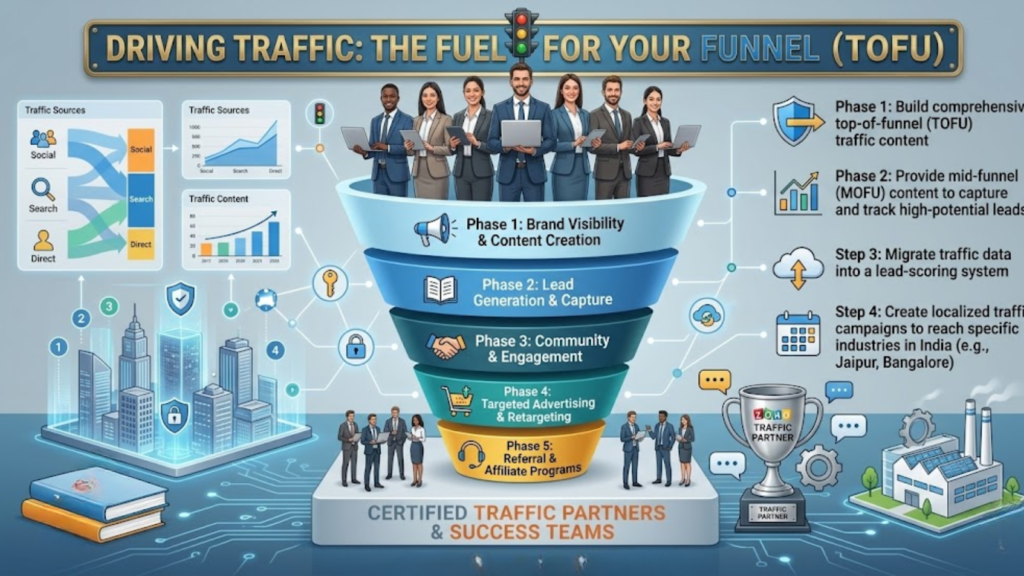
Once the machine is built, you need to send people to it.
A. Content Marketing (The Long Game)
Consistency is key. Post 2-3 times a week on LinkedIn. In India, LinkedIn is the premier platform for B2B networking. Share “behind the scenes” of your projects or client success stories.
B. Paid Advertising (The Fast Track)
- Meta Ads (Facebook/Instagram): Surprisingly effective for Indian MSMEs. Use Lead Forms to reduce friction.
- Google Search Ads: Target people actively searching for your service.
- LinkedIn Ads: Expensive, but the targeting (by Job Title) is unmatched.
5. Lead Nurturing: The Art of Turning “Maybe” into “Yes”
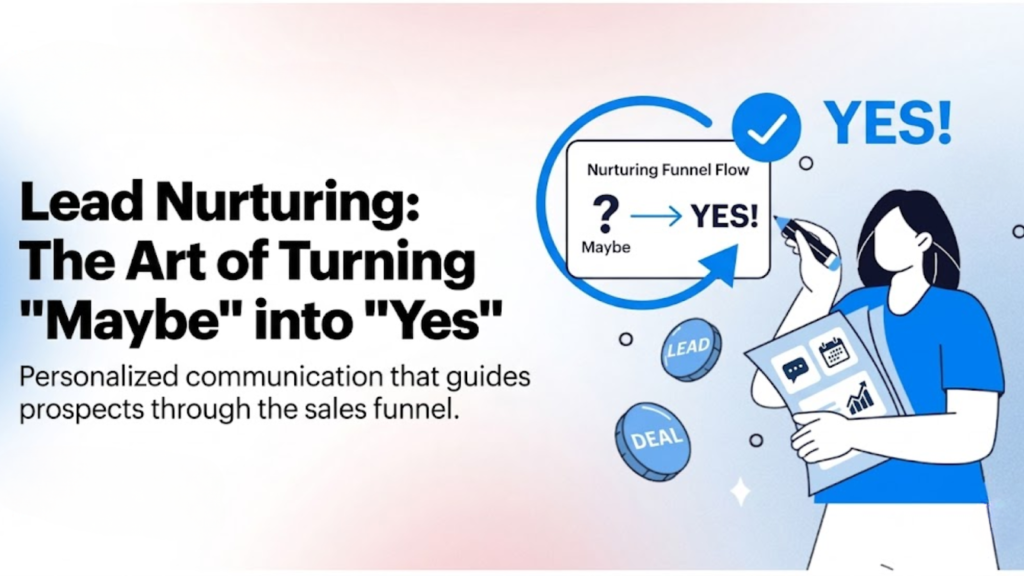
In the Indian B2B landscape, a lead is just a digital handshake. The real business happens in the Nurturing Phase. Statistics show that 80% of B2B sales require at least five follow-ups, yet 44% of sales reps give up after just one.
A. The Multi-Channel Nurturing Strategy
In India, relying solely on Email is a mistake. You must use a “surround sound” approach:
- WhatsApp for Business (The Game Changer): * Speed: A “Welcome” message within 2 minutes of lead generation has a 391% higher conversion rate.
- Personalization: Share PDF brochures or short video testimonials directly.
- Tip: Use official WhatsApp APIs to avoid getting your number banned.
- The “Drip” Email Sequence:
- Day 1: The Value Delivery (Send the promised lead magnet).
- Day 3: The “Case Study” (Show how you solved a problem for another Indian brand).
- Day 7: The “Objection Killer” (Address common fears like pricing or implementation time).
- Day 10: The “Soft Pitch” (Invite them for a 15-minute Discovery Call).
- Retargeting Ads: * If a lead visited your pricing page but didn’t book a call, show them a specific “Client Testimonial” ad on LinkedIn or Facebook.
B. Lead Scoring: Prioritizing Your Efforts
Not all leads are created equal. Use a Lead Scoring Table to decide who to call first:
| Action Taken by Lead | Score | Priority | Follow-up Method |
| Downloaded a generic eBook | +10 | Low | Automated Email |
| Visited the ‘Pricing’ page 3 times | +40 | Medium | WhatsApp Message |
| Requested a Free Audit/Demo | +100 | High | Immediate Phone Call |
| Unsubscribed from Email | -50 | None | Drop from List |
C. The Psychology of the Indian B2B Buyer
Indian decision-makers value Relationships (Rishta) and Reliability (Bharosa).
- The “Consultative” Approach: Don’t sell; solve. Ask, “Sir, what is the biggest challenge you are facing in your manufacturing unit right now?”
- Social Proof is Currency: Mentioning that you have worked with clients in the same industrial hub (e.g., Vishwakarma Industrial Area in Jaipur) builds instant rapport.
6. Common Mistakes to Avoid (The “Pitfalls” of B2B)
Even with a great funnel, small leaks can sink the ship. Avoid these common errors that cost Indian businesses lakhs in lost revenue:
I. The “Speed to Lead” Gap
If a business owner fills out your form at 10:00 AM and you call them the next day, they have already checked three of your competitors.
- The Fix: Use automation tools (like Zapier or Pabbly) to get an instant SMS or Slack notification the moment a lead arrives.
II. Poor Mobile Optimization (The Desktop Fallacy)
Many B2B marketers design their landing pages on 27-inch monitors, forgetting that 70% of Indian B2B traffic comes from mobile devices (often while the user is in a meeting or traveling).
- The Checklist for Mobile:
- Does the page load in under 3 seconds?
- Is the “Call” button big enough for a thumb?
- Are the forms easy to fill without zooming in?
III. Using “Foreign” Marketing Language
Using overly complex “Corporate American English” can alienate Indian MSME owners.
- Mistake: “We leverage synergistic paradigms to optimize your ROI.”
- Better: “Hum aapka marketing budget sahi jagah lagakar zyada leads laane mein madad karte hain.”
- Key: Keep it Professional yet Simple.
IV. Neglecting the “Middle of the Funnel” (MOFU)
Most people focus on “Getting the Lead” and “Closing the Sale.” They forget the middle part where the customer is doing research.
- The Missing Piece: If you don’t have whitepapers, comparison charts, or “How-it-works” videos, the customer will go to a competitor who provides that information.
V. Tracking the Wrong Metrics (Vanity vs. Sanity)
Don’t get excited by “Likes” or “Website Hits.”
- Focus on: * CPL (Cost Per Lead): How much did one name/number cost?
- SQL (Sales Qualified Leads): How many of those leads actually have the budget to buy?
- ROAS (Return on Ad Spend): Are you making ₹5 for every ₹1 spent?
Frequently Asked Questions (FAQ)
Q: How long does it take to see results from a B2B funnel? A: Typically, SEO takes 3-6 months. However, with Paid Ads (Meta/Google), you can start seeing leads within 48 hours.
Q: Is LinkedIn better than Facebook for B2B in India? A: LinkedIn is better for high-level corporate targeting. Facebook/Instagram is often better and cheaper for reaching small business owners and entrepreneurs.
Q: What is a “good” conversion rate for a B2B landing page? A: Between 2% to 5% is standard, but highly optimized pages in niche industries can hit 10%+.
Q: Should I put my prices on the website? A: In B2B, it’s often better to say “Starting from…” or “Request a Quote” to encourage a conversation, unless you are a standardized SaaS product.