The Indian business landscape is witnessing an unprecedented paradigm shift. The era of vanity metrics is officially dead. Gone are the days when digital marketing success was measured by the number of likes on a Facebook post, double-taps on an Instagram grid, or impressions on a banner ad. In today’s hyper-competitive marketplace, every single rupee deployed into marketing must account for its weight in gold. This critical demand has propelled the rapid rise of performance marketing agency services.
Unlike traditional marketing models that work on vague promises of “brand awareness,” performance marketing operates on strict, quantifiable outcomes. However, the market is flooded with agencies claiming to be the absolute best. For a business owner looking to scale, sorting the true growth partners from the smooth-talking sales pitches can be an expensive, exhausting ordeal.
This comprehensive guide breaks down exactly how to critically evaluate performance marketing agency services to ensure your capital is treated as a strategic investment rather than a speculative expense.
1. What Exactly are Performance Marketing Agency Services?
To evaluate a service effectively, you must understand its baseline mechanics. Traditional marketing relies on an upfront payment model where you pay for ad space (e.g., billboards, TV commercials, print ads) regardless of the outcome. You pay, you launch, and you pray.
Performance marketing turns this model on its head. It is an overarching, data-backed approach where payment, optimization, and strategy are driven strictly by measurable user actions. These actions include:
- A completed e-commerce transaction.
- A highly qualified B2B sales lead form submission.
- A phone call to your sales desk.
- A mobile application download.
- A specific micro-conversion (e.g., newsletter sign-up, WhatsApp chat initiation).
When you look into comprehensive performance marketing agency services, you are not buying simple ad setups; you are hiring an ecosystem of analysts, media buyers, copywriters, and conversion rate optimization (CRO) specialists working toward a unified metric: Return on Ad Spend (ROAS) and Customer Acquisition Cost (CAC) reduction.
2. Core Pillars of a Full-Service Performance Marketing Agency
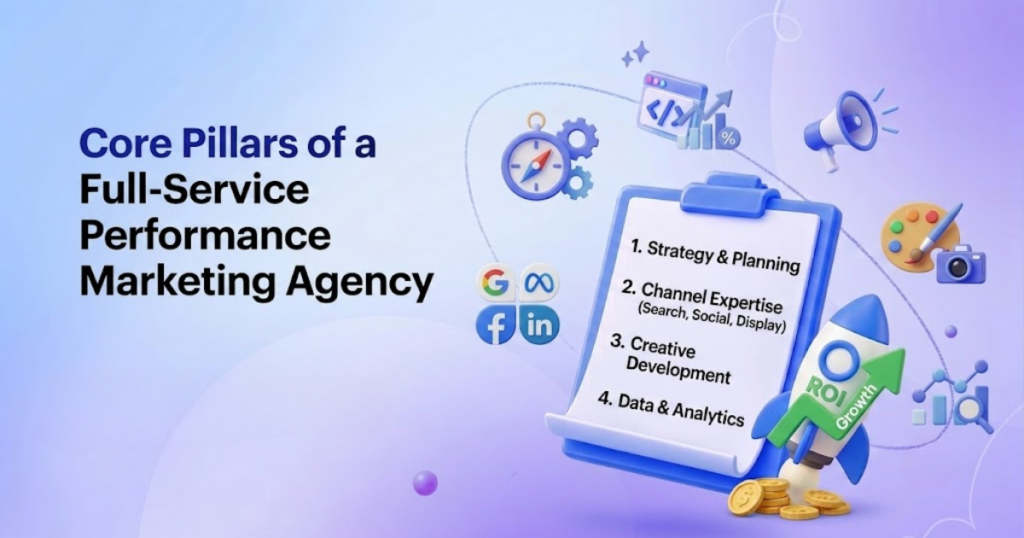
Before partnering with an agency, you must evaluate if they offer a holistic suite of capabilities. Performance marketing does not operate in a silo. An agency that only manages Meta ads without understanding tracking backend infrastructure is simply a media buying agency, not a true performance marketing agency.
A. Advanced Tracking and Data Infrastructure
Data is the lifeblood of performance marketing. If an agency cannot measure data with absolute precision, they cannot optimize your campaigns.
Critical Infrastructure Check: The agency must be proficient in setting up Google Analytics 4 (GA4), custom server-side tracking, Meta Pixels, Conversion APIs (CAPI), and offline conversion tracking linked directly to your CRM (such as Zoho, HubSpot, or Salesforce).
B. Multi-Channel Media Buying
Relying entirely on one channel (like Facebook Ads) makes your business highly vulnerable to algorithm changes and sudden ad account bans. A mature agency expertly orchestrates traffic across a diversified media mix:
- Search Engine Marketing (SEM): Intent-driven campaigns via Google Ads and Bing.
- Paid Social: Disruptive visual marketing on Meta (Instagram/Facebook), LinkedIn, and YouTube.
- Programmatic & Native Advertising: Taboola, Outbrain, or programmatic display networks for top-of-funnel scaling.
C. Creative Strategy and Copywriting
In the modern era of performance marketing, algorithms are highly automated. The primary lever for ad performance is no longer just complex technical bidding hacks; it is the ad creative itself. The agency must possess an in-house creative factory capable of producing high-converting hooks, direct-response ad copy, static carousels, and high-impact Short-Form Video scripts (Reels/Shorts).
D. Conversion Rate Optimization (CRO)
Driving paid traffic to a poorly designed website is like pouring water into a leaking bucket. True performance marketing agency services include analyzing your landing pages, identifying user drop-off points via heatmaps (like Hotjar or Microsoft Clarity), and executing A/B tests on headers, call-to-actions (CTAs), and forms to maximize page conversions.
3. The 5-Step Framework to Evaluate an Agency
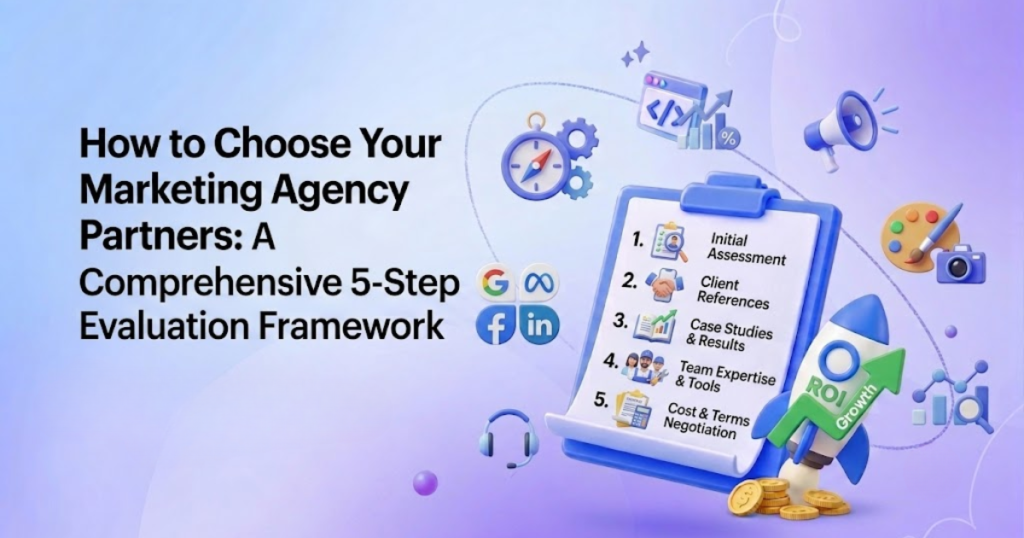
When interviewing prospective growth partners, move away from casual conversations. Use this rigid evaluation framework to assess their operational maturity.
[Step 1: Data Analytics Auditing] ──> [Step 2: Deep Funnel Architecture]
│
[Step 4: Regional Market Nuance] <── [Step 3: Strategic Creative Engine]
│
[Step 5: Operational & Reporting Transparency]
Step 1: Evaluate Their Technical Competence in Data and Analytics
Do not compromise on technical capabilities. During your evaluation pitch, ask the agency to explain how they handle data privacy updates, cookie deprecation, and attribution modeling.
- Ask Them This: “How does your team handle attribution modeling when a user clicks an ad on Instagram, leaves, searches for our brand on Google three days later, and converts?”
- What to Look For: If they mention simple “Last-Click Attribution,” be cautious. You want an agency that understands Data-Driven Attribution or Marketing Mix Modeling (MMM) to accurately map out the customer’s true journey.
- The Tracking Setup: They should be able to audit your existing tracking and fix data discrepancies between your platform backend (e.g., Shopify, Custom Dashboard) and the ad network platforms.
Step 2: Analyze Their Strategic Funnel Architecture
Amateur agencies log into an ad manager and launch generalized “Traffic” or “Conversion” campaigns targeting broad audiences. A world-class performance marketing agency designs a meticulous, multi-tiered conversion funnel customized entirely to your business’s customer lifecycle.
1. Top of Funnel (TOF) – Cold Audience Acquisition
- Objective: Introducing your product or service to people who have zero awareness of your brand.
- Strategy: Educational reels, highly relatable problem-statement ads, and broad targeting using AI lookalike models.
2. Middle of Funnel (MOF) – Intent Nurturing
- Objective: Engaging users who clicked your ad or visited your site but didn’t convert.
- Strategy: Retargeting with detailed case studies, client testimonial videos, product comparisons, or valuable lead magnets (like downloadable checklists or free system calculators).
3. Bottom of Funnel (BOF) – Conversion & Retention
- Objective: Closing the sale or capturing the highly valuable qualified lead.
- Strategy: High-urgency direct-response offers, festive discounts, zero-down financing options, or direct booking hooks.
Step 3: Inspect Their Creative Engine and Direct-Response Capabilities
Because ad platform algorithms automatically push high-performing assets, creative fatigue sets in quickly. If an agency plans to run the same three static graphics for four months straight, your ROAS will rapidly collapse.
Creative Evaluation Checklist:
- [ ] In-House Capabilities: Do they have dedicated scriptwriters and video editors, or do they outsource creative work?
- [ ] Hook Variations: Do they test multiple 3-second visual and audio hooks for video creatives?
- [ ] Direct Response DNA: Is their copywriting focused on emotional triggers, clear problem-solving, and single, unambiguous CTAs?
- [ ] Dynamic Testing: Do they leverage Meta’s Advantage+ creative features or run scientific A/B creative tests?
Step 4: Assess Their Alignment with Regional Market Nuances (The Indian Context)
The Indian consumer base is uniquely fragmented. Consumer psychology, purchasing power, and platform behavior shift drastically across borders. An agency that builds strategies purely for Tier-1 metropolitan audiences will struggle when targeting Tier-2 or Tier-3 regional hubs.
- The Power of Vernacular Marketing: In regions like Rajasthan, Gujarat, Assam, or Uttar Pradesh, running localized ad creatives in Hindi, Gujarati, or Assamese often slashes Cost Per Lead (CPL) by 30% to 50% compared to standard English language ads.
- Friction-Free Checkout Integrations: In India, cash-on-delivery (COD) management for e-commerce, automated WhatsApp confirmations, and single-click UPI payment optimization are vital. The agency must be deeply familiar with optimizing checkout flows for Indian consumer habits.
Step 5: Demand Uncompromised Reporting Transparency
A toxic but common agency practice is hiding low performance behind confusing, overly designed monthly PDF reports filled with useless metrics like “Estimated Ad Recall Lift” or “Total Post Reach.”
- Live Data Access: A reliable agency gives you real-time access to automated, live data tracking dashboards (via Looker Studio, PowerBI, or direct CRM dashboards).
- The Metrics That Matter: Your weekly alignment meetings should focus on bottom-line numbers. Insist on tracking these core variables:
4. Comparing Performance Agency Services vs. In-House Teams vs. Freelancers
Making the wrong structural decision can stall your company’s growth for quarters. Let’s look at a clear operational comparison to help you choose the right path for your business scale:
| Evaluation Criteria | Performance Marketing Agency | In-House Team | Freelancer / Independent Media Buyer |
| Operational Breadth | High. Access to dedicated media buyers, tracking tech experts, copywriters, and video editors. | Medium. Limited by your budget for hiring multiple specialized specialists. | Low. Usually expert in one skill (e.g., running ads) but lacks design or deep tracking depth. |
| Tech & Software Stack | Included. Agency absorbs expenses for premium tools (Spy tools, heatmaps, premium tracking servers). | Expensive. Your business must pay directly for all enterprise software subscriptions. | Very Limited. Relies mostly on free or basic tool tiers. |
| Scalability & Adaptability | Extremely Fast. Can deploy extra assets and handle high ad spends instantly. | Slow. Requires hiring, onboarding, and training additional full-time staff. | Difficult. Limited by the individual’s fixed working hours per day. |
| Industry Benchmarks | Cross-Industry Intelligence. Knows what works across multiple accounts in real-time. | Insular Focus. Only understands your brand’s internal historic data metrics. | Variable. Dependent entirely on their current client list. |
| Ideal Business Stage | Growth Stage. E-commerce brands, B2B firms, and local companies scaling past baseline revenue. | Enterprise. Mega-corporations requiring continuous on-site brand management. | Early Bootstrapping. Micro-startups validating their minimum viable product. |
5. Identifying Performance Marketing Red Flags
During your vendor vetting process, watch out for these dangerous agency red flags:
Red Flag 1: Guarantees on Exact Sales or Leads
No ethical performance marketing agency will ever guarantee an exact number of sales or leads before auditing your account or running test budgets. Ad networks run on real-time bidding systems, and external variables—like website speed, product pricing, and offline sales team closing skills—are beyond the agency’s direct control.
A true professional promises strict optimization frameworks and clear execution SLAs, not magic conversion numbers.
Red Flag 2: Complete Secrecy Around Ad Account Access
If an agency insists on running your campaigns inside their own personal Meta or Google ad accounts and refuses to grant you Admin or Business Manager access, walk away immediately.
- The Risk: You will lose all your valuable pixel data, custom audience assets, and campaign history if you ever decide to part ways with them. You must own your data assets.
Red Flag 3: Hyper-Focus on Cost-Per-Click (CPC) Over Total Revenue
An agency boasting about lowering your CPC from ₹15 to ₹5 means absolutely nothing if those cheaper clicks are low-quality users who bounce from your website within 2 seconds. Look for agencies that steer the conversation toward customer quality, pipeline health, and lifetime value.
Frequently Asked Questions (FAQ)
Q1: What is a reasonable budget to start working with a performance marketing agency?
Answer: While there is no rigid rule, most professional performance marketing agencies require a minimum monthly ad spend budget alongside their retainer fees. In the Indian market, this typically starts between ₹50,000 to ₹1,500,000 per month for ad spend. This ensures there is enough statistical data volume for the ad network algorithms to learn, optimize, and generate consistent results.
Q2: How long does it take to see positive ROI from performance marketing agency services?
Answer: Performance marketing delivers trackable data instantly, but sustainable scaling takes time.
- Weeks 1 to 4: Focus on baseline data auditing, tracking setup, creative design testing, and market validation.
- Weeks 5 to 8: Focus on scaling winning creative hooks, refining custom remarketing funnels, and optimizing landing page layout conversions.
- Month 3 onwards: This is typically where predictable, stabilized scaling and optimized, profitable ROI manifest clearly.
Q3: How do performance marketing agencies structure their professional fees?
Answer: Agencies generally offer three distinct pricing structures:
- Fixed Monthly Retainer: A flat fee based on project complexity and required deliverables.
- Percentage of Ad Spend: Typically ranging between 10% to 20% of the monthly ad spend. This aligns agency growth directly with your budget growth.
- Hybrid Model: A baseline lower fixed retainer combined with a performance incentive fee linked directly to verified revenue or qualified leads generated.
Q4: Will the agency create landing pages, or does my team need to build them?
Answer: This depends on the specific scope of the performance marketing agency services contract. Premium agencies offer complete landing page creation, design, and continuous optimization as part of their standard growth package. Mid-tier agencies may provide detailed UI/UX wireframes, feedback notes, and conversion optimization audits for your internal web developer to implement. Always clarify this structural boundary before signing a contract.
Q5: Can performance marketing work for complex B2B industries with long sales cycles?
Answer: Absolutely. Performance marketing is highly effective for high-ticket B2B models. Instead of running direct conversion ads for an immediate sale, the strategy pivots to capturing high-intent leads via gated industrial case studies, whitepapers, or direct custom quote engines. The funnel is built to capture data, nurture prospective buyers through precise retargeting campaigns, and hand off highly qualified leads to your internal sales team.