The industrial landscape in India is undergoing a massive paradigm shift. From manufacturing plants in Gujarat to commercial setups in Chennai, and residential solar expansions in Rajasthan and Assam, businesses are racing to adopt modern infrastructure and sustainable energy. However, for B2B enterprises and Solar Engineering, Procurement, and Construction (EPC) companies, the biggest bottleneck isn’t the market demand—it is predictable, high-ticket lead generation.To scale efficiently, you do not just need an agency that delivers clicks or impressions. You need the best performance marketing agency in India—a partner that works on actual business revenue, return on ad spend (ROAS), and strictly qualified sales pipelines.
In this comprehensive, data-backed guide, we will unpack the exact strategies, frameworks, data architectures, and operational roadmaps that top performance marketing agencies use to scale high-ticket B2B and solar businesses across India
1. Deconstructing High-Ticket B2B & Solar Lead Generation
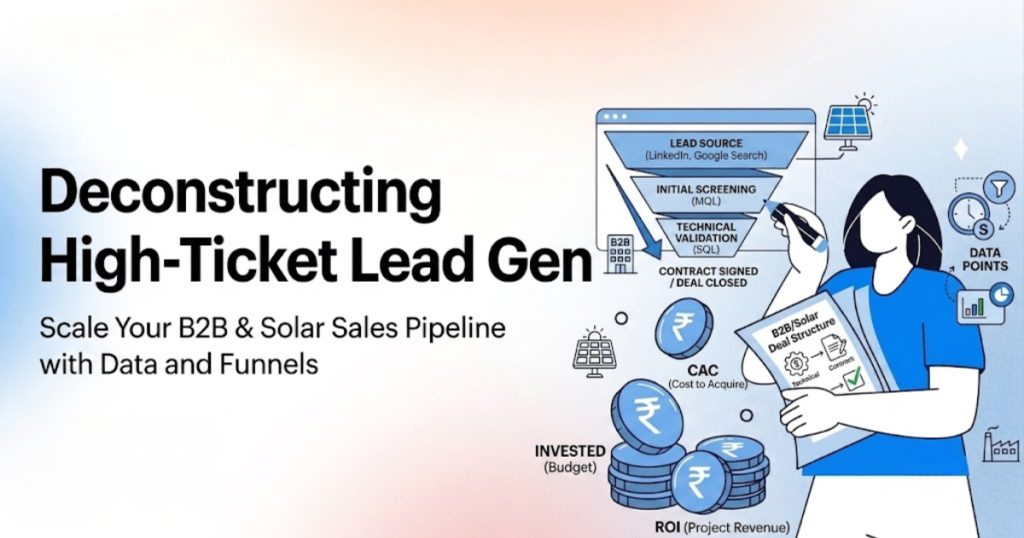
To solve the lead quality problem, we must first analyze why high-ticket lead generation is fundamentally different from traditional B2C digital marketing. Many mainstream agencies fail because they treat a ₹50-Lakh commercial solar project like a ₹5,000 lifestyle product.
The Core Challenges of High-Ticket Sales Pipelines
- Extended Sales Cycles (The Trust Deficit): Unlike impulse-buy products where the conversion happens within minutes, high-ticket B2B and industrial solar sales cycles can last anywhere from 30 days to 6 months. The prospect needs to verify your engineering credentials, financial stability, warranties, and past execution track record.
- The Multi-Layered Decision-Making Unit (DMU): In a typical consumer purchase, there is only one decision-maker. In a B2B or commercial solar deal, your marketing campaign needs to appeal to multiple stakeholders simultaneously:
- The Plant Head/Operations Manager: Cares about technical specifications, durability, equipment downtime, and structural safety.
- The Chief Financial Officer (CFO): Cares about capital expenditures (CAPEX), operational expenses (OPEX), tax depreciation benefits (Section 32 of the Income Tax Act), and internal rate of return (IRR).
- The Managing Director (MD) / Owner: Cares about long-term brand value, operational sustainability, and overall return on investment.
- High Financial Risk Perception: High-ticket purchases involve a massive upfront capital outlay. Prospects are naturally risk-averse. If your marketing content does not immediately radiate industry authority, corporate stability, and rigorous technical expertise, high-value prospects will not share their verified contact information.
Why Standard Digital Marketing Agencies Fail in B2B & Solar
Most generic digital agencies focus on vanity metrics. They optimize campaigns for the lowest Cost-Per-Lead (CPL). To drive down CPL, they create broad target audiences, use clickbait ad creatives, and use hyper-simplified lead forms.
The result? You receive hundreds of leads from individuals with zero buying power, inadequate roof space, or no registered business entity.
Conversely, a dedicated performance marketing agency aligns its ad budgets with your bottom-line revenue. They optimize campaigns for the lowest Customer Acquisition Cost (CAC) and the highest Pipeline Velocity, ensuring that every rupee spent on ads actively contributes to verified contract signings.
2. B2B vs. B2C Marketing Funnels: The Strategic Divide
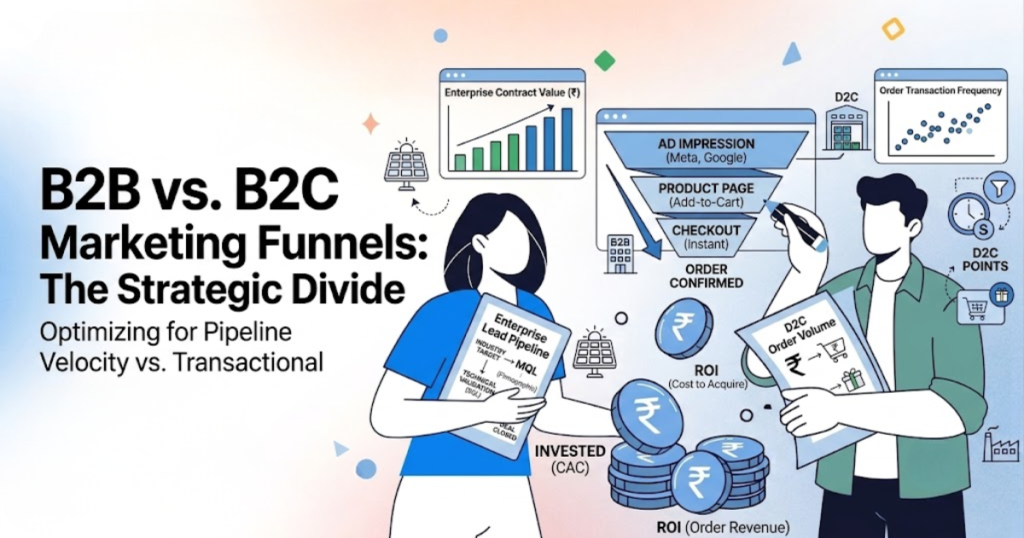
To successfully capture and convert high-ticket enterprise clients, your entire digital infrastructure must be designed to cater to a deeply analytical, low-impulse audience.
The structural differences between high-ticket B2B/Solar funnels and standard consumer marketing funnels are highlighted below:
| Structural Dimension | Standard B2C Marketing Funnel | High-Ticket B2B & Solar Funnel |
| Primary Campaign Metric | Cost Per Click (CPC) & Click-Through Rate (CTR) | Cost Per Qualified Lead (CPQL) & Sales Pipeline Value |
| Target Audience Scope | Broad, mass-market demographics based on casual interests | Niche, laser-targeted firmographics (Job Titles, Industries, Revenue, GST Status) |
| Core Conversion Trigger | Emotional appeal, discount coupons, and FOMO (Fear Of Missing Out) | Financial logic, technical whitepapers, ROI calculators, and case studies |
| Ad Platform Strategy | Heavy reliance on Instagram, TikTok/Reels, and broad Meta ads | Highly coordinated Omni-Channel strategy (LinkedIn, Google Search, Intent-based Meta Ads) |
| Lead Nurturing Process | Short-term automated email sequences with discount reminders | Long-term multi-channel nurturing via WhatsApp Automation, Case Studies, and Retargeting |
| Data Optimization Hook | Pixel tracking on instant checkout/add-to-cart events | CRM-integrated Offline Conversion Tracking (OCT) via API engines |
3. The 4-Stage Multi-Channel Performance Marketing Architecture
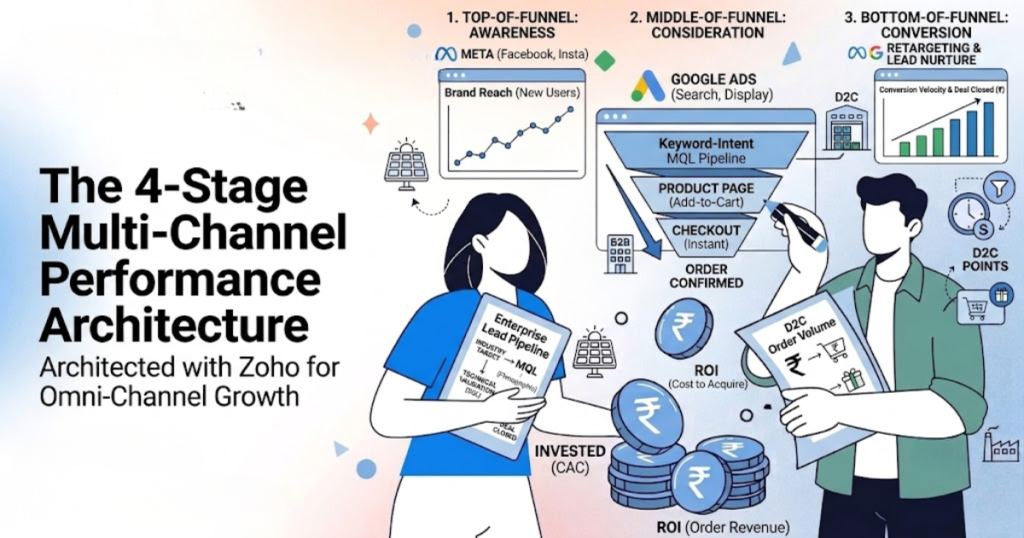
The best performance marketing agency in India does not rely on a single ad platform. They build an integrated ecosystem where different channels work in tandem to capture interest, validate intent, build trust, and drive conversions.
[ STAGE 1: INTENT CAPTURE & DISCOVERY ]
(Google Search Ads + LinkedIn Account-Based Ads)
│
▼
[ STAGE 2: FRICTIONLESS CONVERSION ]
(Interactive ROI Tools + Technical Landing Pages)
│
▼
[ STAGE 3: HYPER-QUALIFICATION ENGINE ]
(API-Driven Form Filters + Instant GST/Bill Queries)
│
▼
[ STAGE 4: OMNIPRESENT REMARKETING ]
(Meta Retargeting + WhatsApp Automation Pipelines)
Here is a comprehensive breakdown of how this multi-channel architecture operates across its four core stages:
Stage 1: Intent Capture and Discovery – best Performance marketing agency in India
Google Search Ads (Capturing Active Intent)
When a factory owner or infrastructure director experiences high energy costs, they do not browse social media looking for solutions; they open Google and search for actionable answers.
Top performance agencies target high-commercial-intent keywords rather than broad informational terms:
- Informational Keyword (Avoid for Direct Ads): “How do solar panels work?”
- Commercial Intent Keyword (Target Heavily): “Industrial solar panel installers in Ahmedabad”
- High-Ticket Intent Keyword (Target Heavily): “Commercial rooftop solar EPC company Delhi NCR”
By bidding aggressively on long-tail, high-intent phrases, the agency positions your brand directly in front of buyers who already have an active budget and a pressing need.
LinkedIn Ads (Account-Based Marketing & Precise Targeting)
For enterprise B2B products and multi-megawatt commercial solar installations, LinkedIn is the ultimate lead generation engine. A premium performance marketing agency utilizes Account-Based Marketing (ABM) frameworks to target specific user groups:
- Industry Filters: Target Manufacturing, Textiles, Cold Storage, Chemical Plants, Warehousing, and Heavy Infrastructure.
- Company Size Filters: Limit ad delivery to companies with more than 50, 200, or 500 employees to filter out underfunded micro-businesses.
- Job Title/Function Filters: Serve ads exclusively to Managing Directors, Chief Financial Officers, Operations Heads, Plant Managers, and Facilities Directors.
Stage 2: Frictionless Conversion and Trust Architecture – best Performance marketing agency in India
Once a prospect clicks on your ad, they must land on a highly optimized, high-speed, secure landing page designed specifically for corporate decision-makers.
The Elements of a High-Converting B2B & Solar Landing Page
- Technical Transparency over Fluff: Instead of using vague taglines like “We provide the best solar solutions,” use clear, data-backed headlines: “Reduce Your Factory’s Monthly Electricity Bill by Up to 70% with Tier-1, ALMM-Approved Rooftop Solar Systems. 4-Year Payback Period Guaranteed.”
- Interactive Solar ROI Calculators: High-ticket prospects appreciate data. Top performance agencies design interactive calculators on the landing page where a business owner can input their current monthly electricity bill, available roof area (in square feet), and state location. The tool instantly generates a preliminary report detailing their estimated system size, total capital expenditure, annual savings, and carbon offset statistics.
- Real Asset Case Studies: Avoid using generic stock images of solar panels or corporate offices. High-ticket buyers can spot stock photography instantly, which can erode trust. Use crisp, high-resolution imagery and video walkthroughs of your actual, executed projects. Detail the precise technical components used (e.g., N-Type TOPCon Mono Perc Solar Modules, high-efficiency String Inverters, and hot-dip galvanized mounting structures).
- Regulatory & Subsidy Compliance Data: For the Indian market, explicitly state compliance with regional DISCOM guidelines, net metering approvals, and state-specific commercial solar subsidies. This establishes immediate regulatory credibility.
Stage 3: The Hyper-Qualification Engine – best Performance marketing agency in India
To protect your sales team from burnout caused by cold or low-quality leads, a premium performance agency implements advanced qualification filters directly into the capture form.
Critical Data Points for High-Ticket Qualification – best Performance marketing agency in India
A basic lead form asks for a Name, Phone Number, and Email. A high-ticket performance form requests deep structural data points:
- Company Name & Verified Corporate Email: Instantly filters out casual, non-business users.
- Average Monthly Electricity Bill: Dropdown options like Under ₹50,000, ₹50,000 to ₹2 Lakhs, or Above ₹2 Lakhs. Anyone selecting “Under ₹50,000” is immediately routed to a lower-priority automated bucket, while high-value entries are instantly forwarded to senior account managers.
- Available Rooftop Area / Sanctioned Load: Ensures the client has the physical infrastructure necessary to justify a high-capacity commercial solar deployment.
- GST Number (Optional Field for Advanced Validation): Allows your backend sales systems to pull automated corporate health reports via public registries before your team even places the first discovery call.
Stage 4: Omnipresent Remarketing and Lead Nurturing – best Performance marketing agency in India
Because high-ticket conversion cycles are long, a prospect who visits your landing page today might not be ready to sign a contract for another two months. A performance agency designs an omnipresent remarketing framework across Meta (Facebook & Instagram), YouTube, and Google Display Networks to keep your brand top-of-mind.
The Dynamic Remarketing Content Matrix
- Day 1 to 7 Post-Visit: Show video case studies of your largest commercial installations, featuring real client testimonials detailing how much money they saved in their first quarter.
- Day 8 to 15 Post-Visit: Highlight financial benefits, such as accelerated depreciation tax savings, available 100% collateral-free commercial solar financing options, and low-interest institutional loan tie-ups.
- Day 16 to 30 Post-Visit: Show technical and engineering certifications, safety protocols, wind-load testing certificates for mounting structures, and operations and maintenance (O&M) warranty terms.
Automated WhatsApp & Email Workflows
Simultaneously, the lead is funneled into an automated CRM pipeline. They receive regular, educational WhatsApp updates containing structured PDFs, such as: “The Ultimate Checklist for Plant Heads Before Installing Commercial Solar Panels.” This positions your brand as an industry educator rather than just an aggressive vendor.
4. Advanced Technical Frameworks: OCT & Conversions API
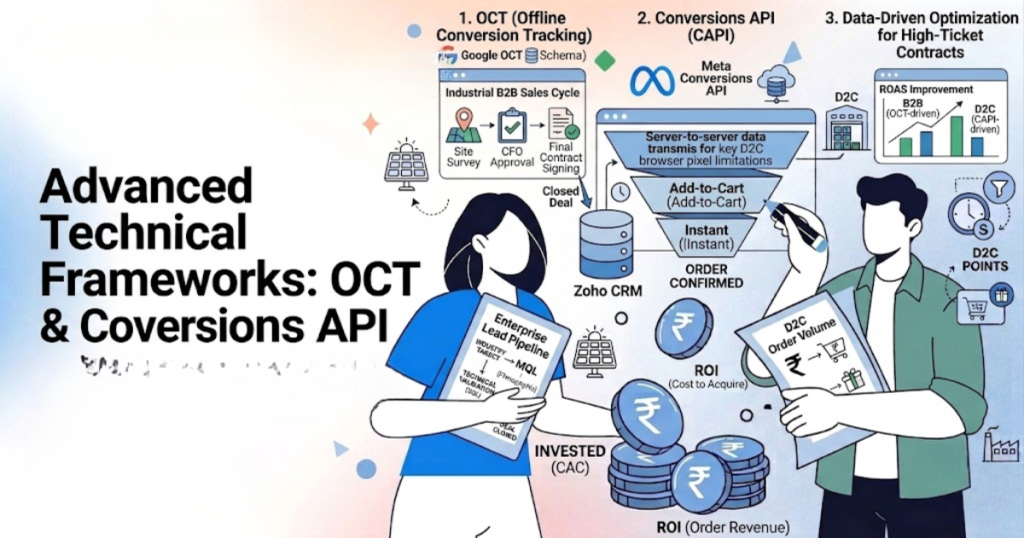
In 2026, relying solely on basic browser-based pixel tracking is no longer sufficient. Browser privacy policies, third-party cookie restrictions, and advanced ad-blockers can cause standard tracking pixels to miss up to 30% of your conversion data.
To bridge this gap, the best performance marketing agency in India deploys advanced server-side data tracking infrastructures.
+——————–+ Server-Side API Integration +——————–+
| Your CRM System | ====================================> | Ad Platform Engines|
└─────────────────── Optimizes Ad Spend ─────────────────────┘ more buyers with
matching profiles
Meta Conversions API (CAPI)
Instead of tracking conversions through a user’s web browser, Meta Conversions API establishes a direct connection between your web server and Meta’s data centers. This ensures 100% accurate attribution for every form filled, phone number clicked, or brochure downloaded, allowing ad delivery algorithms to scale without losing data clarity.
Google Offline Conversion Tracking (OCT)
This is the ultimate game-changer for B2B and high-ticket solar lead generation. Here is how Google OCT works step-by-step:
- A prospect searches for a commercial product on Google and clicks on your search ad.
- Google automatically appends a unique identifier called a GCLID (Google Click ID) to the landing page URL.
- When the user fills out your qualification form, the GCLID is captured alongside their contact information and saved inside your CRM (such as Zoho CRM, HubSpot, or Salesforce).
- As the lead progresses through your offline sales cycle, your team updates the CRM status:
- Status 1: Form Submitted (MQL)
- Status 2: Site Survey Completed (SQL)
- Status 3: Commercial Proposal Shared (High Value)
- Status 4: Deal Closed / Contract Signed (Success)
- At regular intervals, your CRM automatically sends a data ping back to Google Ads, telling the platform: “The user associated with GCLID X has officially signed a contract worth ₹45 Lakhs.”
Why This Matters
By feeding offline sales data back into the ad platform, you shift the optimization target. Google’s artificial intelligence stops looking for users who merely fill out forms. Instead, it analyzes the behavioral profiles of the prospects who actually spent money with your business and optimizes your budget to find more high-value buyers.
5. Tailored Copywriting Frameworks for High-Ticket B2B & Solar Ads
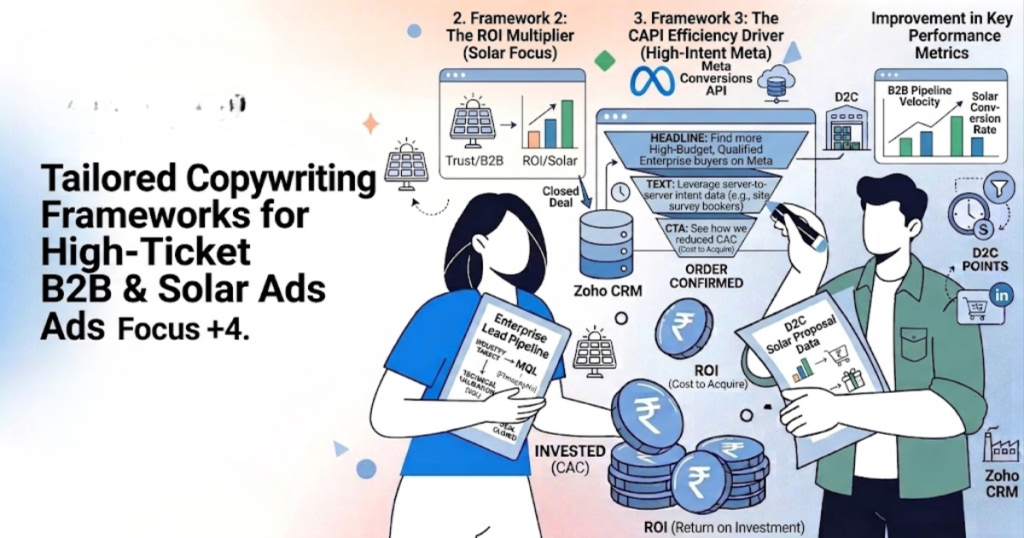
Your ad creatives and copywriting need to resonate with technical and corporate decision-makers. Generic promotional copy like “Hurry up! Big discounts on solar panels!” fails in the corporate sector.
Below are two proven, high-converting ad copy frameworks designed for premium Indian audiences.
Ad Framework 1: The CFO & Managing Director Focus (Google/LinkedIn Search & Display)
- Primary Headline: Stop Paying 11+/Unit for Commercial Grid Power.
- Sub-Headline: Scale Your Factory’s Net Profits with Zero-Collateral Financed Rooftop Solar Systems.
- The Hook: For Indian manufacturing units, electricity bills are one of the top three operational expenses. By switching to a custom-engineered, captive rooftop solar plant, you can cut your grid energy dependence by up to 70% and utilize Section 32 accelerated depreciation benefits to claim massive tax savings in Year 1.
- Core Core Pillars:
- ✅ Tier-1 Components Only: High-efficiency ALMM-approved modules with a 25-year performance warranty.
- ✅ Flexible Financing: 100% CAPEX financing options with leading Indian banking partners.
- ✅ Turnkey Execution: We handle everything from structure engineering and state DISCOM approvals to final net-metering commissioning.
- Call To Action (CTA): [Book a Free Site Survey & Download Your Savings Assessment Report]
Ad Framework 2: The Plant Head & Operations Focus (Meta/LinkedIn Video Ad Script)
- Visual Hook (0-5 seconds): Video opens with a high-resolution drone shot panning across a massive, clean industrial factory roof covered in premium solar panels. On-screen bold text overlay reads: “How This Textile Mill in Ahmedabad Saved ₹18 Lakhs Annually in Energy Costs.”
- The Problem Definition (5-15 seconds): “Every time your state DISCOM hikes industrial electricity tariffs, your manufacturing margins shrink. For a plant running 24/7, grid instability and high power bills make it incredibly difficult to stay competitive.”
- The Solution (15-30 seconds): “That is why leading Indian industrial brands are moving to high-yield captive solar infrastructures. Our team engineered a robust, wind-load-tested structural setup that seamlessly integrates with their existing industrial electrical panels without a single minute of plant downtime.”
- The Proof & Trust Validation (30-45 seconds): Show a brief clip of the actual factory owner or plant head speaking into a microphone: “We recovered our entire capital investment within 3.5 years. Our O&M support from the engineering team has been completely seamless.”
- The Actionable Close (45-60 seconds): “Do not let high energy tariffs eat into your operating margins. Click below, enter your monthly power bill details, and our senior engineering team will design a custom solar ROI assessment blueprint for your facility.”
- Call To Action (CTA): [Click Learn More to Secure Your Industrial ROI Evaluation]
6. Crucial Regulatory & Policy Realities for 2026
When running performance campaigns for the Indian solar sector, your marketing assets must remain aligned with the latest regulatory changes.
The ALMM Mandate Implementation
The Ministry of New and Renewable Energy (MNRE) has enforced strict guidelines regarding the Approved List of Models and Manufacturers (ALMM). All commercial, industrial, and government-subsidized solar projects are legally required to use solar modules certified under the ALMM framework.
A high-ticket marketing campaign should highlight that your brand uses ALMM-approved, domestic-content-compliant components. This immediately signals legitimacy and helps corporate clients avoid regulatory compliance issues or project delays.
Corporate ESG Tracking and Incentives
Indian corporations are focusing heavily on Environmental, Social, and Governance (ESG) compliance metrics, driven by institutional investor mandates and international trade regulations. Your performance marketing copy should emphasize how installing a captive solar project helps a manufacturing unit lower its carbon footprint, secure green energy certifications, and satisfy corporate sustainability compliance audits.
7. Frequently Asked Questions (FAQ)
Q1: What is a realistic cost-per-lead (CPL) for high-ticket commercial solar or B2B lead generation in India?
For qualified, high-ticket B2B and commercial solar leads (e.g., a minimum 100kW rooftop requirement with a verified GST number and corporate contact details), a realistic Cost-Per-Qualified-Lead (CPQL) ranges between ₹1,500 to ₹4,500.
While general consumer leads can be generated for under ₹100, they are typically unqualified individuals without the necessary budget or property ownership. In high-ticket marketing, your target metric should always be Customer Acquisition Cost (CAC) and total closed pipeline revenue, rather than a low front-end CPL.
Q2: How do you filter out residential users when running ads for commercial and industrial (C&I) solar?
We implement a multi-layered filtration architecture across our funnels:
- Targeting Constraints: We deliberately exclude residential, consumer-focused interests and explicitly target professional business job titles and corporate demographics on LinkedIn and Meta.
- Ad Creative Exclusion Copy: We use precise framing inside the ad headline itself, such as “Exclusively for Commercial Factories & Industrial Units” or “Minimum Requirement: Monthly Electricity Bill > ₹50,000”. This clearly signals to residential homeowners that the ad is not intended for them.
- Landing Page Verification: The lead generation form features conditional logic fields that require users to select their business type, mention their available commercial roof space, or state their average industrial energy tariff.
Q3: Which platform delivers a better return on investment (ROAS) for B2B lead generation: Google Search or LinkedIn Ads?
Both platforms serve distinct, complementary roles within a balanced performance marketing ecosystem:
- Google Search Ads yield the fastest short-term conversions because they capture active buyer intent. Users searching for specific enterprise keywords are looking for immediate solutions, making these leads highly sales-ready.
- LinkedIn Ads are highly effective for strategic, long-term Account-Based Marketing (ABM). They allow you to proactively introduce your brand to senior corporate decision-makers at target enterprises before they actively begin looking for alternatives on search engines.
Q4: How long does it take for a performance marketing framework to show consistent revenue results for a B2B or solar brand?
Because high-ticket enterprise sales cycles involve complex evaluations and approval processes, a proper performance marketing architecture requires a runway of 60 to 90 days to calibrate effectively.
- Month 1 focuses on deploying server-side tracking, launching target campaigns, testing ad concepts, and gathering initial lead data.
- Month 2 leverages those data insights to refine targeting parameters, eliminate low-yield audiences, and launch hyper-targeted remarketing funnels.
- Month 3 establishes a consistent flow of Qualified Leads (SQLs) moving efficiently through your offline sales pipeline toward final deal closures.