The digital advertising ecosystem has undergone a massive paradigm shift over the last decade. Gone are the days when businesses would allocate millions of rupees to a billboard on a prime highway or a 10-second television spot during a cricket match, purely hoping that it would translate into sales. Today, in an era dominated by hyper-connectivity, data analytics, and shrinking profit margins, businesses can no longer afford to shoot arrows in the dark.If you are a business owner, a startup founder, or a digital marketer running campaigns in a highly competitive landscape, you have likely asked yourself: How do I ensure that every single rupee I spend on advertising directly contributes to my bottom line?The answer lies in a highly accountable, data-driven framework. Let’s explore the core mechanics of this strategy and understand exactly why performance marketing has become the ultimate game-changer for modern businesses.
1. Demystifying Performance Marketing: What Is It Exactly?
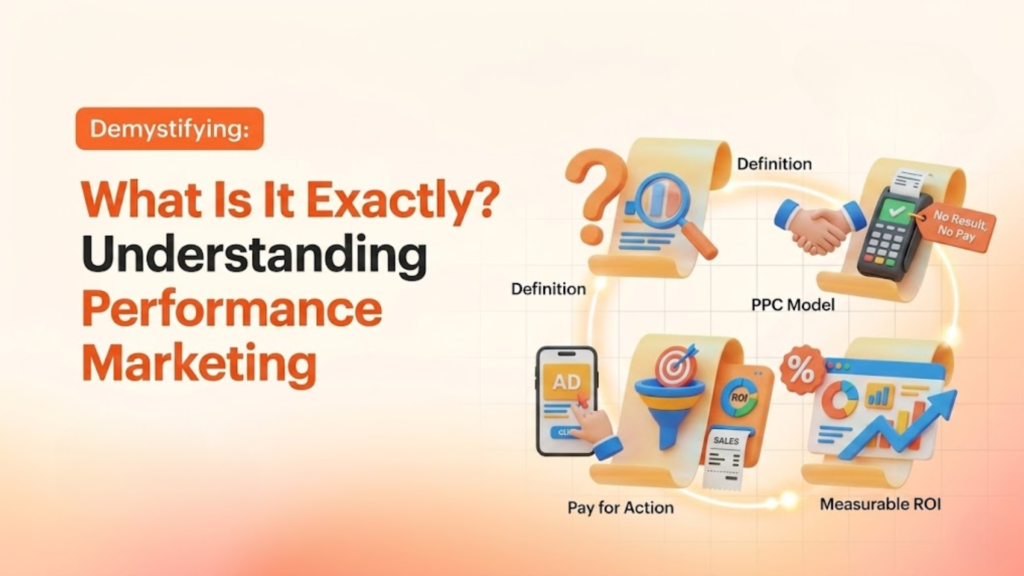
Before diving into the strategic advantages, it is essential to establish a crystal-clear definition.
Performance marketing is a comprehensive, results-oriented digital marketing strategy where advertisers pay marketing companies, platforms, or agencies only when a specific, pre-determined action is successfully completed. Unlike traditional brand-building exercises that focus on vague metrics like “brand awareness,” “reach,” or “estimated ad recall,” this approach operates strictly on a “Pay-for-Results” model.
The Anatomy of Measurable Actions
In this framework, you do not pay for the mere potential of an audience seeing your ad. Instead, you pay for tangible consumer behaviors, including:
- Clicks (CPC): A user actively clicks on your ad, directing them to your landing page or website.
- Leads (CPL): A user fills out a contact form, requests a quote, or signs up for a webinar.
- Sales/Conversions (CPA): A user completes a financial transaction, purchasing a product or booking a paid service.
- App Installs (CPI): A user downloads and installs your mobile application on their smartphone.
2. Structural Comparison: Performance Marketing vs. Traditional Marketing
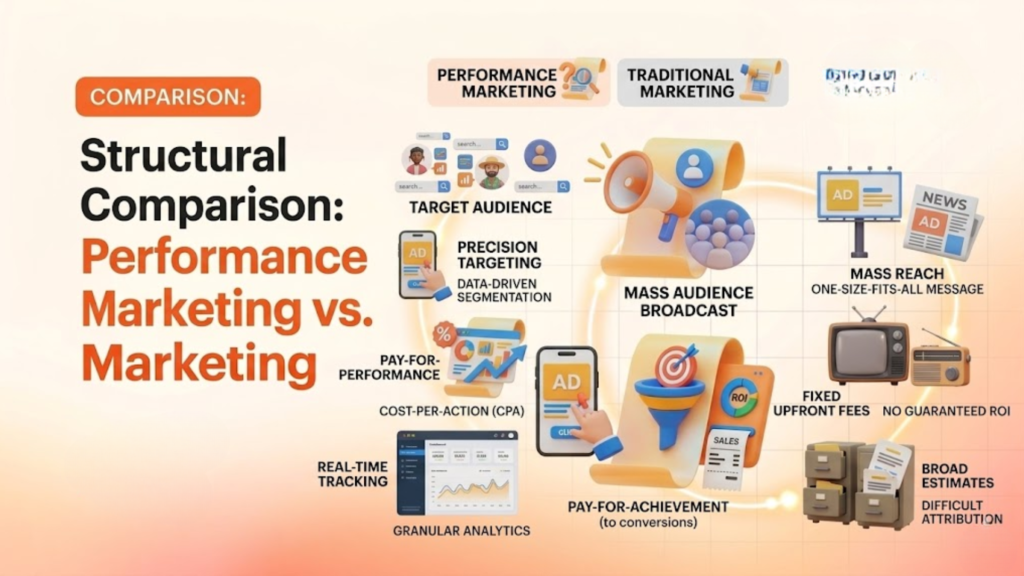
To truly grasp why performance marketing is viewed as a revolutionary upgrade, we must contrast it with traditional media channels. The table below outlines the core operational differences between the two methodologies:
| Operational Metric | Traditional Marketing (Billboards, Print, TV) | Performance Marketing (Meta Ads, Google Ads, SEO) |
| Payment Model | Upfront Fee: Paid entirely in advance based on estimated viewership or circulation. | Result-Based: Paid only when a specific action (Click, Lead, Sale) occurs. |
| Data & Tracking | Delayed & Estimated: Relies on third-party surveys, sample sizes, and delayed reports. | Real-Time & Exact: Instantly tracks user journeys, click-through rates, and conversion paths. |
| Audience Targeting | Broad/Mass-Market: Spreads a wide net across a geographic area, leading to high ad waste. | Hyper-Targeted: Filters by demographics, precise interests, intent, and historical behavior. |
| Financial Risk | High Risk: High initial capital investment with no guarantee of generating revenue. | Low Risk: Controlled daily budgets that can be scaled up or paused instantly based on daily ROI. |
| Optimization Flexibility | Rigid: Once a billboard is printed or a TV ad is scheduled, it cannot be changed mid-campaign. | Fluid: Ad creatives, copy, and audience targeting can be edited instantly based on real-time data. |
3. Deep-Dive Analysis: Why Performance Marketing is the Ultimate Game-Changer
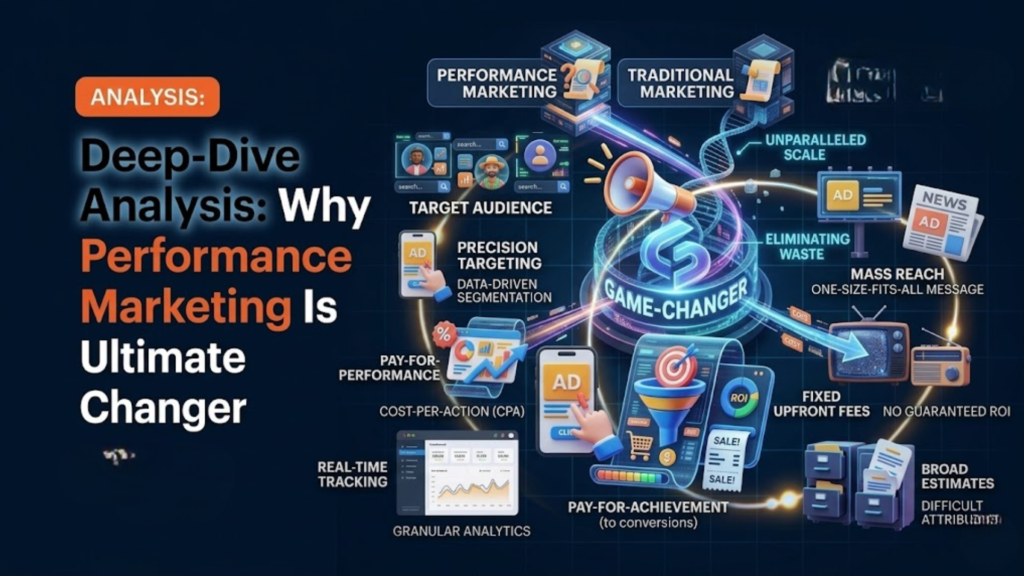
A. 100% Trackability and the Elimination of Waste
One of the most famous quotes in advertising history comes from John Wanamaker, who stated, “Half the money I spend on advertising is wasted; the trouble is I don’t know which half.”
Performance marketing completely solves this age-old dilemma. Through advanced tracking pixels, UTM codes, and analytics dashboards, every single penny is accounted for.
When you run a campaign, you receive clear, empirical answers to crucial business questions:
- Which specific ad creative generated the highest number of high-intent inquiries?
- At what exact hour of the day do users show the highest conversion probability?
- What is the exact Customer Acquisition Cost (CAC) for your business this week versus last week?
This absolute transparency allows businesses to ruthlessly eliminate low-performing campaigns and reallocate capital into highly profitable assets.
B. Hyper-Granular Audience Targeting and High Intent
Traditional advertising is fundamentally inefficient because it treats a diverse population as a homogenous group. For instance, displaying an ad for premium, commercial-grade solar panels on a highway billboard means that 99% of the people viewing it—including daily commuters, students, and tourists—have zero use for it. You are effectively paying to show your message to an irrelevant audience.
Performance marketing shifts the focus from broad demographics to granular consumer intent. By leveraging platforms like Google Search Ads, you target individuals at the exact moment they are looking for a solution.
Example: If a factory owner types “industrial IP67 electrical junction box manufacturers in India” into Google, their purchasing intent is incredibly high. Showing a targeted performance ad to this specific user yields a significantly higher probability of conversion compared to showing a standard banner to a million random internet users.
C. The Power of Dynamic Scalability
For small and medium enterprises (MSMEs) or bootstrapped startups, financial liquidity is a frequent challenge. Committing lakhs of rupees to an untested marketing campaign can be financially catastrophic.
Performance marketing democratizes the business landscape by offering unparalleled scalability:
- Micro-Budgets: You can launch a highly targeted Meta or Google ad campaign with a modest daily budget of just ₹500 to ₹1,000.
- Proof of Concept: This minimal investment allows you to safely test your product market fit, ad copy, and landing page conversion rates.
- Aggressive Scaling: Once the data demonstrates a positive return on ad spend (e.g., spending ₹1,000 consistently yields ₹4,000 in revenue), you can systematically scale the daily budget to ₹10,000, ₹50,000, or more to capture market share.
D. Accelerated Speed-to-Market and Quick Feedback Loops
Developing an organic brand footprint via traditional PR, word-of-mouth, or standard search engine optimization (SEO) is highly valuable, but it requires months—sometimes years—of continuous effort to bear fruit.
When a business introduces a new product line or expands into a new regional territory, waiting months for momentum is rarely an option. Performance marketing acts as a digital accelerator. A precisely constructed campaign can be built, approved, and launched within a few hours, funneling highly qualified traffic to a website almost immediately. This rapid deployment provides immediate market feedback, allowing you to validate offers and refine your positioning in days rather than quarters.
4. Understanding Key Financial Performance Metrics (KPIs)
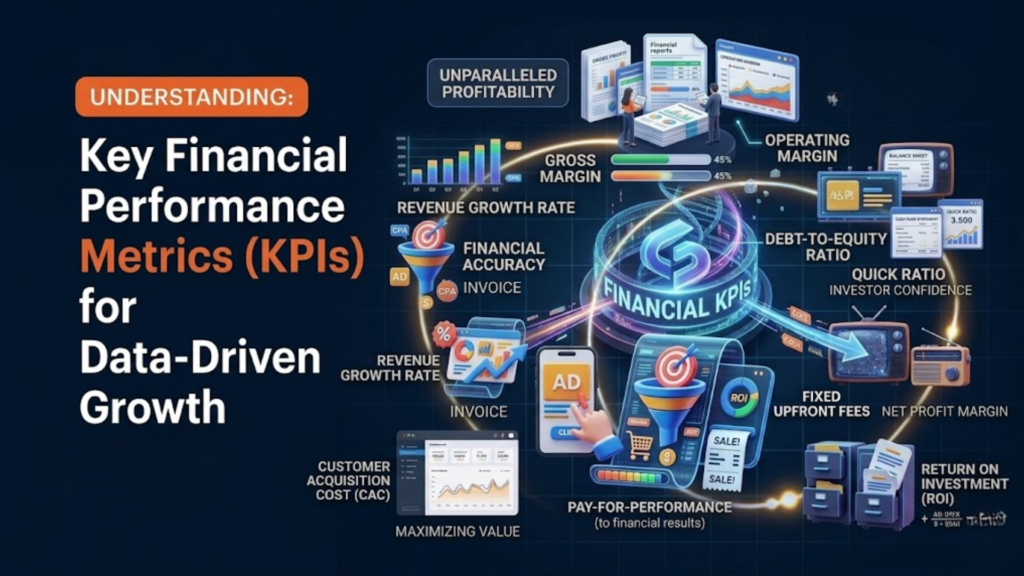
To navigate the performance marketing ecosystem successfully, a business leader must look beyond surface-level vanity metrics like “likes,” “shares,” or “page views.” Instead, focus should be directed toward Core Performance Metrics that influence the balance sheet:
- Return on Ad Spend (ROAS): This metric measures the gross revenue generated for every single rupee spent on advertising.
$$\text{ROAS} = \frac{\text{Total Revenue Generated from Ads}}{\text{Total Cost of Ad Campaign}}$$
If an ad campaign costs ₹25,000 and generates ₹1,00,000 in direct sales, the ROAS is 4:1. - Cost Per Acquisition (CPA) / Cost Per Lead (CPL): The exact amount of money expended to acquire a single paying customer or a qualified business lead. Keeping this metric lower than your average profit margin is the fundamental rule of business profitability.
- Click-Through Rate (CTR): The percentage of users who see your ad and actually click on it. A high CTR indicates that your visual creative and promotional copy resonate strongly with the target market.
- Conversion Rate (CR): The percentage of website or landing page visitors who take the desired action (such as filling out an inquiry form or completing a purchase). This serves as a primary indicator of how compelling your core offer and landing page experience are.
5. Tailoring the Strategy for the Indian Business Ecosystem
The Indian marketplace presents a unique blend of massive digital adoption alongside deeply ingrained consumer habits. With data costs remaining highly accessible, hundreds of millions of individuals across Tier-1, Tier-2, and Tier-3 cities browse the internet daily. However, Indian consumers are notoriously value-conscious and require high levels of trust before parting with their money.
To make performance marketing work effectively in India, consider these localized strategies:
Embracing Regional Languages and Hyper-Local Context
While English remains dominant in corporate circles, the vast majority of new internet users in India consume content in regional languages. Designing performance marketing ad creatives and landing pages in Hindi, Gujarati, Marathi, Tamil, or Assamese dramatically lowers your Cost Per Lead (CPL).
A regional business owner or local consumer is far more likely to trust an advertisement that addresses them in their native tongue, utilizing localized references, cultural nuances, and regional pricing benefits.
Building Trust via Direct, Frictionless Communication
In the Western world, automated email funnels and complex self-service checkout pages are standard practice. In the Indian market, trust is built through direct, personalized human interaction.
Integrating direct WhatsApp Business API links into your performance ads can be highly effective. Allowing a prospective client to click an ad and immediately chat with a representative drastically reduces friction, accelerates trust, and increases overall conversion rates.
6. Common Pitfalls to Avoid in Performance Marketing
While the advantages of this marketing framework are undeniable, it is not a foolproof silver bullet. Mismanaging campaigns can quickly drain your ad budget. Avoid these critical mistakes:
- Ignoring Creative Fatigue: Running the exact same banner image or video ad for months causes your target audience to develop “ad blindness.” Your CTR will drop, and your acquisition costs will steadily rise. Refresh ad creatives at regular intervals.
- Neglecting the Landing Page Experience: You can design the most brilliant, high-converting ad copy on Meta or Google, but if a user clicks it and lands on a slow-loading, confusing, or unoptimized website, they will leave immediately. The conversion path must be clean and fast.
- Over-Optimizing for Cost Instead of Quality: Bidding strategies focused strictly on acquiring the cheapest possible clicks or leads often result in low-intent, junk data. It is far more profitable to pay ₹500 for a single highly qualified, conversion-ready lead than ₹50 for ten unqualified leads who will never pick up the phone.
Frequently Asked Questions (FAQ)
Q1: Is performance marketing suitable for small businesses with limited budgets?
Absolutely. In fact, performance marketing is highly ideal for small businesses because it eliminates financial wastage. You do not need a multi-lakh budget to begin. By setting strict daily limits and targeting narrow, high-intent audiences, small businesses can compete directly with large corporations and scale their budget inline with organic revenue growth.
Q2: How long does it take to see tangible results from a campaign?
Unlike organic SEO or brand building, which can take several months to mature, performance marketing delivers near-instantaneous data. Once your campaign goes live, you will typically see traffic, clicks, and initial lead generation within the first 24 to 48 hours. However, optimizing a campaign for peak profitability usually requires 2 to 4 weeks of continuous data collection.
Q3: Does performance marketing completely replace traditional brand building?
Ideally, no. While performance marketing focuses heavily on immediate, short-term conversions, brand equity creates long-term market stability. A holistic business strategy combines both: performance marketing secures immediate revenue and high-intent leads today, while long-term branding ensures that customers recognize and trust your name tomorrow without relying solely on paid ads.
Q4: Which platform is better for generating B2B leads: Google Ads or Meta Ads?
Both platforms serve distinct, valuable purposes based on user psychology:
- Google Ads is built around explicit search intent. It targets users who are actively searching for a specific solution right now (e.g., “commercial solar financing options”).
- Meta Ads (Facebook & Instagram) relies on demographic and interest targeting. It is excellent for introducing a solution to users who may need it but aren’t actively searching for it yet, allowing you to educate the market using engaging visual formats.
Q5: What is a healthy Return on Ad Spend (ROAS) to aim for?
A sustainable ROAS varies by industry, product margins, and business models. Generally, a 3:1 to 4:1 ROAS (generating ₹3 to ₹4 for every ₹1 spent) is considered healthy and profitable for most standard product and service businesses. High-margin industries or digital products often achieve significantly higher ratios.
Summary: Securing Long-Term Business Vitality
At its core, the answer to why performance marketing has become an indispensable pillar of modern business is simple: it introduces absolute accountability, financial predictability, and radical efficiency to your commercial growth. It transforms marketing from an unpredictable, speculative gamble into a reliable, repeatable engine for revenue generation.
By embracing detailed data tracking, structuring your campaigns around hyper-targeted user intent, and continuously refining your customer touchpoints, your business can navigate highly competitive markets with precision, security, and continuous profitability.