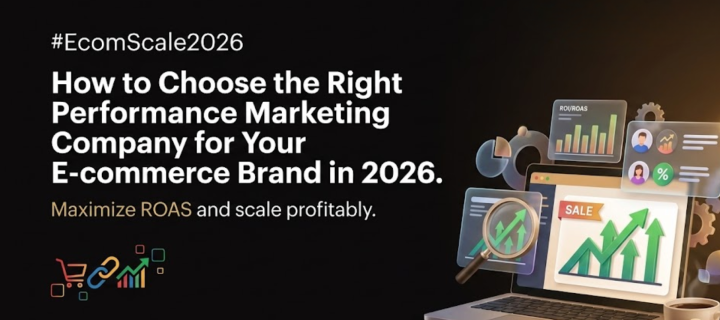
The Indian e-commerce landscape has undergone a tectonic shift. We are no longer in the era of “post and pray.” With the rise of Quick Commerce, AI-driven bidding, and Social-led discovery, your brand’s survival depends on how scientifically you spend your marketing dollars.Choosing a performance marketing company is no longer about finding someone to “run ads”; it’s about finding a partner who understands unit economics as well as they understand algorithms.
1. Defining Performance Marketing in the 2026 Context
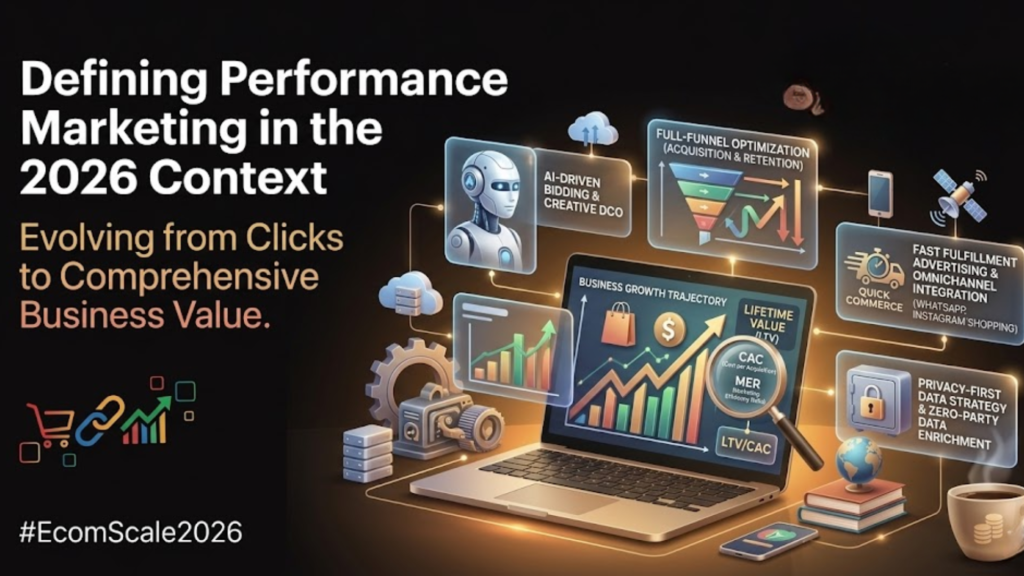
In the early days of digital advertising, marketing was often a “black box.” You spent money on a billboard or a TV spot and hoped for the best. Performance Marketing flipped the script by introducing accountability. However, in 2026, the definition has shifted from “paying for clicks” to “paying for profitable business outcomes.”
For an E-commerce brand, this means every rupee spent must be traceable through a complex, multi-touch journey. We no longer look at a single click; we look at the ecosystem of influence.
A. The Evolution: From “Pay-per-Click” to “Pay-per-Value”
In the past, a performance marketing company would focus solely on Top-of-Funnel (ToFu) metrics. Today, the focus is on Predictive Performance. Using AI models, agencies can now predict which users are likely to become “High-Value Customers” (HVCs) before they even make their first purchase.
- The 2026 Shift: We are moving away from Vanity Metrics (likes, impressions, reach) and moving toward Velocity Metrics (how fast a lead turns into a repeat buyer).
B. The 4 Modern Pillars of Performance Marketing
To understand what your agency should be doing, you must understand these four pillars in detail:
i. Search Engine Marketing (SEM) & AI-Search
By 2026, Google Search has evolved into SGE (Search Generative Experience). People don’t just type keywords; they ask complex questions.
- The Strategy: Your agency must optimize for “Answer Engine Optimization.” It’s not just about bidding on “Buy Shoes”; it’s about appearing when a user asks, “What are the best sustainable running shoes for flat feet under ₹5000?”
- Key Focus: Improving Quality Score to lower your CPC (Cost Per Click).
ii. Paid Social & Discovery Commerce
Platforms like Meta (Instagram/Facebook) and LinkedIn are now “Discovery Engines.”
- The Strategy: Using Broad Targeting. In 2026, the algorithm is smarter than any human. A great performance marketing company stops micro-managing interests and instead focuses on Creative Diversification.
- The Logic: If your creative is good, the algorithm will find the buyer.
iii. Programmatic & Native Advertising
This involves buying ad space across millions of websites and apps automatically.
- The Strategy: Using DCO (Dynamic Creative Optimization). This means the ad changes its headline, image, and CTA (Call to Action) automatically based on who is looking at it (e.g., showing a different ad to a Mumbai user vs. a Delhi user).
iv. Retention & LTV Optimization (The “Second Sale”)
Performance marketing doesn’t end at the first sale. In fact, the first sale is often where you lose money due to high CAC (Customer Acquisition Cost).
- The Strategy: Profitability is found in the 2nd, 3rd, and 4th purchase. Your agency must integrate Email, SMS, and WhatsApp flows to ensure the “Retention Loop” is closed.
C. The “Full-Funnel” Framework
A trustable agency will explain performance marketing using this 2026 framework:
| Funnel Stage | Objective | Primary KPI (Key Performance Indicator) |
| Top (TOFU) | Brand Discovery | CPM (Cost Per Mille) & Click-Through Rate (CTR) |
| Middle (MOFU) | Consideration | Add to Cart Rate & View Content |
| Bottom (BOFU) | Conversion | ROAS & Cost Per Acquisition (CPA) |
| Post-Purchase | Advocacy/Retention | LTV (Lifetime Value) & Repeat Purchase Rate |
D. Why This Matters for Your Brand
If you hire a performance marketing company that only looks at the “Bottom of the Funnel,” your brand will eventually hit a “Scaling Ceiling.” You will run out of people to sell to.
The 2026 Secret: True performance marketing is about creating demand at the top and harvesting demand at the bottom. It is a continuous cycle of data and creativity.
2. Critical Evaluation Metrics (The Decision Table)
When interviewing a performance marketing company, don’t just ask about “sales.” Use this table to compare potential partners:
| Metric | Traditional Approach | 2026 Performance Approach |
| Primary Focus | ROAS (Return on Ad Spend) | MER (Marketing Efficiency Ratio) |
| Tracking | Browser Cookies | Server-Side Tagging / CAPI |
| Channel Mix | Meta & Google only | Omnichannel (Q-Comm + WhatsApp) |
| Customer Data | Third-party audiences | First-Party Data Enrichment |
| Creative | Static Banners | AI-Generated Video & UGC |
3. Deep Dive: Why “The Indian Context” Matters
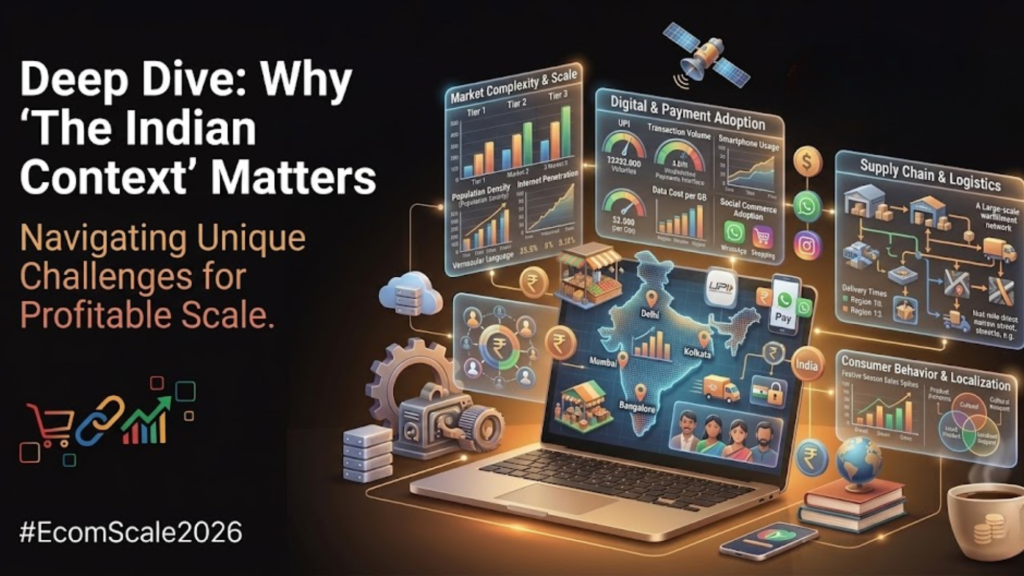
India is a unique market. A global strategy often fails here because of local nuances. Your chosen performance marketing company must master these three Indian realities:
A. The RTO (Return to Origin) Challenge
In India, Cash on Delivery (COD) still accounts for a huge chunk of orders. High RTO can kill an E-commerce brand.
- What a great agency does: They use predictive analytics to identify high-risk pin codes and exclude them from “High-Intent” ad sets.
- The Goal: Reducing RTO by at least 15-20% through smart targeting.
B. The Rise of Quick Commerce (Q-Comm)
With platforms like Blinkit and Zepto, “patience” is dead.
- If your agency doesn’t know how to run Retail Media Ads on Q-comm platforms, you are losing out on the “impulse buy” segment.
C. Vernacular Marketing
The next 200 million shoppers are coming from Tier 2 and Tier 3 cities.
- Bold Strategy: Your agency should be testing ads in Hindi, Tamil, Telugu, and Marathi to lower your CPA (Cost Per Acquisition).
4. The 5-Step Framework to Selecting Your Agency
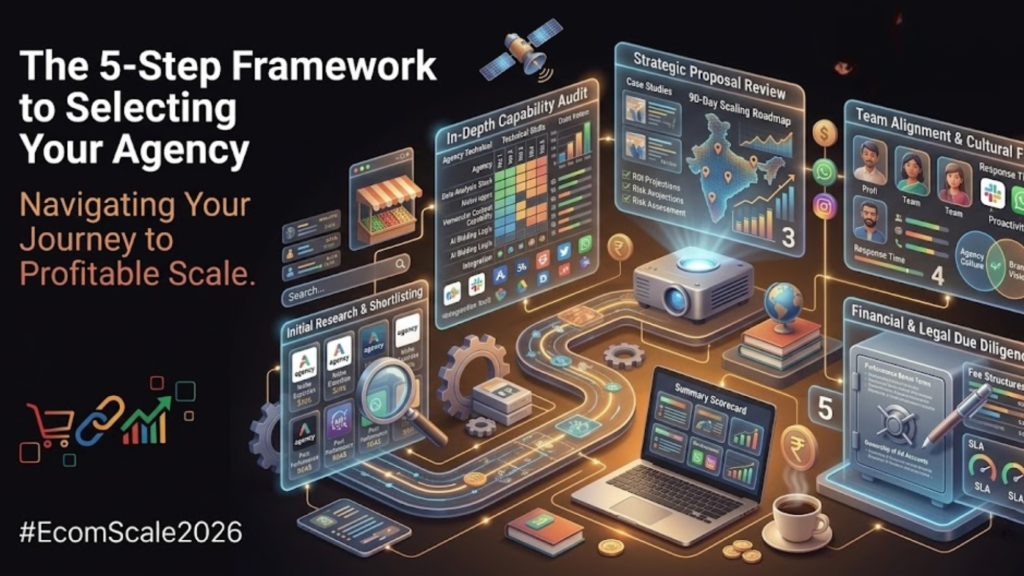
Step 1: Audit Their Tech Stack
A reliable performance marketing company should be proficient in:
- Retention Tools: Klaviyo, WebEngage, or CleverTap.
- Analytics: GA4, Northbeam, or Triple Whale.
- Creative Testing: Motion App or similar creative analytics tools.
Step 2: Transparency of Ad Accounts
Never let an agency run ads from their ad account. You must own the data.
- Rule: Your brand owns the Meta Business Manager and Google Ads account. The agency gets “Partner Access” only.
Step 3: Creative Strategy (The New Targeting)
In 2026, “Interest Targeting” is less effective because AI handles the targeting. Creatives are the new targeting. * Ask the agency: “How many new creative hooks do you test per week?” * A good answer is 5–10 new variations weekly.
Step 4: Understanding Unit Economics
If an agency promises a 10x ROAS but your product margin is only 20%, you might still be losing money.
- A trustable partner will ask for your COGS (Cost of Goods Sold) and Shipping Costs before setting a target.
Step 5: Communication Protocol
Performance marketing moves fast. You need:
- A dedicated Slack/WhatsApp channel for real-time updates.
- Weekly Deep-Dive calls (not just monthly reports).
5. Frequently Asked Questions (FAQ)
Q1: What is a realistic timeline to see results?
- Answer: While “performance” is instant, “optimization” takes time. Usually, the first 30 days are for testing, 60 days for stabilization, and 90 days for scaling.
Q2: Should I pay a flat fee or a percentage of ad spend?
- Answer: Most top-tier performance marketing companies charge a base fee + a small % of ad spend (usually 10-15%). This aligns their growth with yours.
Q3: Is SEO included in performance marketing?
- Answer: Generally, no. Performance marketing focuses on “Paid” media. However, a good agency will give you feedback on your landing page SEO to improve Quality Scores.
Q4: How much budget do I need to start?
- Answer: For a D2C brand in India, a minimum spend of ₹2,00,000 – ₹5,00,000 per month is usually required to gather enough data for the AI to optimize effectively.
Conclusion
Scalability in 2026 is about efficiency. Your brand doesn’t just need more traffic; it needs profitable traffic. By choosing a performance marketing company that prioritizes data transparency, understands the Indian consumer, and focuses on your bottom-line profit, you aren’t just buying ads—you are building an empire.