The Indian business landscape is witnessing a digital revolution. With the rollout of 5G and a massive surge in rural internet penetration, digital marketing for business has transitioned from a “luxury” to a “survival kit.” In 2026, simply having a website isn’t enough; you need a dynamic digital ecosystem that builds trust and converts visitors into loyal customers.
1. Why Digital Marketing is Essential for Indian Businesses
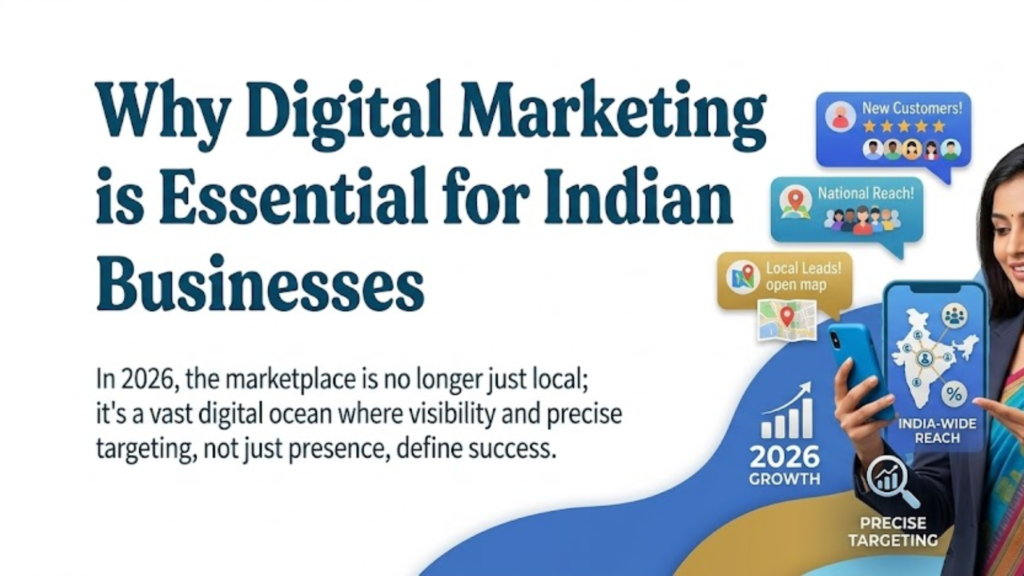
In a country as diverse as India, traditional marketing often falls short because it cannot be personalized. Digital marketing solves this by offering precision targeting.
Key Advantages for SMEs
- Hyper-Local Reach: Reach customers in specific neighborhoods (e.g., Mansarovar in Jaipur or Hanumangarh Road in Sri Ganganagar).
- Cost-Effectiveness: Unlike expensive newspaper ads, you only pay when someone interacts with your digital ads.
- Two-Way Communication: Unlike a billboard, digital platforms allow customers to ask questions and get instant answers.
2. The Core Components of a 2026 Strategy
To achieve sustainable growth, your business must master these five pillars.
A. Search Engine Optimization (SEO)
SEO is the art of making your business “findable.” If you sell solar panels or provide acupressure therapy, you want to be the first name Google suggests.
| SEO Type | Focus Area | Why It Matters |
| On-Page | Keywords, Content Quality, Meta Tags | Helps Google understand what your page is about. |
| Technical | Site Speed, Mobile-friendliness | Ensures users don’t leave because of a slow-loading site. |
| Local SEO | Google Business Profile, Local Citations | Critical for getting walk-in customers to your shop or clinic. |
| Off-Page | Backlinks, Social Shares | Builds your “reputation” on the internet. |
B. Content Marketing (The Trust Builder)
Content is the “salesperson” that never sleeps. In 2026, educational content wins over “salesy” content.
- Blogs: Detailed guides on topics like “How to reduce electricity bills with solar” or “Benefits of acupressure for kids.”
- Case Studies: Real stories of how your business solved a problem for a client.
- E-books/Checklists: Free resources that people can download in exchange for their email.
C. Social Media Marketing (SMM)
Social media in India is dominated by Instagram, YouTube, and WhatsApp.
- Short-Form Video: Reels and Shorts are the fastest way to get viral reach.
- Community Building: Use Facebook Groups or Telegram channels to keep your customers engaged.
3. Advanced Digital Marketing for Business Strategies in 2026
To truly scale, you need to look beyond the basics.
The Rise of Video Marketing
Video is the most consumed content format in India. Businesses that use video build trust 10x faster.
- Product Demos: Show how your CCTV junction box is waterproof.
- Expert Tips: Share interior design hacks for small Indian homes.
- Customer Reviews: A video of a happy customer is worth more than 100 written reviews.
WhatsApp Marketing: The Indian “Super-App”
Email marketing has low open rates in India. WhatsApp is where the action is.
- Automated Updates: Send order confirmations or appointment reminders.
- Catalog Sharing: Let customers browse your products directly within WhatsApp.
- Direct Sales: Close deals through a quick chat rather than a long email thread.
4. Measuring Success: The Science of KPIs (Key Performance Indicators)
In the world of digital marketing for business, “what gets measured, gets managed.” Many Indian business owners make the mistake of looking only at “Vanity Metrics”—like how many followers they have or how many ‘likes’ a photo received. While these feel good, they don’t necessarily pay the bills.
To achieve true growth in 2026, you must look at Actionable Metrics. Below is a detailed breakdown of the KPIs that actually matter for your bottom line.
A. Conversion Rate (CR): The Ultimate Litmus Test
The Conversion Rate is the percentage of people who visit your website or social media page and take a specific, desired action.
- What is a “Conversion”? It could be filling out a lead form for a solar installation, calling your clinic for an appointment, or purchasing a wedding accessory online.
- Why it Matters: If you have 10,000 visitors but 0 conversions, your marketing is attracting the wrong people, or your website is not trustworthy. In 2026, a “Good” conversion rate for Indian service businesses typically ranges between 3% to 7%.
B. Cost Per Lead (CPL): Managing Your Budget
For businesses like Saini Interior or Aarogyam Acupressure, the goal isn’t an immediate online sale; it’s getting a “Lead” (a name and phone number).
- The Indian Context: CPL varies by industry. For example, a solar lead in Rajasthan might cost ₹200–₹500, while a high-end interior design lead might cost ₹1,000+.
- Optimization Tip: If your CPL is too high, check your ad targeting. Are you showing ads to people who can’t afford your service? Or is your ad copy not clear enough?
C. Customer Acquisition Cost (CAC) vs. Lifetime Value (LTV)
This is the “Golden Ratio” of business growth.
- CAC: This is the total amount you spend (Ads + Agency fees + Content) to get one paying customer.
- LTV: This is how much a customer spends with you over their entire life.
- The Goal: Your LTV should be at least 3x higher than your CAC. For a clinic, a patient might come once (Low LTV), but if they come for a 6-month therapy course, their LTV becomes very high, justifying a higher marketing spend.
D. Detailed KPI Comparison Table for 2026
To help you track these daily, use this reference table:
| Metric Name | Category | What it Tells You | 2026 Benchmark (India) |
| CTR (Click-Through Rate) | Ad Performance | Is your ad “eye-catching” enough? | Above 2% is healthy. |
| ROAS (Return on Ad Spend) | Finance/Sales | For every ₹1 spent on ads, how much revenue did you make? | 4x to 6x for E-commerce. |
| Bounce Rate | Website Health | Do people leave your site immediately? | Keep it below 45%. |
| Engagement Rate | Social Media | Does your audience trust your brand? | 3% to 5% on Instagram Reels. |
| GMB Interactions | Local SEO | How many people clicked “Call” or “Directions” on Google Maps? | Target 50+ per month for local shops. |
E. ROAS: Measuring Revenue, Not Just Clicks
Return on Ad Spend (ROAS) is critical for businesses selling physical products, like CCTV junction boxes or Wedding Knot Creations.
- Formula: $Revenue / Ad Spend$.
- Strategic Insight: If you spend ₹10,000 on Meta Ads and sell ₹50,000 worth of products, your ROAS is 5x. In the competitive Indian market, a ROAS of 3x is usually the “Break-even” point after considering manufacturing and shipping costs.
F. Retention Rate: The Hidden Growth Engine
Digital marketing is not just about getting new customers; it’s about keeping the old ones.
- The WhatsApp Advantage: In India, using WhatsApp sequences to reach out to past customers for repeat business is the cheapest form of marketing.
- The Math: Increasing customer retention by just 5% can increase profits by 25% to 95% because you aren’t paying “Ad Costs” for a repeat buyer.
G. Share of Voice (SOV)
In 2026, brand awareness is measured by Share of Voice. This tracks how often your brand is mentioned compared to your competitors.
- How to track: Use tools like Google Alerts to see when “Solar Jaipur” or “Best Interior Designer Jhunjhunu” is searched and whether your brand name appears in the top discussions.
Frequently Asked Questions (FAQs)
Q1: How much should a small business spend on digital marketing?
Answer: Ideally, start with 5-10% of your monthly revenue. In India, even a budget of ₹10,000 to ₹20,000 per month can show significant results in local SEO and social media ads.
Q2: How long does it take to see results from SEO?
Answer: SEO is a long-term investment. While you might see minor improvements in 45 days, significant ranking and traffic usually take 4 to 6 months of consistent effort.
Q3: Is digital marketing better than traditional marketing?
Answer: For most modern businesses, yes. It offers better tracking, lower costs, and the ability to change your strategy instantly based on data.
Q4: Do I need a website for digital marketing?
Answer: While you can start on social media, a website is your digital office. It is the only platform you truly own and is essential for ranking on Google.