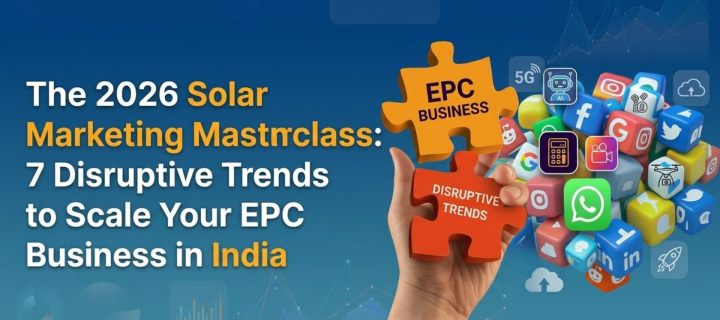
The Indian solar landscape has undergone a tectonic shift. In 2026, we are no longer “introducing” solar to people; we are helping them navigate a crowded marketplace. With the PM Surya Ghar: Muft Bijli Yojana aiming to illuminate 1 crore households, the search volume for solar marketing terms has skyrocketed by over 400%.
If your solar business is still relying on outdated “pamphlet distribution” or low-quality “data-buying” from third-party vendors, you are burning your margins. To dominate the rooftop solar sector this year, you must master these 7 disruptive digital strategies.
1. Hyper-Local SEO: Dominating the “Solar Near Me” Search
In 2026, Google’s algorithm has become incredibly location-sensitive. A homeowner in Jaipur or Jodhpur doesn’t want to see a solar company based in Mumbai. They want a local expert who understands Rajasthan’s dust levels and high-temperature panel degradation.
Why “Local” is the New “Global”
Solar marketing success now depends on the “Map Pack.” When someone searches “solar panel installation cost in [City Name],” Google prioritizes businesses with a verified local presence.
- Google Business Profile (GBP) Optimization: This is no longer optional. You need at least 50+ high-quality photos of actual installations, not stock images.
- Localized Landing Pages: Create separate pages for every city you serve. For example: yourwebsite.com/solar-installation-jaipur.
- The Review Flywheel: Google rewards “freshness.” A 5-star review from 2 years ago is useless. You need a system to collect 2-3 reviews every week.
Local SEO Comparison Table
| Strategy Factor | Traditional National SEO | 2026 Hyper-Local SEO |
| Primary Goal | Traffic Volume | Store Visits & Site Surveys |
| Keywords | Solar Panels India | Solar EPC in [Your Area] |
| Trust Factor | Brand Recognition | Local Reviews & Community Trust |
| Cost Per Lead | ₹500 – ₹1200 | ₹150 – ₹400 |
2. AI-Driven Lead Qualification: Ending the “Junk Lead” Crisis
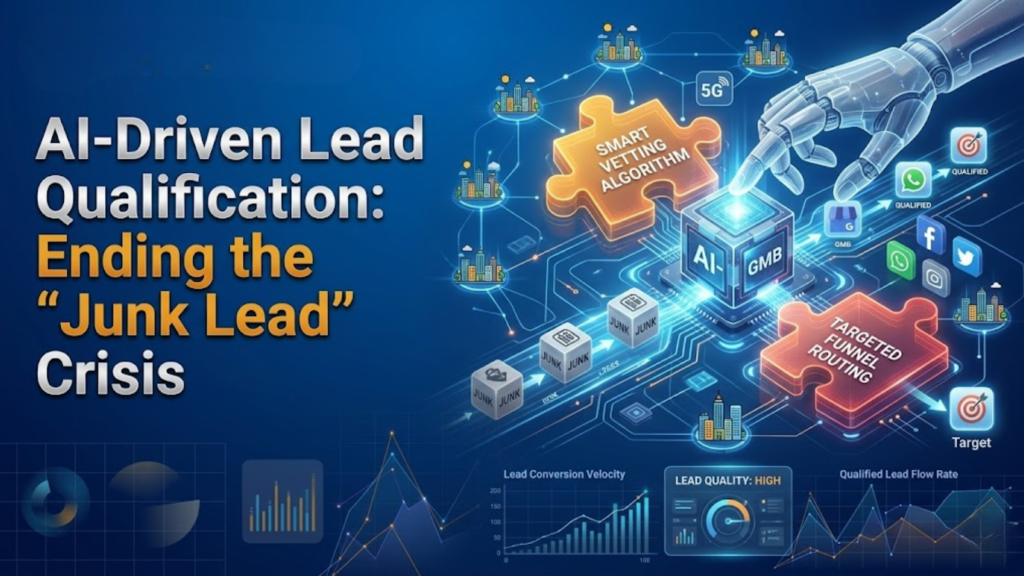
The biggest “silent killer” of solar businesses is the sales team’s time wasted on “unqualified leads”—people who just want “free solar” or don’t have a roof.
The 2026 AI Marketing Funnel
Disruptive solar marketing involves an automated “Gatekeeper.”
- Phase 1 (The Hook): A Meta or Google Ad offering a “Free 2026 Solar Savings Report.”
- Phase 2 (The AI Vetting): Instead of a name/phone form, the user interacts with an AI bot.
- Bot: “What is your average monthly electricity bill?” (Filters out low-consumption users).
- Bot: “Do you have an RCC roof or a Tin shade?” (Helps in technical scoping).
- Bot: “Are you the owner of the property?” (Filters out tenants).
- Phase 3 (The Score): The AI assigns a score. Leads with a score of 8/10 get an immediate callback. Leads with 3/10 are put into an automated WhatsApp nurturing sequence.
Result: Your sales team spends 100% of their time talking to people who can actually afford solar.
3. The “Subsidy Consultant” Content Strategy
With the PM Surya Ghar Yojana offering up to ₹78,000 subsidy, the Indian consumer is looking for a “Guide,” not a “Salesman.” Your solar marketing must focus on educational transparency.
Detailed Topic Breakdown for Content Authority:
- The DCR (Domestic Content Requirement) Debate: Explain why Indian-made cells are mandatory for subsidies. Many customers are being misled by cheap Chinese imports that don’t qualify for government rebates.
- The National Portal Walkthrough: Create a screen-recording video showing exactly how to apply on the government portal. This positions you as an expert who knows the system.
- Net-Metering Myths: Many Indians believe they get “cash back” from the government for extra power. Explain the “Credit” system clearly to avoid future customer complaints.
Key Takeaway: In 2026, the company that explains the subsidy best wins the contract. Period.
4. Video Marketing: The “Trust Asset” and Virtual Site Tours
In 2026, solar marketing is 80% visual. Since a solar plant is a 25-year commitment, customers need to see the “engineering quality” before they sign. Static images can be faked, but video builds raw, unfiltered trust.
A. The “Site-Walkthrough” Strategy
Don’t just show the panels. Create a “Behind the Scenes” video of an installation.
- The Structure: Show the Hot-Dipped Galvanized (HDG) mounting. Explain why it won’t rust in the Indian monsoon.
- The Wiring: Show neat “Conduit Pipe” routing. In India, monkeys and rats are a major threat to solar cables; explaining how you protect the wires is a huge selling point.
- The Earthing: Dedicate a 30-second clip to the Chemical Earthing and Lightning Arrestor. Explain how it protects the customer’s expensive home appliances from power surges.
B. YouTube “Educational Shorts” for 2026
In the age of low attention spans, use YouTube Shorts to answer “One Question per Video”:
- “Does solar work in the rain?”
- “How to clean panels without scratching them?”
- “Can I run a 1.5 Ton AC on a 3kW system?”
C. The “Zero-Bill” Social Proof
The most powerful solar marketing tool in India is the Electricity Bill Comparison.
- Video Format: Interview a local homeowner holding their pre-solar bill (e.g., ₹8,000) and their current bill (e.g., ₹150).
- The “Hook”: “Meet Sharma Ji from Jaipur, who just retired his electricity bills for the next 25 years.”
5. Transparency in Component Quality (The “Tier-1” Marketing Edge)
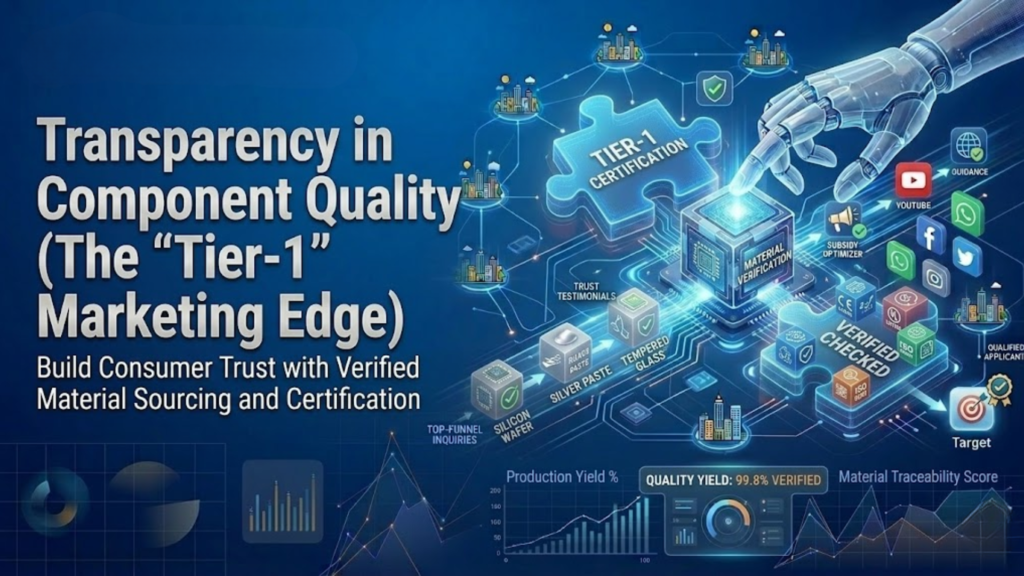
The Indian consumer is becoming tech-savvy. They are no longer asking “if” solar works; they are asking “which brand is best?” Your solar marketing must pivot from selling “Solar” to selling “High-Performance Engineering.”
A. Explaining the “TOPCon” Revolution
By 2026, Mono-PERC is becoming old news. High-end installers are moving to TOPCon (Tunnel Oxide Passivated Contact) technology.
- Marketing Pitch: TOPCon panels have better “Low-light performance” (works better at 7 AM and 5 PM) and a lower “Temperature Coefficient” (crucial for states like Rajasthan where roof temperatures hit 50°C).
- Visual Aid: Use a comparison chart on your blog showing TOPCon vs. Polycrystalline efficiency.
B. The Inverter: The “Brain” of the System
Most marketers focus only on panels. You should focus on the Inverter.
- AI-Integration: Highlight inverters that have AI-Arc Fault Detection. This prevents roof fires by shutting down the system if a spark is detected.
- Data Monitoring: Show the mobile app interface. Customers love seeing their “Daily Earnings” and “Carbon Offset” on their smartphones.
C. Detailed Component Comparison Table (For SEO Authority)
| Component | Budget/Local Grade | Premium/Tier-1 (Your Agency) | Customer Benefit |
| Solar Cells | Polycrystalline | N-Type TOPCon Mono-PERC | 20% more power in the same space. |
| Inverter | Local Transformer based | String Inverter with MPPT | Higher efficiency and app-tracking. |
| Structure | Painted Iron / Light GI | Hot-Dipped Galvanized (HDG) | No rust for 25+ years. |
| Protection | Basic MCB | SPD (Surge Protection Device) | Protects home from lightning. |
6. WhatsApp Marketing: The Conversion Engine of India
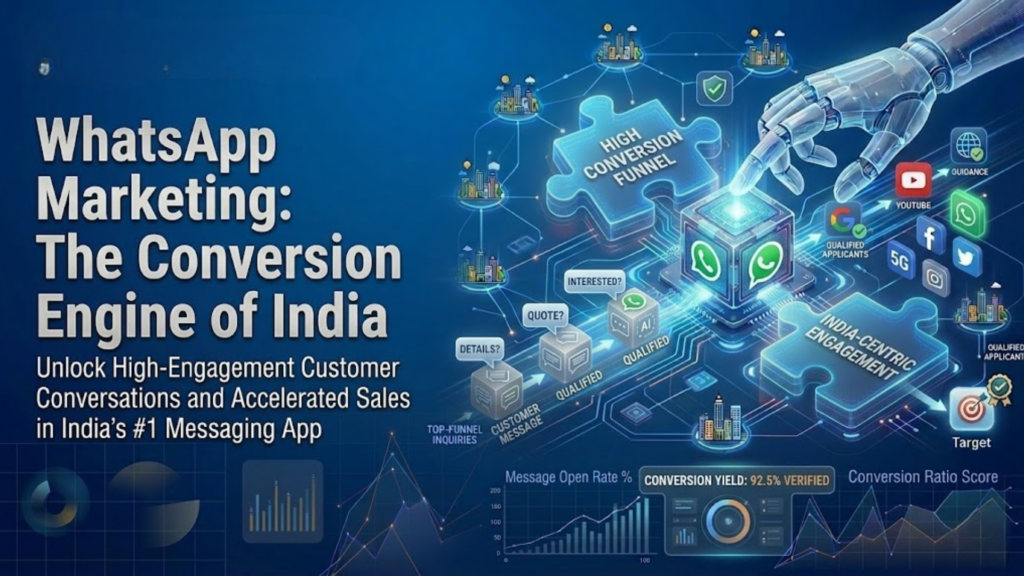
In India, solar marketing happens on WhatsApp, not Email. By 2026, “WhatsApp Automation” is the difference between a lead that “ghosts” you and a lead that “closes.”
A. The “Instant Response” Workflow
When a lead comes from Facebook or Google, they expect an answer now.
- Lead Trigger: User clicks “Get Quote.”
- WhatsApp Automation: Instantly sends a message: “Namaste [Name]! Thanks for your interest in solar. To give you an accurate quote, could you please send a photo of your latest electricity bill?”
- The Result: You get the bill instantly, allowing your engineer to design a custom quote before your competitor even makes a phone call.
B. Nurturing with “Solar Education”
Most people take 30 to 90 days to decide on solar. Use a WhatsApp “Drip Campaign”:
- Day 1: Send a PDF titled “5 Mistakes to Avoid When Buying Solar.”
- Day 4: Send a video testimonial of a local project.
- Day 10: Send an update on PM Surya Ghar Subsidy deadlines.
C. Community Building via WhatsApp Channels
Create a WhatsApp Channel for “Solar Seekers.” Share daily tips on energy saving and maintenance. This keeps your brand “Top-of-Mind” so that when the customer is finally ready to pay, yours is the first name they remember.
7. Virtual Reality (VR) & AI-Powered Digital Site Surveys
The “Old Way” of solar was: Inquiry -> Physical Visit -> Design -> Quote. This is too slow for 2026. Solar marketing agencies are now using “Digital-First” surveying to scale.
A. Satellite-Based Shadow Analysis
Using tools like Google Earth Pro and specialized solar software (like Helioscope or PVsyst), you can perform a Shading Analysis remotely.
- Marketing Pitch: “Get a 95% accurate solar design without anyone stepping on your roof.”
- The Trust Factor: Show the customer a “Heat Map” of their roof. Explain where the shadows from nearby trees or water tanks will fall.
B. Augmented Reality (AR) Proposals
Imagine a customer pointing their phone at their empty roof and seeing a 3D model of your panels magically appear.
- Impact: This “Visual Ownership” makes the customer feel like the system is already theirs. It reduces sales friction significantly.
- AR in Ads: Use video ads showing a user interacting with an AR solar model. This has a 3x higher Click-Through Rate (CTR) than normal image ads.
C. The “Digital Twin” Concept
For large-scale commercial (B2B) solar, offer a “Digital Twin.” This is a virtual 3D model that tracks real-time performance. It turns a boring technical product into a “Smart Asset” that business owners can show off to their board members.
2026 Solar Marketing FAQ (Expanded)
Q: How do we handle customers asking for “Free Solar” under the PM Surya Ghar scheme?
A: Use your blog to clarify the “Subsidy vs. Free” myth. Explain that while the subsidy covers a huge portion (up to ₹78,000 for 3kW), the consumer still needs to invest in a quality installation to ensure the system lasts 25 years. This filters out non-serious leads.
Q: Is LinkedIn a good platform for solar marketing in India?
A: For Residential solar, Facebook and Instagram are king. However, for Commercial & Industrial (C&I) solar, LinkedIn is the #1 tool. Target Factory Owners, Warehouse Managers, and School Principals with “Tax Saving” and “Depreciation Benefit” content.
Q: What is the most important SEO factor for a Solar Agency in 2026?
A: E-E-A-T (Experience, Expertise, Authoritativeness, and Trustworthiness). Google ranks sites that show “Real World Experience.” This means your blog should include project case studies, certificates of your engineers, and actual photos of your team working on roofs.