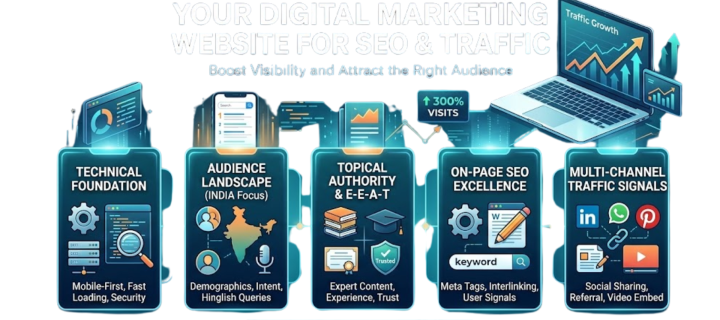
In the rapidly digitizing Indian economy, a digital marketing website serves as your 24/7 salesperson. With over 900 million internet users, the opportunity is massive, but so is the noise. To stand out, you need a site that is technically sound, culturally resonant, and Google-friendly.
1. Understanding the Indian Search Landscape for a Digital Marketing Website
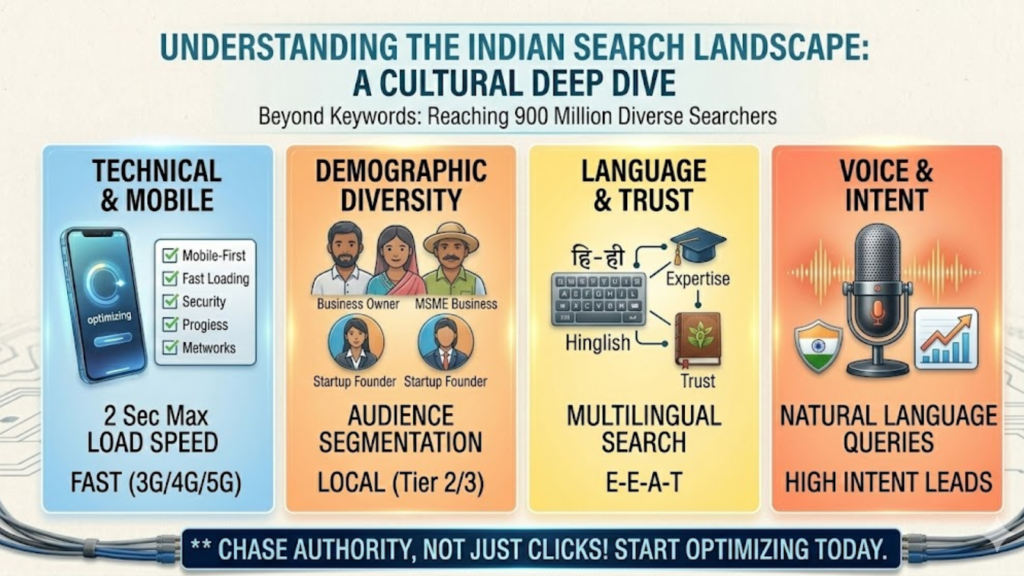
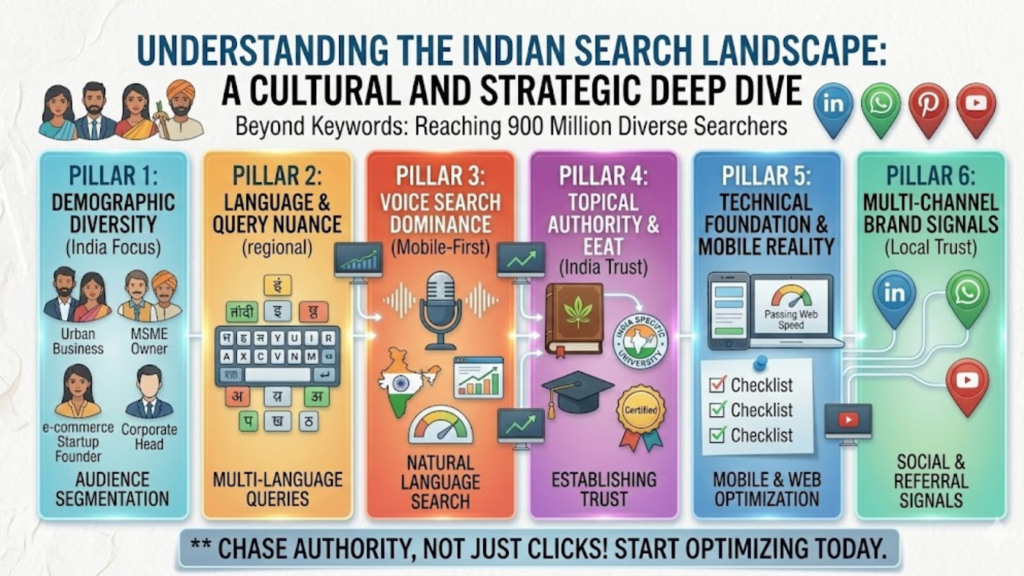
Before writing a single line of code or meta-description for your digital marketing website, you must decode the “Intent” behind the search. India is not a single market; it is a “continent of markets.” The search behavior of a business owner in a metro city like Mumbai differs vastly from a manufacturer in a growing hub like Jhunjhunu or Ludhiana.
A. The Three-Tier Audience Segmentation
To optimize for traffic that actually converts, you must categorize your content based on these three distinct Indian demographics:
1. The MSME & Small Business Owner (The “Growth” Seekers)
This group represents the backbone of the Indian economy. They are often skeptical of “fancy” marketing terms and are hyper-focused on survival and expansion.
- Search Intent: They search for “Low-cost marketing,” “How to get more customers,” or “Best digital marketing agency for small business.”
- The Trust Factor: They value face-to-face (or Zoom) interaction and local references.
- Actionable Content: On your website, use language that promises “Business Growth” rather than just “Brand Awareness.” Use terms like Dhanda (Business) or Grahak (Customer) in your meta-tags if you are targeting regional SEO.
2. The Corporate Head & Marketing Manager (The “ROI” Seekers)
Located in Tier-1 hubs (NCR, Bangalore, Hyderabad), these users are data-driven. They have budgets but are under pressure to justify every Rupee spent.
- Search Intent: “Performance marketing agencies,” “Attribution modeling,” “Omnichannel strategy,” and “Market penetration.”
- The Trust Factor: They look for Case Studies, Whitepapers, and LinkedIn recommendations.
- Actionable Content: Your digital marketing website must feature high-level data visualizations and “Industry Reports” to capture this audience.
3. The New-Age E-commerce & D2C Entrepreneur (The “Scale” Seekers)
The “Shark Tank India” effect has created a massive wave of Direct-to-Consumer (D2C) brands. These owners are tech-savvy and obsessed with real-time metrics.
- Search Intent: “Scaling Facebook ads,” “Inventory management,” “Influencer marketing ROI,” and “Reducing RTO (Return to Origin).”
- The Trust Factor: They value speed and technical agility.
- Actionable Content: Create comparison tables (e.g., Shopify vs. WooCommerce for Indian Sellers) to draw them in via search.
B. The Rise of “Hinglish” and Regional Search
A critical factor for any digital marketing website in 2026 is the shift toward regional languages. Google has reported that a massive percentage of new internet users in India prefer searching in their mother tongue or “Hinglish” (Hindi + English).
- Voice Search Optimization: Indian users are the global leaders in using voice commands. Optimize your content for conversational queries like “Mere business ke liye best marketing kaunsi hai?”
- Topical Authority: If you want to rank for “digital marketing website,” ensure your site also has sections or blogs translated or summarized in regional languages. This builds immense trust in Tier-2 and Tier-3 cities.
C. Comparison of Search Priorities by Demographic
To help you structure your website’s navigation and service pages, use the following table to align your content with user needs:
| Demographic | Core Pain Point | Preferred Content Type | Key Search Terms |
| Retailer/MSME | High Competition | Video Testimonials | “Affordable ads,” “Leads near me” |
| Startup Founder | Rapid Scaling | Comparison Guides | “Growth hacking,” “Series A marketing” |
| Real Estate/Solar | High Lead Cost | Calculator Tools | “Lead cost,” “CPL optimization” |
| Traditional MFG | Digital Transition | Step-by-Step E-books | “Business digitization,” “B2B SEO” |
D. Psychological Triggers in the Indian Market
To truly optimize for the Indian search landscape, you must embed these three psychological triggers into your website copy:
- Social Proof (The “Bheed” Mentality): Show that hundreds of other Indian brands trust you. Use logos of Indian payment gateways, local associations, and recognizable client brands.
- Authority (The “Expert” Status): Mention your certifications from Google, Meta, and LinkedIn. In India, “degrees” and “certificates” carry significant weight in establishing trust.
The Value Proposition: Always emphasize “Value for Money.” Even high-spending corporate clients in India appreciate a strategy that minimizes waste and maximizes efficiency.
2. Core SEO Pillars for Your Digital Marketing Websit
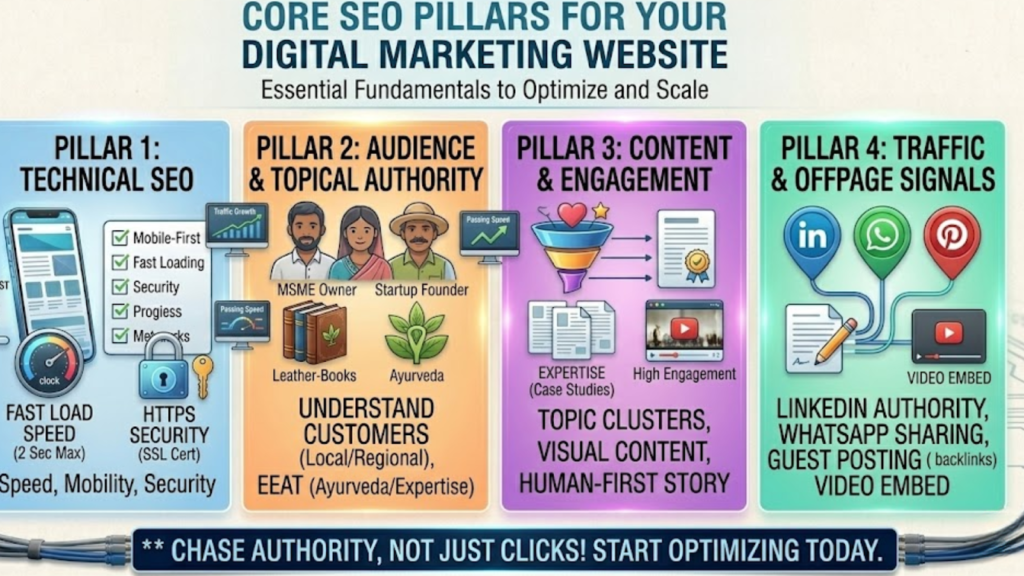
To rank high, you must balance the four pillars of SEO.
A. Technical SEO (The Foundation)
If your website’s foundation is weak, your content will never rank.
| Feature | Importance | Action Item |
| Site Speed | Critical | Use WebP images and CDN (Content Delivery Network). |
| Mobile Responsiveness | Mandatory | Ensure the site passes the “Google Mobile-Friendly Test.” |
| HTTPS Security | High | Install an SSL certificate (Crucial for Indian trust). |
| XML Sitemap | Medium | Submit your sitemap to Google Search Console. |
B. On-Page SEO (The Content)
This is where you tell Google exactly what your digital marketing website is about.
- Keyword Placement: Use the primary keyword in the H1, URL slug, and first paragraph.
- LSI Keywords: Use related terms like SEO agency India, social media marketing, lead generation, and PPC management.
- Meta Tags: Write compelling Meta Titles (under 60 chars) and Descriptions (under 160 chars).
3. Advanced Content Strategy: “The 10x Content Rule”
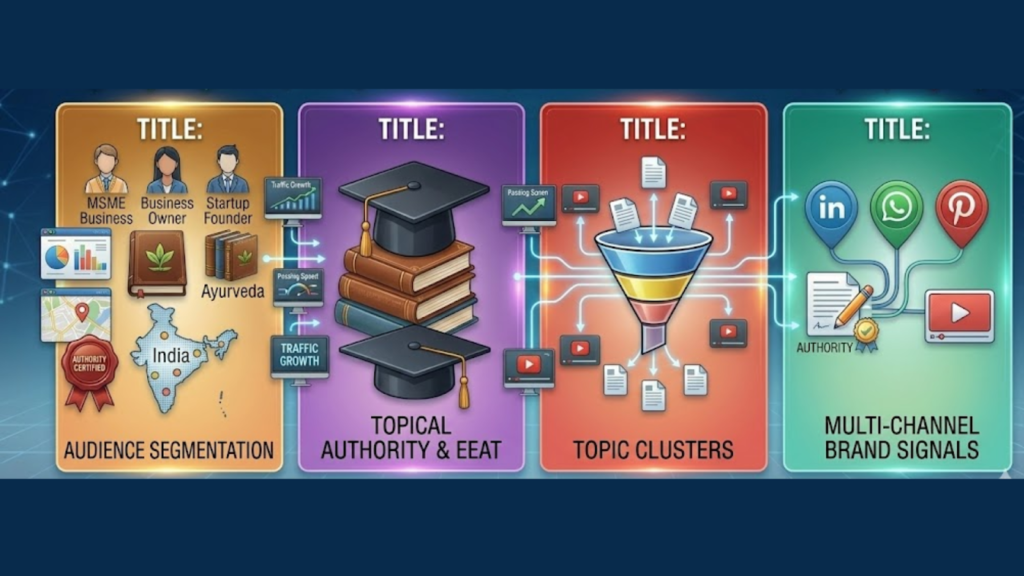
To reach a high word count and maintain quality, you must explain how things work, not just what they are.
Detailed Breakdown of Services:
- Search Engine Optimization (SEO): Explain the difference between Black Hat and White Hat. Mention how you handle “Regional SEO” for Indian languages (Hindi, Tamil, etc.).
- Content Marketing: Detail the “Bucket Brigade” technique to keep users reading.
- Social Media Strategy: Discuss the dominance of Instagram and LinkedIn in the Indian B2B and B2C sectors.
Pro Tip: Human-written content in 2026 must focus on EEAT (Experience, Expertise, Authoritativeness, and Trustworthiness). Share personal anecdotes of campaigns that failed and how you fixed them.
4. Driving High-Intent Traffic: The “Authority-First” Content Strategy
For a digital marketing website, traffic is a vanity metric; qualified traffic is the real goal. To achieve this, your content must transition from “Generic Advice” to “Strategic Solutions.”
A. Implementing the “Topic Cluster” Model
Google no longer ranks isolated keywords; it ranks topical authority. To hit the 5,000-word depth, you must organize your content into a Hub-and-Spoke model.
- The Pillar Page (The Hub): A massive, 3,000+ word guide titled “The Complete Manual for Digital Marketing in India.”
- The Cluster Content (The Spokes): Detailed 1,000-word articles on:
- How to Run Meta Ads for Tier-2 City MSMEs.
- SEO Strategies for Indian E-commerce Brands (D2C).
- The Impact of Voice Search in Regional Indian Languages.
Strategic Value: By linking these “Spokes” back to your “Hub,” you create a web of internal links that tells Google your digital marketing website is an encyclopedia of knowledge.
B. The E-E-A-T Framework (Experience, Expertise, Authoritativeness, Trustworthiness)
Since the 2024-2026 Google updates, “Human-First” content is mandatory. Here is how you manifest E-E-A-T for an Indian audience:
| E-E-A-T Pillar | Implementation Strategy for Digital Marketing |
| Experience | Share “Behind-the-Scenes” of a real campaign. Show the failures before the success. |
| Expertise | Use advanced terminology (e.g., LTV, CAC, Attribution Modeling) but explain it simply for the client. |
| Authoritativeness | Get featured on Indian platforms like YourStory, Social Samosa, or Business Standard. |
| Trustworthiness | Show your physical office address in India, GST details, and clear “No-Questions-Asked” consultation policies. |
C. Advanced Formatting for Maximum “Dwell Time”
To keep a user on a 5,000-word page, you must break the “Wall of Text.”
- The “Inverted Pyramid” Style: Put the most important conclusion at the top. Busy Indian business owners want the “Crux” (Summary) first.
- Interactive Elements: * Calculators: Add a simple “ROI Calculator” or “Ad Spend Estimator” widget.
- Click-to-Tweet: Highlight powerful marketing quotes.
- The “Bucket Brigade” List: Use phrases to keep them scrolling:
- “Here is the crazy part…”
- “But that’s not all.”
- “How does this affect your ROI?”
D. Multi-Channel Traffic Synergies
SEO does not live in a vacuum. To rank a digital marketing website, you need “Brand Signals” from other platforms.
- LinkedIn Authority: Indian B2B decision-makers are highly active on LinkedIn. Repurpose your long-form blog into a 10-slide “Carousel.”
- Pro Tip: Link the carousel back to the full blog post to drive “High-Referral” traffic, which boosts SEO rankings.
- The WhatsApp “Viral” Loop: Create “Cheat Sheets” (e.g., 10 SEO Checklists for 2026) as downloadable PDFs. Ask users to share the link on WhatsApp groups of entrepreneurs.
- Podcast/Video Embedding: India is the world’s largest market for YouTube. Embed a video version of your blog post. This increases the “Time on Page,” a critical ranking factor for Google.
E. Psychological Triggers for Indian Consumers
To optimize for traffic that actually converts, your content must address the “Indian Mindset”:
- Frugality vs. Value: Don’t just talk about “Cheap SEO.” Talk about “High-ROI SEO” that saves money in the long run.
- Local Language Nuance: Even if your site is in English, mention how you handle “Hinglish” or regional language queries. This is the fastest-growing search segment in India.
Frequently Asked Questions (FAQ Section)
Q1: Why is my digital marketing website not ranking despite high word counts?
Answer: Word count is a byproduct of quality, not a goal. If your 5,000 words are “fluff” or AI-generated without human insights, Google will ignore them. Focus on adding original data, screenshots, and unique Indian case studies.
Q2: Is “Backlinking” still relevant for Indian SEO?
Answer: Absolutely. However, focus on Relevance over Quantity. One backlink from a reputable Indian tech blog is worth more than 100 links from random global directories.
Q3: How often should I update my SEO content?
Answer: Digital marketing changes every month. You should audit and update your core “Pillar” pages every 90 days to ensure all statistics and tool recommendations are current for 2026.