The digital landscape in India is exploding. For small and medium-sized enterprises (SMEs), success is no longer defined just by the quality of the product or service, but by their ability to effectively reach and engage their target audience online. At the heart of this digital transformation lies Social Media Advertising, the most powerful tool for scaled visibility and lead generation.However, navigating the complexities of platforms like Facebook, Instagram, LinkedIn, and YouTube—with their ever-changing algorithms and intricate ad policies—can be overwhelming for a small business owner. This is where a dedicated and expert Social Media Advertising Firm steps in, transforming your marketing budget from a gamble into a strategic investment.
This comprehensive guide is tailored specifically for Indian small businesses, providing a deep-dive into why you need professional help, how to vet the right partner, and the strategic road map they should implement to ensure robust and sustainable business growth.
Part I: Why Small Businesses Need a Professional Social Media Advertising Firm

Many small business owners in India attempt to manage their social media advertising in-house, believing it saves costs. While admirable, this approach often leads to wasted ad spend and sub-optimal results. A professional Social Media Advertising Firm offers distinct advantages that are crucial for scaling:
1. Unmatched Expertise and Platform Mastery
Social media platforms are not static; they are constantly evolving. A professional firm’s core competency lies in keeping pace with these changes. They possess:
- Algorithm Fluency: They understand the nuances of the Facebook Pixel, Google Tag Manager, and the precise targeting parameters that drive down Cost Per Acquisition (CPA) and increase conversions.
- Creative Best Practices: They know which ad formats (e.g., Carousel, Story Ads, Reels) perform best for different objectives and audience segments, especially within the context of Indian consumption habits (e.g., mobile-first, short-form video preference).
- Policy Compliance: They ensure all campaigns adhere strictly to complex platform policies, preventing ad account flags or suspensions, a common headache for inexperienced advertisers.
2. Strategic Efficiency and Resource Optimization
Time is a small business owner’s most valuable asset. Outsourcing to an experienced Social Media Advertising Firm frees up internal resources:
- Focus on Core Business: You can dedicate your time to product development, sales, and operations, while the firm handles the complex, time-consuming tasks of campaign setup, monitoring, A/B testing, and reporting.
- Budget Maximization (ROI Focus): They don’t just spend money; they spend it smartly. Their primary focus is on Return on Investment (ROI), utilizing techniques like lookalike audiences, custom conversions, and bid strategy optimization to achieve the highest possible return on every rupee spent.
3. Data-Driven Decision Making
The difference between amateur advertising and professional advertising is data.
- In-Depth Analytics: A high-quality firm goes beyond surface-level metrics like “Likes” or “Reach.” They focus on actionable KPIs such as Lead Quality, Customer Lifetime Value (CLV), Customer Acquisition Cost (CAC), and Conversion Rate.
- Continuous Optimization: They implement a rigorous testing framework (creatives, copy, and targeting) and use the data generated to continuously refine campaigns, ensuring peak performance and optimal budget allocation throughout the campaign lifecycle.
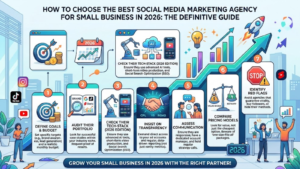
Part II: The 5-Step Vetting Process for Selecting the Right Firm

Finding the ideal Social Media Advertising Firm requires a strategic and rigorous vetting process. For Indian SMEs, local market knowledge and ethical practices are paramount.
Step 1: Evaluate Industry Experience and Portfolio Relevance
Do not be swayed by firms that only showcase work for massive, multinational corporations.
- Focus on SMEs: Ask to see case studies specifically involving small to medium-sized businesses in India. Results from a ₹5 Lakh budget campaign are far more relevant to you than those from a ₹5 Crore campaign.
- Industry Specialization: A firm with experience in your niche (e.g., EdTech, D2C Fashion, Real Estate, Local Services) will understand your audience pain points and the competitive landscape immediately.
- Proof of Results (Not Efforts): Demand quantifiable metrics related to bottom-of-the-funnel results (e.g., “Generated 500 Qualified Leads at a CPA of ₹150”) rather than vanity metrics (“Increased followers by 10,000”).
Step 2: Assess Strategic and Local Market Competency
A firm must prove they understand the unique dynamics of the Indian consumer.
- Regional Language Expertise: Given India’s linguistic diversity, a top-tier firm should be capable of running campaigns in Hindi, Tamil, Telugu, Marathi, etc., as regional targeting often yields higher engagement and trust.
- Platform Diversity: Do they rely solely on Meta (Facebook/Instagram)? Or do they have proficiency in LinkedIn for B2B, YouTube for high-impact video ads, and emerging platforms like Snapchat or native ad networks where your audience might be present?
- Full-Funnel Strategy: The firm must demonstrate a clear plan covering the entire customer journey: Awareness (Reaching cold audiences), Consideration (Generating leads/traffic), and Conversion (Driving sales/bookings).
Step 3: Demand Transparency and Reporting Clarity
Trust is built on clear communication and ethical financial practices.
- Media Spend Transparency: The firm should clearly separate the Media Budget (money paid directly to the social platform) from their Management Fee. They must provide direct access to ad spend reports showing exactly where your budget is going.
- Actionable Reporting: Their reports should not be dense technical dumps. They should be clear, easy-to-understand summaries that explain What happened, Why it happened, and What they will do next.
- Contract and Pricing Model: Insist on a flexible contract, perhaps a 3-6 month initial term. Performance-based fee structures (where a part of their fee is tied to achieving agreed-upon KPIs) can align their success directly with yours.
Step 4: Evaluate Creative and Content Capabilities
Ads are only as good as the content they carry.
- In-House or Partnered Creative: Determine if the firm has an in-house creative team capable of designing ad visuals and writing compelling copy, or if they rely on external partners. Integrated creative and media planning leads to faster optimization cycles.
- Mobile-First Design: Given that over 90% of social media consumption in India is on mobile devices, their creative output must be designed for vertical viewing, fast load times, and attention-grabbing elements within the first few seconds.
Step 5: Check Technology and Tool Usage
Modern advertising relies on technology.
- AdTech Tools: Does the firm use advanced tools for competitor analysis, campaign automation, and sophisticated A/B testing? (e.g., third-party reporting tools, heat mapping for landing pages).
- Landing Page Optimization (LPO): Social media ads drive traffic to a landing page. The firm should have a strategy for optimizing your landing pages to ensure the maximum number of clicks turn into leads—a critical, often overlooked step.
Part III: The Strategic Roadmap – What a Top Firm Will Execute

Once you partner with a high-quality Social Media Advertising Firm, they should roll out a structured plan that leverages platform capabilities for your growth.
1. Audience Segmentation and Localization
The firm will move beyond basic demographics to create hyper-targeted segments:
- Tier 2/3 City Targeting: Recognizing the massive purchasing power emerging in non-metro Indian cities, they will tailor campaigns to these specific geographies with relevant regional appeals.
- Custom and Lookalike Audiences: They will utilize your existing customer data (email lists, website visitors) to create high-value Custom Audiences and then use platform AI to generate Lookalike Audiences—finding new prospects who share the exact characteristics of your best customers.
2. The Conversion-Focused Campaign Structure
Effective campaigns must be structured to guide the user from discovery to purchase:
| Funnel Stage | Campaign Objective | Key Performance Indicators (KPIs) |
| Awareness (ToFu) | Maximize Reach and Video Views | CPM (Cost Per Mille), Brand Recall |
| Consideration (MoFu) | Traffic Generation, Lead Forms | CPC (Cost Per Click), CTR (Click-Through Rate), CPL (Cost Per Lead) |
| Conversion (BoFu) | Sales, Product Purchases | CPA (Cost Per Acquisition), ROAS (Return on Ad Spend) |
| Loyalty & Advocacy | Customer Service, UGC Collection | Repeat Purchase Rate, Review Count |
3. Integration with the Indian Digital Ecosystem
The firm should integrate social advertising with other dominant Indian digital channels:
- WhatsApp Business Integration: Since WhatsApp is the preferred communication tool in India, ads should be designed to drive users directly to a WhatsApp chat for instant lead qualification and follow-up.
- E-commerce Synergy: If you sell products, the firm will integrate your product catalogue (e.g., via Facebook Catalogue Ads) to run dynamic retargeting, showing users the exact products they viewed on your website.
- SEO and Content Alignment: They should ensure that the messaging in your ads is consistent with your organic social media content and website for a seamless brand experience.
4. Budgeting and Scaling Strategy
A small business budget needs disciplined management:
- Phased Scaling: They will start with a small test budget to establish a baseline CPA and optimize the creative and targeting. Only after achieving a positive ROI will they recommend incrementally increasing the budget.
- Cross-Platform Budget Allocation: Based on performance data, they will dynamically shift the budget toward the platforms and campaigns delivering the highest ROI, ensuring no money is wasted on underperforming channels.
Frequently Asked Questions (FAQ) for Small Businesses
Q1: How much should a small business budget for social media advertising in India?
A: This depends heavily on your industry and goals. As a starting point, many SMEs dedicate 10% to 15% of their total marketing budget to digital advertising. A good firm will advise you on a minimum viable budget (MVB) required to get statistically significant results (usually ₹30,000 to ₹50,000 per month for ad spend alone).
Q2: How long does it take to see results from a Social Media Advertising Firm?
A: You should expect to see initial data and key learnings within 3 to 4 weeks. However, statistically reliable and significant improvements in ROI typically take 2 to 3 months as the firm optimizes the funnels and the platform’s AI learns.
Q3: Should I hire a boutique firm or a large agency?
A: For most small businesses, a boutique firm or a specialized mid-sized agency is better. They often offer:
- More personalized attention (you won’t be a small fish in a big pond).
- Lower management fees and more flexible contracts.
- A deeper focus on performance-based outcomes crucial for SMEs.
Q4: What metrics should I hold my Social Media Advertising Firm accountable for?
A: Focus on metrics that impact your bottom line:
- Return on Ad Spend (ROAS): The most important metric for sales-driven businesses.
- Cost Per Qualified Lead (CPQL): Crucial for service-based businesses.
- Customer Acquisition Cost (CAC): The total cost to acquire one paying customer.
Conclusion: Your Digital Partner for Growth
Choosing a Social Media Advertising Firm is arguably the most critical marketing decision a small business can make. It is not an expenditure; it is an investment in professional execution, data intelligence, and accelerated growth.